

Abstract
This article examines the construct of employee organizational commitment, focusing on two key aspects. First, it explores how learning-friendly working conditions can help strengthen employee commitment to their employer. Second, building on this, the article analyses the effects of this commitment on employee health. The results show that existing learning and development opportunities primarily address emotional commitment components. These emotional commitment components, in turn, have a positive effect on health, while other types of commitment may be associated with higher health risks.
Introduction
In recent years, increasing mental and physical stress in the workplace has led to a greater willingness to change jobs among employees in western industrialized nations. According to current data from the Gallup Institute, taking Germany as an example, only 9% of employees still felt a strong emotional attachment to their employer in 2024. This represents the first time that the figure has fallen into single digits [1]. A lack of attachment can be detrimental to both sides – employees and companies – as unattached employees often experience higher levels of stress, are absent more often and are considered less productive [2]. Conversely, certain forms of attachment could be beneficial for both, organizations and employees, creating a win-win situation.
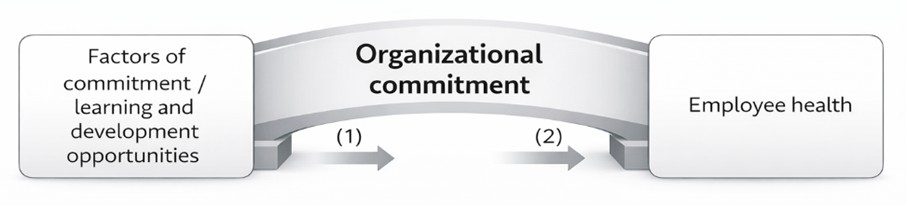
Companies can take various measures to promote employee retention. This article therefore focuses on the concept of employee loyalty to an organization, as illustrated in Figure 1. The article is based on the hypothesis that factors in the workplace that promote learning have an influence on employee loyalty, whereby a high level of loyalty in turn influences employee health.
Based on this hypothesis, this article examines two key questions (see Figure 1). First, it aims to demonstrate empirically the extent to which workplace conditions that are considered conducive to learning have the potential to create a sense of loyalty among employees (1). Second, it analyses the extent to which employee loyalty can have an impact on the health of employees (2).
Theoretical Assumptions
In order to fully understand this article, a basic understanding of the underlying assumptions about commitment and development opportunities are presented in Chapter 2.
Determination of organizational commitment
Viewed from a meta-level, commitment is a multi-layered construct that can be divided into different directions and dimensions [3]. The figure below (see Figure 2) attempts to systematically organize and structure the field of commitment for the purposes of this article. It follows a commitment model developed by Meyer and Allen [4].
The different directions of commitment shown in Figure 2 address a central question when dealing with the construct of commitment: Which objects can people choose as points of commitment in the work environment? As can be seen from the figure, this commitment can be to a specific form of employment, an individual's career, a manager, a work team or the organization as a whole [5]. This article focuses on employees' commitment to their employer, with the term "organizational commitment" (OC) being used synonymously with "employee retention". OC is described here as a perceived, long-term relationship between the individual and the organization that affects the entire workforce and is metaphorically represented as an invisible bond between the two parties [6].
Each of the described types of commitment encompasses different dimensions (see Figure 2):
- Affective OC refers to the intense emotional connection employees feel to their organization. A strong affective bond means that the organization is very important to them and that they feel like they are part of a family and want to belong to it in the long term [2]. This form of attachment results from positive experiences, the fulfilment of expectations, stable social relationships in the workplace and satisfaction with working conditions [5,6].
- Calculative or continuity-related OC is based on commitment to an organization in order to avoid the costs associated with changing jobs. This form of commitment arises from the threat of losing long-standing positions or social relationships at work as a result of a possible change [2]. Employees with strong calculative OC carefully weigh up whether the disadvantages of a change outweigh the advantages [2].
- Normative OC arises when employees remain with the company for moral reasons [2]. It is based on ethical obligations and on the organization’s investment in its employees, such as financial support for further training. Such measures can promote a feeling of having to give something back to the company. Employees with strong normative OC are critical of change because it would contradict their ethical standards, even though their emotional and calculative commitment may be weak [6].
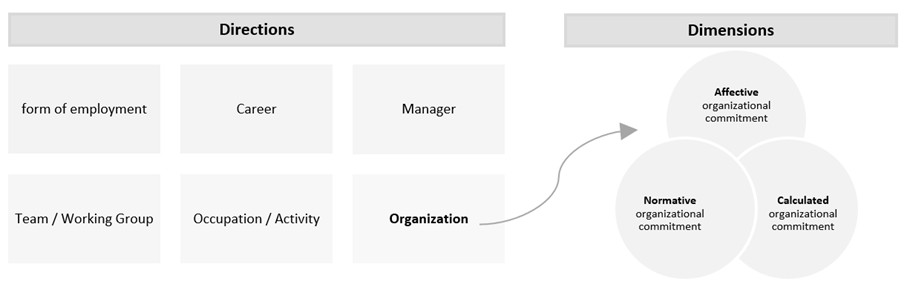
Figure 2. Directions and dimensions of commitment in the context of work (own representation).
Aspects of work that promote learning and development
Various conditions in the workplace and in the organizational context are closely related to the promotion of OC. Examples include salary, working conditions, and corporate culture. In the study to be presented, the development and learning opportunities in the workplace were used to illustrate another of many conditions that potentially promote commitment and were examined in more detail in relation to their relationship with OC.
First, it was necessary to clarify what exactly is meant by the term "learning and development opportunities". Development opportunities are defined here as all prospects that help employees to promote their personal and professional progress. In the context of personnel development measures, such individual opportunities can be provided through further training or conditions in the workplace that promote learning and development. The basic idea behind the following remarks is that organizations can use their division of labor structure to create a wide range of opportunities for employees to learn and develop in the course of their work. A job in product development, for example, usually offers numerous opportunities for continuous learning and personal development through the constant mastering of new challenges. In contrast, a job characterized by daily routine and repetitive tasks has significantly less potential for learning and development processes. Figure 3 attempts to systematize the aspects of work that promote learning and development, which are explained in the rest of the article and linked to organizational commitment (OC).
Formal learning environments (see Figure 3) are usually characterized by systematic structures, planned arrangements and defined learning objectives that are organized according to specific teaching and learning principles. A classic example of a formal learning setting is participation in continuing education. In contrast, informal learning environments are often not systematically organized. Here, learning processes often take place spontaneously, for example in the workplace through experience and learning from mistakes [7]. Based on these considerations, two settings are presented below that can be classified as informal learning environments and in which employers can specifically create conditions for learning and development: learning within the organizational structure of a company and context-related learning in the workplace (see Figure 3).
(1) The setting of learning via the structure of the organization describes competence-promoting characteristics of a company organization, the presence of which is considered conducive to learning and development (see Figure 3, left-hand side, bottom). These are as follows:
- Participatory working methods are considered to be more conducive to learning than those without employee involvement [8]. In highly standardized environments, opportunities for employee involvement are often limited. Employees who participate in decision-making processes engage intensively with the issues at hand, thereby promoting their personal development and sense of participation.
- The aspect of recognition of independence and social climate emphasizes that positive interpersonal relationships and valued personal responsibility can promote learning and development processes [9]. Studies show that activities with limited scope for action hardly promote cognitive development, while independent action correlates positively with intrinsic motivation.
- The dimension of temporal conditions of work refers to temporal freedom with regard to break and working time regulations [9]. In order to promote learning and development processes, it is crucial to have sufficient time resources to enable exchange with colleagues. Time pressure and stress are often associated with psychosomatic illnesses and have a negative effect on learning [10].
- The dimension of development opportunities addresses the extent to which employees can experience personal development through their work [9]. Employees who have access to desired training, for example, undergo learning and development processes more frequently than those who receive fewer training opportunities and show less interest in them.
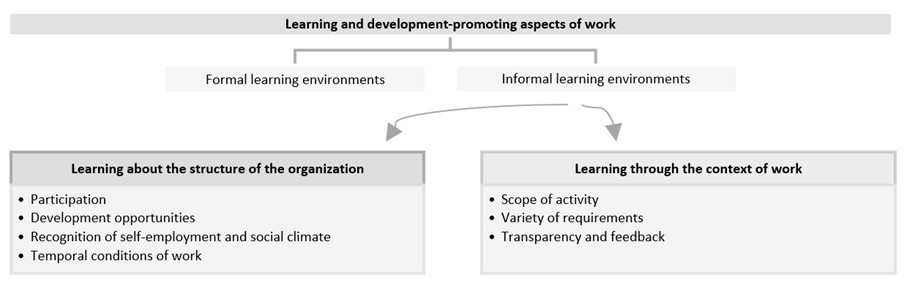
Figure 3. Aspects of work that promote learning and development (own representation).
(2) The aim of the second approach, learning through the context of work, is to describe the characteristics of a specific work task that are relevant for learning based on the subjective perception of the job holder [11].
- The aspect of scope of activity and completeness describes how much influence an employee has on the pace of work, the sequence of tasks and the selection of new tasks. A large scope of activity means that employees can plan, organize and control their work largely independently, thereby gaining valuable learning experiences [9].
- The construct of job variety describes the extent to which different skills are required to perform the work [12]. A high degree of job variety implies that employees have diverse skills and changing tasks, which has a positive effect on their sense of self-worth and competence [13].
- The dimension of transparency and feedback refers to employees' perception of the clarity of work processes and the feedback they receive on the quality of their work [12]. Transparency means that employees understand the work processes and have sufficient information at their disposal.
The Influence of Aspects of Work That Promote Learning and Development on Employee Retention
In order to answer the first key question addressed in this article, empirical results are presented and analyzed below that examine the relationship between the previously discussed concepts of employee retention and the aspects of work that promote learning and development. The underlying study was conducted as part of a research project and published in 2018 [3,6].
Study
The aim of the study was to find evidence of the extent to which there are links between the three dimensions of employee engagement and the work-related aspects that promote learning and development. Employees from various industries who were employed by an organization at the time of the survey were interviewed. The data was collected using a cross-sectional design. To this end, all aspects discussed in Chapter 2 relating to the promotion of learning and development as well as organizational commitment were captured using appropriate latent constructs. This can be illustrated using the example of the construct ‘participatory forms of work’. Four items were used to determine whether employees are consulted when changes are made in the organization, whether they are involved in decisions, whether they can participate in setting goals, and whether managers take new ideas from employees into account. The employees surveyed had the opportunity to respond on a scale of 1 to 5, with responses ranging from “does not apply” to “fully applies”. Inferential statistical methods were used to examine the aspects conducive to learning and development for possible correlations with the three dimensions of OC that were also recorded. Figure 4 illustrates the fundamental research interest and the results of the study.
Results and discussion
The study sample comprised a total of 507 individuals. The gender distribution within the group was approximately equal. Of the individuals surveyed, 76.6% were in permanent employment, while the remainder were employed on a fixed-term basis. Approximately 80% of the participants were employed full-time. More than half of the respondents (52.6%) worked in companies with more than 250 employees, while the rest worked in smaller organizations. The study was conducted with the aim of providing a cross-industry and cross-organizational perspective. Approximately 26.6% of participants worked in industry or manufacturing, while the remaining 73.4% were assigned to the service sector.
The results of this study show that affective OC correlates strongly with, in particular, co-determination (r = .519), autonomy and the social climate (r = 0.548), and employee development opportunities (r = 0.539) (see Figure 4). Other aspects considered conducive to learning and development, such as time flexibility, job demands and scope of activity, also show significant correlations with emotional attachment.
Analysis of the results with regard to calculative OC shows that development opportunities in particular have a higher positive correlation compared to the other aspects surveyed. Employees who have access to comprehensive development opportunities and want to actively use them tend to develop a stronger calculative attachment to their company (see Figure 4).
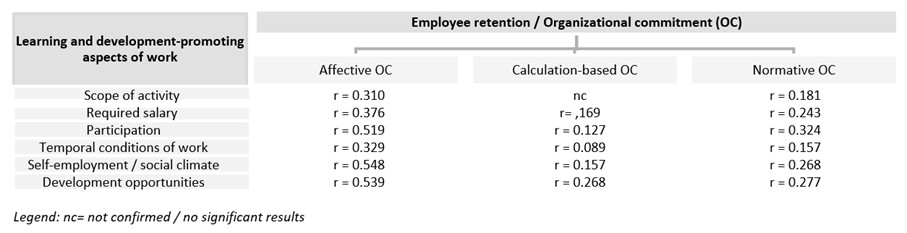
Furthermore, the results of the study with regard to normative OC indicate that the connections are not as strong as with affective OC, but stronger than with calculative OC. Normative attachment is often explained by an organization’s investment in its employees, such as providing expensive training. If an employee feels the need to give something back to the company, this suggests ethical and moral values. Such an employee might decide against changing jobs for moral (normative) reasons, even if attractive alternatives are available. In contrast, employees with a purely calculative attachment might leave for a more tempting offer despite substantial investments by the company.
Looking at the results as a whole, it can be concluded for the three types of OC that the affective attachment component offers the greatest advantage for employees and companies. Learning and development opportunities can promote this emotional attachment, leading to higher satisfaction and greater commitment among employees. Employees with a higher calculative commitment are also attracted by such opportunities, but to a lesser extent, and may leave the company if a better offer comes along. Normatively committed employees, on the other hand, remain loyal even when faced with tempting alternatives due to their ethical and moral convictions. The results of this study suggest that organizations that provide learning and development opportunities, promote a positive social climate and integrate participatory elements into everyday work increase their chances of strengthening employee commitment – especially in terms of affective commitment. The central message of the study could be summarized as follows: "Aspects of work that promote learning and development have the potential to retain employees."
It should be noted at this point that the present study has limitations. For example, its significance is limited by the fact that the survey was conducted using a cross-sectional design and therefore cannot reflect any developments. In addition, the question arises as to whether the construct used to measure commitment is sufficient as the sole measure for assessing employee commitment or whether a more comprehensive approach is required. In addition to the dimension of organizational commitment, other types of commitment, such as commitment to the profession or to one's own manager, could also have been taken into account. Despite these limitations and certainly other restrictions, the study appears to be meaningful in relation to the question posed.
Employee Retention and Health
In order to cover the entire range of topics addressed in this article, I would like to briefly summarize the arguments presented so far: Based on the theoretical explanations and the study presented, it has become clear that various framework conditions in organizations and in the workplace can significantly influence the construct of employee engagement with its three dimensions. Affective OC in particular seems to be addressed by the learning and development opportunities provided. We have thus developed an initial idea of what constitutes OC and how it can be promoted. Building on this, the second key question of the article now examines the relationship between OC and employee health. The study presented in Chapter 3 does not provide any specific findings on this, but the findings from current research on this topic are relatively clear.
The following chapter is therefore not based on the author's own research, as was the case with the study presented above, but rather provides a concise summary of the current state of research on the topic. First, general findings on the topic of employee stress as an element that is not conducive to good health are presented. Subsequently, the three dimensions of OC are examined separately in terms of their relationship to employee health.
General findings on perceived employee stress
A study by the Techniker Krankenkasse health insurance company shows that 70% of organizations perceive the psychological stress of their employees as a growing problem. In addition, 42% of employees report that they feel exhausted [14]. Another study by the AOK health insurance company shows that the number of mental illnesses and the associated absenteeism days have risen by 47 per cent since 2014 [15]. These and other findings suggest that employees are increasingly exposed to stress, which has risen significantly in recent years. The increasing rise in stress perceived by employees also poses a considerable challenge for organizations [16].
But why exactly do employees perceive their situation at work as increasingly stressful? Various factors can contribute to this development. These include, among other things, an increase in communication, flexible working hours and multiple stresses due to the simultaneous handling of many tasks [17,18]. Technologies such as mobile phones mean that it is possible or even expected to be constantly available. This can significantly limit opportunities for relaxation and necessary boundaries [19]. Increasing self-management and personal responsibility can also lead to stressful expectations [20].
Stress can have a variety of effects. These range from short-term or medium-term stress symptoms, such as tension, anger or irritability, to chronic, long-term physical and mental health problems [21]. When dealing with these stresses, each person has individual resources and strategies at their disposal. Among other things, professional experience and the extent of social support from colleagues and managers play an important role [22]. The question arises as to whether, in addition to the resources described above, the construct of employee loyalty also has an influence on how individuals deal with the stresses described. Specifically, we can ask whether employees who perceive increasing stress react differently to these situations based on their individual commitment to the organization, and whether the nature of this individual commitment has long-term effects on employee health. This brings us to the second key question of the article.
A differentiated view of health and organizational commitment
It can be noted in advance that the three dimensions of OC have different influences on employee health. Therefore, the individual dimensions of OC will be analyzed separately in the following argumentation.
Numerous studies show that affective OC, i.e. emotional attachment to the employer, correlates negatively with the experience of stress. For example, a meta-study by Meyer et al. found a negative correlation between stress experience and affective OC with r = -0.21 [23]. This means that employees who perceive a strong affective attachment to their organization find their everyday work less stressful than their colleagues with a less pronounced emotional attachment. Another study by Horstmann and Remdisch shows similar findings. They conducted a study with nursing staff that included 861 participants. The results showed a negative correlation (r = -0.34) between affective OC and health impairments among the respondents [24]. Another survey of tax officials showed similar trends. In this study, Schmidt found a strong negative correlation between affective OC and health impairments, with a correlation coefficient of r = -0.40 [25]. Constructs such as employee resilience, on the other hand, appear to be positively associated with affective OC [26]. Taken together, the findings suggest that people who perceive a high level of affective OC experience less stress, are more resilient and are less likely to suffer from health impairments.
The results of various studies on the relationship between calculative OC and health appear less favorable. For example, Meyer found a positive correlation between calculative OC and stress experience, with a correlation coefficient of r = 0.14 [23]. This means that employees who perceive a strong calculative commitment to their organization are less able to buffer stress in their everyday working lives compared to colleagues who are less strongly calculatively committed. These and other findings suggest that calculative commitment, which can be characterized by a restriction of life plans and general opportunities for action, tends to be associated with certain health risks. The feeling of being bound against one's will reduces the likelihood that negative conditions in the workplace can be compensated for and could itself act as an additional stress factor [23]. In this context, Fischer coined the term "escalating commitment" as early as 1989 [27].
The connections to normative OC appear to have been researched less extensively, but nevertheless provide clear indications. A meta-analysis of 19 individual studies with over 5,000 participants concluded that normative OC is less effective at cushioning stress than affective OC. Compared to calculative OC, normative OC appears to have a similar effect, but may be slightly more beneficial to health. This study described a correlation between normative OC and stress experience of r = 0.05 [28].
Overall, the three dimensions of OC present a nuanced picture. Felfe aptly summarizes this in his book "Employee Retention" by raising the question of whether organizational commitment can be considered a resource or a risk factor [5]. Let us try to summarize the findings: Affective OC tends to be beneficial to health, as it can effectively cushion stress. In contrast, calculative OC does little to reduce the stresses of everyday working life, which makes it more risky. Normative OC could lead employees to ignore health risks due to excessive perceived obligations. Overall, affective OC can be seen as beneficial to health and thus as a resource, while calculative and normative OC seem to be more associated with health risks.
Conclusion
The article followed the hypothesis that factors in the workplace that promote learning have an influence on employee retention, whereby high retention in turn influences employee health. This assumption was examined on the basis of two key questions. The first key question examined the extent to which providing working conditions that promote learning and development can foster employee loyalty (1). Building on this, the article analyzed the effects that different dimensions of loyalty can have on employee health (2). The main argument underlying the answers to the two key questions in the article, which is supported by the empirical data presented and the current state of research, is as follows:
With regard to key question 1, the author's own research presented in the article showed that employees who perceive their learning and development conditions at work as conducive develop a stronger commitment to their employer, especially on an emotional level. The research results show that opportunities for participation, a positive social climate and the general provision of learning and development opportunities in particular have an emotionally binding effect.
The answer to key question 2, to what extent employee commitment affects the health of employees, shows, based on a compilation of various study results, that different types of commitment can have different health consequences. Affective OC generally promotes health, as it helps to reduce stress, among other things. In contrast, calculative commitment is associated with higher health risks, as it is less effective at cushioning stress, for example. Normative commitment could also pose risks if a strong sense of duty suppresses health needs.
The article has shown that working conditions that promote learning and development can strengthen employees' emotional attachment in particular. It was also demonstrated that affective OC is beneficial to health. Calculative and normative OC, on the other hand, tend to pose health risks.
Due to the limitation to the construct of organizational commitment and a single determining factor (learning and development opportunities), future research could attempt to broaden the field of OC and examine additional factors of organizational commitment as well as other types of commitment (e.g. professional, to managers) in relation to their impact on employee health. Organizations could develop programs to sensitize managers to how they can specifically promote the affective OC of their employees. This could help to create a supportive working environment that not only strengthens employee loyalty but also improves their health and well-being in the long term.
References
2. van Dick R. Commitment und Identifikation mit Organisationen. Göttingen: Hogrefe; 2004.
3. Klaiber S. Die Bedeutung lern- und entwicklungsförderlicher Aspekte für die Mitarbeitendenbindung. In: Badura B, Ducki A, Baumgardt J, Meyer M, Schröder H, Editors. Fehlzeiten-Report 2024. Fehlzeiten-Report, vol 2024. Berlin, Heidelberg: Springer; 2024.
4. Meyer JP, Allen NJ. Testing the" side-bet theory" of organizational commitment: Some methodological considerations. Journal of Applied Psychology. 1984 Aug;69(3):372–8.
5. Felfe J. Mitarbeiterbindung. Hogrefe Verlag GmbH & Company KG; 2020.
6. Klaiber S. Organisationales commitment. Dissertation. Wiesbaden: Springer Fachmedien Wiesbaden GmbH; 2018.
7. Solga M. Beziehung zwischen Arbeitszufriedenheit und Arbeitsleistung: Neue Entwicklungen und Perspektiven. In: Ryschka J, Solga M, Mattenklott A, Editors. Arbeitszufriedenheit: Konzepte und empirische Be funde. Wiesbaden: Gabler; 2006. pp. 189–204.
8. Rosenstiel LV. Partizipation: Betroffene zu Beteiligten machen. In: Rosenstiel LV, Editor. Motivation durch Mitwirkung. Stuttgart: Schäfer-Poeschel; 1987. pp. 1–11.
9. Richter F. Methodik der Querschnittsuntersuchungen. In: Bergmann B, Fritsch A, Göpfert P, Richter F, Wardanjan B, Wilczek S. Kompetenzentwicklung und Berufsarbeit von. (Edition QUEM, 11). Münster: Waxmann; 2000.
10. Kohn ML, Schooler C. Job conditions and personality: A longitudinal assessment of their reciprocal effects. American journal of Sociology. 1982 May 1;87(6):1257–86.
11. Uhlemann K, Wardanjan B. Erfassung von erlebten Merkmalen einer Arbeitstätigkeit im Zusammenhang mit ihrer Lernförderlichkeit - Entwicklung eines Fragebogens zu lernrelevanten Arbeitsmerkmalen. Forschungsbericht des Institutes für Allgemeine Psychologie und Methoden der Psychologie der TU Dresden, Band 43; 1997.
12. Richter F, Pohlandt A. Arbeitsintegrierte Ansätze der Personal-entwicklung. In: Ryschka J, Solga M, Mattenklott A, Editors. Praxishandbuch Personalentwicklung: Instrumente, Konzepte, Beispiele. Wiesbaden: Gabler; 2008.
13. Benninghaus H. Substantielle komplexität der arbeit als zentrale dimension der jobstruktur. Zeitschrift für Soziologie. 1987 Oct 1;16(5):334–52.
14. Techniker. #whatsnext2022: Studie zeigt psychische Belastungen auf der Überholspur. 2022 (Accessed on 19.12.2025). Available at: https://www.tk.de/firmenkunden/service/gesund-arbeiten/gesundheitsberichterstattung/whatsnext2022-psychische-belastungen-steigen-2146936?tkcm=aaus.
15. AOK. Krisensituationen von Arbeitnehmern in Zahlen. 2025 (Accessed on 19.12.2025). Available at: https://www.aok.de/fk/betriebliche-gesundheit/psychische-gesundheit/psychische-belastung-am-arbeitsplatz/#:~:text=der%20individuellen%20Bew%C3%A4ltigungsstrategien-,Krisensituationen%20von%20Arbeitnehmern%20in%20Zahlen,h%C3%A4ufig%20lange%20Ausfallzeiten%20mit%20sich.
16. Badura B, Schröder H, Ducki A, Klose J, Macco K. Fehlzeiten-Report 2011. Berlin: Springer; 2011.
17. Lohmann-Haislah A. Stressreport Deutschland 2012. Dortmund: Bundesanstalt für Arbeitsschutz und Arbeitsmedizin; 2012.
18. Bruch H, Vogel B. Fully charged: How great leaders boost their organization's energy and ignite high performance. Boston: Harvard Business Press; 2011.
19. Rau R. Erholung als Indikator für gesundheitsförderlich gestaltete Arbeit. In: Badura B, Ducki A, Schröder H, Klose J, Meyer M, Editors. Fehlzeiten-Report 2012: Gesundheit in der flexiblen Arbeitswelt: Chancen nutzen–Risiken minimieren. Berlin, Heidelberg: Springer; 2012. pp. 181–90.
20. Krause A, Dorsemagen C, Stadlinger J, Baeriswyl S. Indirekte Steuerung und interessierte Selbstgefährdung: Ergebnisse aus Befragungen und Fallstudien. Konsequenzen für das Betriebliche Gesundheitsmanagement. In: Badura B, Ducki A, Schröder H, Klose J, Meyer M, Editors. Fehlzeiten-Report 2012: Gesundheit in der flexiblen Arbeitswelt: Chancen nutzen–Risiken minimieren. Berlin, Heidelberg: Springer. 2012. pp. 191–202.
21. Zapf D, Semmer NK. Stress und Gesundheit in Organisationen. In: Schuler H, Bierbaumer N, Frey D, Kuhl J, Schneider W, Schwarzer R, Editors. Organisationspsychologie – Grundlagen und Personalpsychologie. Göttingen: Hogrefe; 2004. pp. 1007–112.
22. Bakker AB, Demerouti E. The job demands‐resources model: State of the art. Journal of managerial psychology. 2007 Apr 3;22(3):309–28.
23. Meyer JP, Stanley DJ, Herscovitch L, Topolnytsky L. Affective, continuance, and normative commitment to the organization: A meta-analysis of antecedents, correlates, and consequences. Journal of Vocational Behavior. 2002 Aug 1;61(1):20–52.
24. Horstmann D, Remdisch S. Gesundheitsorientierte Führung in der Altenpflege. Zeitschrift für Arbeits- und Organisationspsychologie. 2016;60(4):199–211.
25. Schmidt KH. Beziehung zwischen Arbeitszufriedenheit und Arbeitsleistung: Neue Entwicklungen und Perspektiven. In Fischer L, Editor. Arbeitszufriedenheit: Konzepte und empirische Be funde. Göttingen: Hogrefe; 2006. pp. 189–204.
26. Felfe J. Transformationale Führung: Neue Entwicklungen. In: Felfe J, Editor. Trends der psychologischen Führungsforschung: Neue Konzepte, Methoden und Erkenntnisse. Göttingen: Hogrefe; 2015. P. 40–56.
27. Fischer L. Mitarbeiterbindung. 2., überarbeitete und erweitere Auflage: Hogrefe; 2020.
28. Krause M. Organisationales Commitment und Stressempfinden-Untersuchung direkter und indirekter Zusammenhänge. Unveröffentlichte Masterarbeit. Hamburg: Helmut Schmidt Universität; 2013.