

Abstract
Higher levels of self-control or willpower are associated with greater mental health and favorable life outcomes. Despite its importance, strategies to enhance self-control remain limited. This randomized, single-blinded, sham-controlled study aims to assess the impact of the ExoTMS technology on enhancing self-control, using changes in food cravings as a behavioral indicator of self-regulation. 37 subjects were included in this interim analysis (n = 37, 24–74 years, BMI 20.2–58.8 kg/m2) and assigned to either active (n = 29) or sham (n = 8) group. The active group received treatment intensity up to 70% of MT and the sham group received 5% of MT. The Brief Self-Control Scale (BSCS) and Food Cravings Questionnaire–Trait (FCQ-T) were used to evaluate changes in self-control and food cravings, respectively. At one month, the active group showed an improvement of 6 points in BSCS scores and 38.1 points in FCQ-T scores. Within the active group, BSCS improvement was associated with FCQ-T reduction (R² = 0.215, p = 0.011). These preliminary findings suggest that ExoTMS may enhance self-control, and reduce food cravings.
Keywords
TMS, Self-control, Willpower, Food cravings, Non-invasive, Neuromodulation, Impulse control
Introduction
Self-control, often referred to as willpower, is the capacity to regulate one’s impulses, emotions, and behaviors in the presence of immediate temptations, thereby enabling the pursuit of long-term objectives. Within the field of behavioral medicine, self-control is recognized as a critical factor in human functioning. Higher levels of self-control have consistently been associated with favorable life outcomes, including superior academic performance, increased income, stronger interpersonal relationships, and greater psychological well-being [1,2]. Dual-systems models describe self-control as the outcome of a competition between impulsive processes, driven by the immediate reward value of a temptation, and reflective processes that support long-term goals, with situational and dispositional factors determining which prevails [3]. Consistent with this framework, meta-analytic evidence shows that trait self-control relates to a wide range of behaviors, including eating [4], and higher self-control has been associated with less binge eating [5].
One particular area of the brain involved in self-control is the Dorsolateral Prefrontal Cortex (DLPFC), a region involved in executive functions such as inhibitory control, working memory, and decision-making. These are important components of self-regulation [6,7]. Neuroimaging studies have shown that reduced activity in the DLPFC is associated with diminished self-control and thus increased susceptibility to impulses such as all-around food cues [8,9]. This relationship is evident in modern food environments, where individuals are continually exposed to energy-dense, highly palatable foods specifically engineered to elicit strong reward responses. Resisting these cues demands considerable self-control capacity and relies on the DLPFC’s top-down control over subcortical regions involved in reward processing [9]. This top-down control is often compromised in individuals with eating disorders [10]. Food craving is a clinically relevant expression of this imbalance: tonic and cue-induced cravings prospectively predict eating behavior and weight gain [11]. Craving is also shaped by environmental factors such as food advertising, which increases food intake [12]. Eating-related self-regulation therefore reflects cognitive and environmental influences as well as prefrontal control.
Transcranial Magnetic Stimulation (TMS) is a non-invasive technique that has been increasingly used for targeted neuromodulation across various behavioral and mental health disorders [13,14]. It works by applying electromagnetic fields to specific brain regions, generating electric currents that depolarize neurons [15]. This process alters cortical excitability and can lead to long-term after-effects and the induction of brain neuroplasticity [16,17]. TMS has been the subject of extensive research and is currently used in the treatment of several clinical conditions, including major depressive disorder, obsessive-compulsive disorder, substance use disorders, and chronic pain [18]. While it is generally safe and well-tolerated, some patients may experience mild discomfort during or after treatment [19].
Recent technological advancements, such as the ExoTMS system, have been developed to optimize both the effectiveness and tolerability of TMS stimulation. Unlike traditional systems that use rectangular pulses, ExoTMS applies magnetic stimulation using ramp-up shaped pulses allowing for a gradual pulse delivery, enhancing comfort during stimulation without compromising effectiveness. In addition, the device features a dual-core coil with parallel wiring to improve magnetic field delivery. An integrated air-cooling system helps regulate temperature, reducing energy loss, allowing for more stable and efficient stimulation [20].
This study aims to assess the impact of the novel ExoTMS technology on enhancing self-control, using changes in food cravings as a behavioral indicator of food-related impulse regulation. Changes in food cravings represent a behavioral indicator of food-related impulse regulation, a key area of interest for the treatment of eating-related behavioral disorders.
Methods
This ongoing study uses a prospective, interventional, randomized, single-blinded, two-arm, sham-controlled design. It was approved by the institutional review board Advarra and conducted in accordance with the Declaration of Helsinki. The study is registered on ClinicalTrials.gov under the identifier NCT07056036.
Participants were enrolled based on the following inclusion criteria: age 22 or older; ability to determine the participant's motor threshold; willingness and ability to abstain from treatments other than the pre-procedure therapy regimen aimed at improving willpower, self-control, and reducing food cravings; willingness and ability to maintain prescribed medications at a stable therapeutic dosage and to continue their regular exercise regimen; willingness to comply with study instructions; and, for women of childbearing age, the use of birth control measures.
Exclusion criteria included any contraindications to the application of an electromagnetic field, such as the presence of electronic implants or metallic, conductive, ferromagnetic, or other magnetically sensitive implants or objects in the head or within 30 cm of the treatment coil, a history of seizures, ongoing anticoagulation therapy, heart disorders, renal insufficiency, or fever. Pregnant or nursing women, as well as individuals diagnosed with eating disorders, major depression, post-traumatic stress disorder, psychotic disorders or symptoms, bipolar disorder, obsessive-compulsive disorder, or borderline personality disorder, were also excluded. Participants were recruited from four centers, three of which contributed participants to this interim analysis. All subjects were informed about the study procedures and provided written informed consent.
Participants were randomly assigned to either the active or sham group in a 3:1 ratio. This ratio was chosen to maximize the number of participants receiving active stimulation while retaining a sham group to control for non-specific effects. Group allocation was performed using a block randomization scheme. The randomization sequence was generated prior to study initiation using a computerized random number generator. Allocation concealment was maintained by implementing the randomization sequence through a centralized assignment process, whereby group allocation was determined at the time of enrollment without prior access to future assignments by study personnel.
All participants received six TMS treatment sessions using the ExoTMS technology (ExoMIND, BTL Industries Inc., Boston, MA), with sessions spaced 3 to 7 days apart. Treatment was administered to the left Dorsolateral Prefrontal Cortex (DLPFC) and each lasted for 24.5 Min. In the active group, treatment intensity was adjusted based on participant feedback but did not exceed 70% of the individual's Motor Threshold (MT). The sham group received stimulation at 5% of the individual's MT. Sham stimulation used the same device, coil, coil placement, session duration, and number of sessions as active stimulation, at an intensity intended to be too low to meaningfully stimulate the cortex. Only participants were blinded to group assignment; study staff were aware of allocation. Follow-up visit was conducted one month after the sixth treatment session.
The 13-item Brief Self-Control Scale (BSCS) was administered at baseline, after the final treatment, and at the follow-up visit to assess changes in participants' self-control. The BSCS is a validated, self-reported questionnaire that measures components of self-control such as impulse control, goal-directed behavior, self-discipline, delayed gratification, and thought suppression [5]. Responses are given on a 5-point Likert scale (1 = Not at all like me, 5 = Very much like me), yielding a total score ranging from 13 to 65, with higher scores indicating greater self-control.
The 39-item Food Cravings Questionnaire–Trait (FCQ-T) [21] was also administered at baseline, after the final treatment, and at the follow-up to assess changes in food cravings as a measurable behavioral indicator of food-related impulse regulation. This validated instrument asks participants how frequently each statement applies to them in general, using a 6-point scale (1 = Never/Not applicable, 6 = Always). Total scores range from 39 to 234, with higher scores indicating more frequent and intense food cravings. The FCQ-T has demonstrated high internal consistency (α > 0.90 across samples), good test–retest reliability, and construct validity, including positive associations with BMI and eating-disorder psychopathology, and its psychometric properties have been supported in overweight and obese adults [21–23]. In the present sample, baseline internal consistency was α = 0.97. The FCQ-T analysis included the calculation of the following subscales [21]. Anticipation of positive reinforcement that may result from eating (summary of items 9, 10, 15, 24, 38), Anticipation of relief from negative states and feelings as a result of eating (summary of items 16, 19, 21), Lack of control over eating (summary of items 2, 3, 22, 25, 26, 29), Thoughts and preoccupation with food (summary of items 6, 8, 27, 28, 31, 32, 33), Emotions that may be experienced before or during food cravings or eating (summary of items 20, 30, 34, 39), Cues that may trigger food cravings (summary of items 1, 35, 36, 37), Guilt from cravings and/or for giving into them (summary of items 4, 7, 17).
Following the final treatment session, participants completed the Therapy Comfort Questionnaire, an internally developed questionnaire, to evaluate how comfortable they felt during therapy. This questionnaire used a 5-point Likert scale (1 = strongly disagree, 5 = strongly agree) and included the statement “I found the treatment comfortable”. In addition, pain was measured using a 10-point Numerical Rating Scale for pain (NRS), where 0 indicated no pain and 10 represented the most pain imaginable. To assess satisfaction with the outcomes, participants also completed the 5-point Likert scale (1 = strongly disagree, 5 = strongly agree) Subject Satisfaction Questionnaire after the last treatment and during the 1-month follow-up visit.
Where applicable, the difference between baseline and follow-up values was calculated for each subject, along with the average relative difference compared to the baseline. To detect statistical significance of changes in both BSCS and FCQ-T scores, Friedman’s test was performed. Simple linear regression was used to assess the relationship between the 1-month percentage changes in BSCS and FCQ-T scores. Between group differences in the 1-month percentage change in BSCS and FCQ-T scores were evaluated with the Mann–Whitney U test, given the small and unequal group sizes; Hedges’ g effect sizes and 95% Confidence Intervals (CIs) for mean differences are reported. Analyses included participants with complete 1-month data, without imputation. Subscale and questionnaire-item comparisons were descriptive and not formally tested. A significance level of α = 0.05 was applied to all statistical tests.
No a priori sample size calculation was performed for this preliminary analysis. In a sensitivity analysis, the achieved sample (29 active, 8 sham) provided 80% power (two-sided α = 0.05) to detect only large between-group effects (Cohen’s d ≥ 1.15) and, within the active group, correlations of r ≥ 0.50.
Results
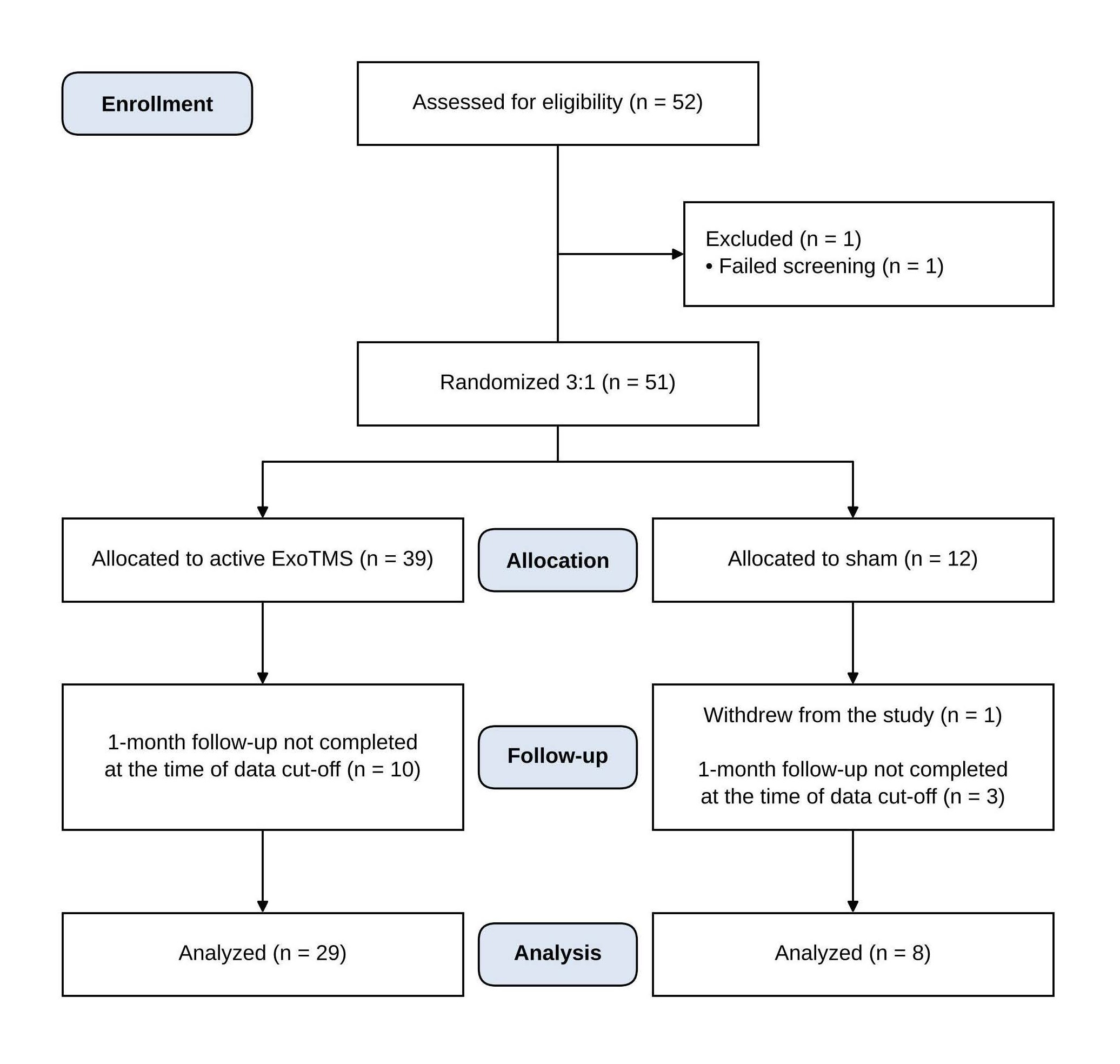
Of fifty-two individuals assessed for eligibility, one failed screening and 51 were randomized (39 active, 12 sham; (Figure 1). One sham participant withdrew from the study, and 13 participants (10 active, 3 sham) had not completed the 1-month follow-up at the time of the data cut-off. Thirty-seven participants (n = 37, 24–74 years, 11 males and 26 females, BMI 30.7 ± 8.0 kg/m2) completed the treatment sessions and the 1-month follow-up visit, and were included in this interim analysis. Twenty-nine subjects were assigned to the active group (n = 29, 24–74 years, 8 males and 21 females, BMI 29.8 ± 6.9 kg/m2) and eight to the sham group (n = 8, 25–57 years, 3 males and 5 females, BMI 33.7 ± 11.1 kg/m2).
Brief Self-Control Scale (BSCS)
The mean BSCS baseline score was 39.1 ± 6.7 across all subjects, 38.6 ± 6.9 in the active group, and 41.3 ± 5.4 in the sham group. In the active treatment group, BSCS scores significantly (p < 0.001) increased by 5.3 ± 6.3 at final treatment (to 43.9 ± 7.4) and 6.0 ± 7.3 at 1-month follow-up (to 44.6 ± 6.9), whereas the sham group showed smaller, non-significant changes (p = 0.45) of 2.4 ± 5.8 (to 43.6 ± 8.3) and 2.5 ± 5.8 (to 43.8 ± 8.6), respectively. For the illustration of the results, see Figure 2.
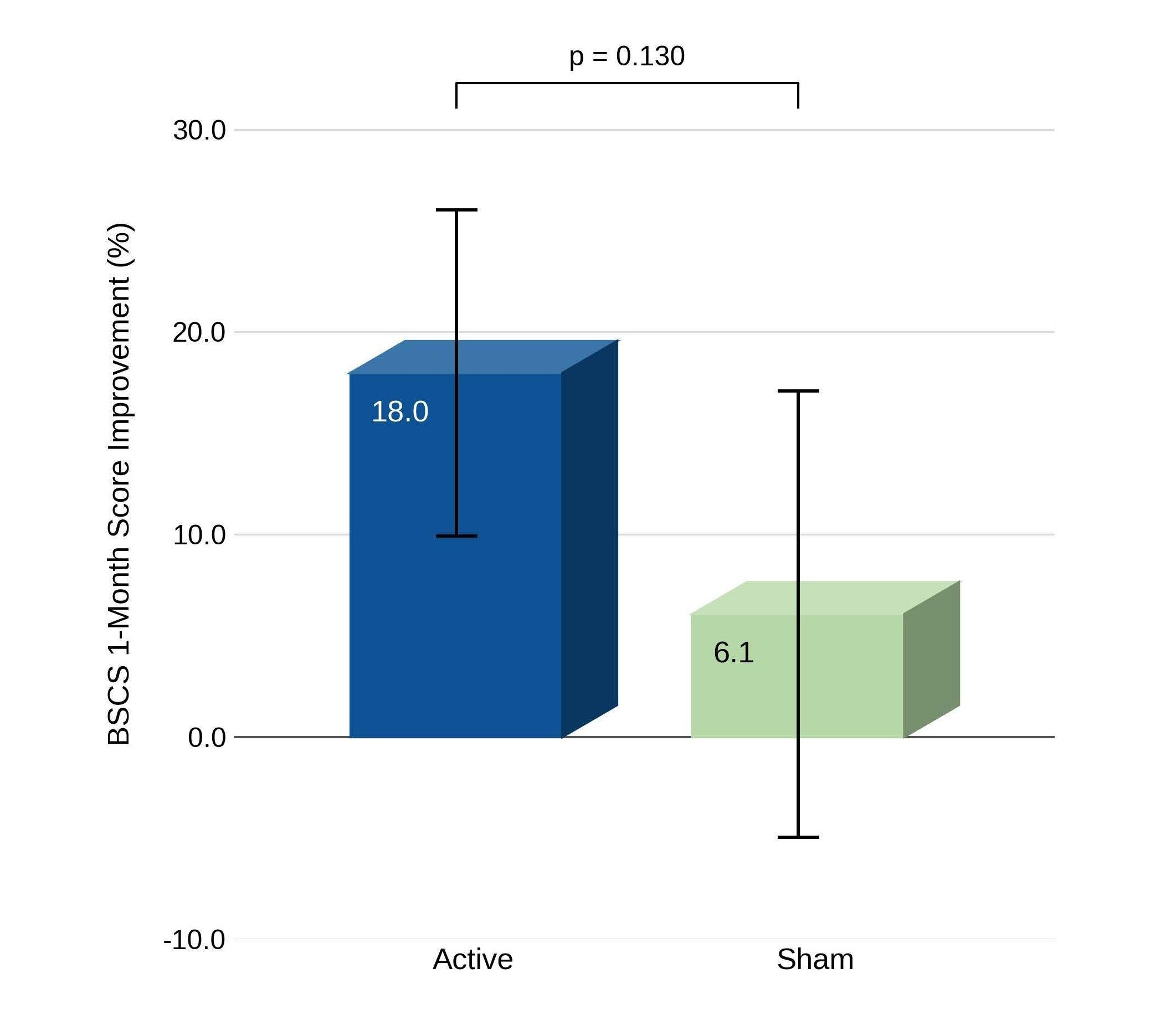
The 1-month percentage improvement in BSCS was larger in the active group (18.0%, 95% CI 9.9 to 26.0) than in the sham group (6.1%, 95% CI−5.0 to 17.1; mean difference 11.9 percentage points, 95% CI−0.9 to 24.7; Hedges’ g = 0.59), but the between-group difference was not statistically significant (Mann–Whitney U = 157.5, p = 0.130; Figure 2).
Food Cravings Questionnaire–Trait (FCQ-T)
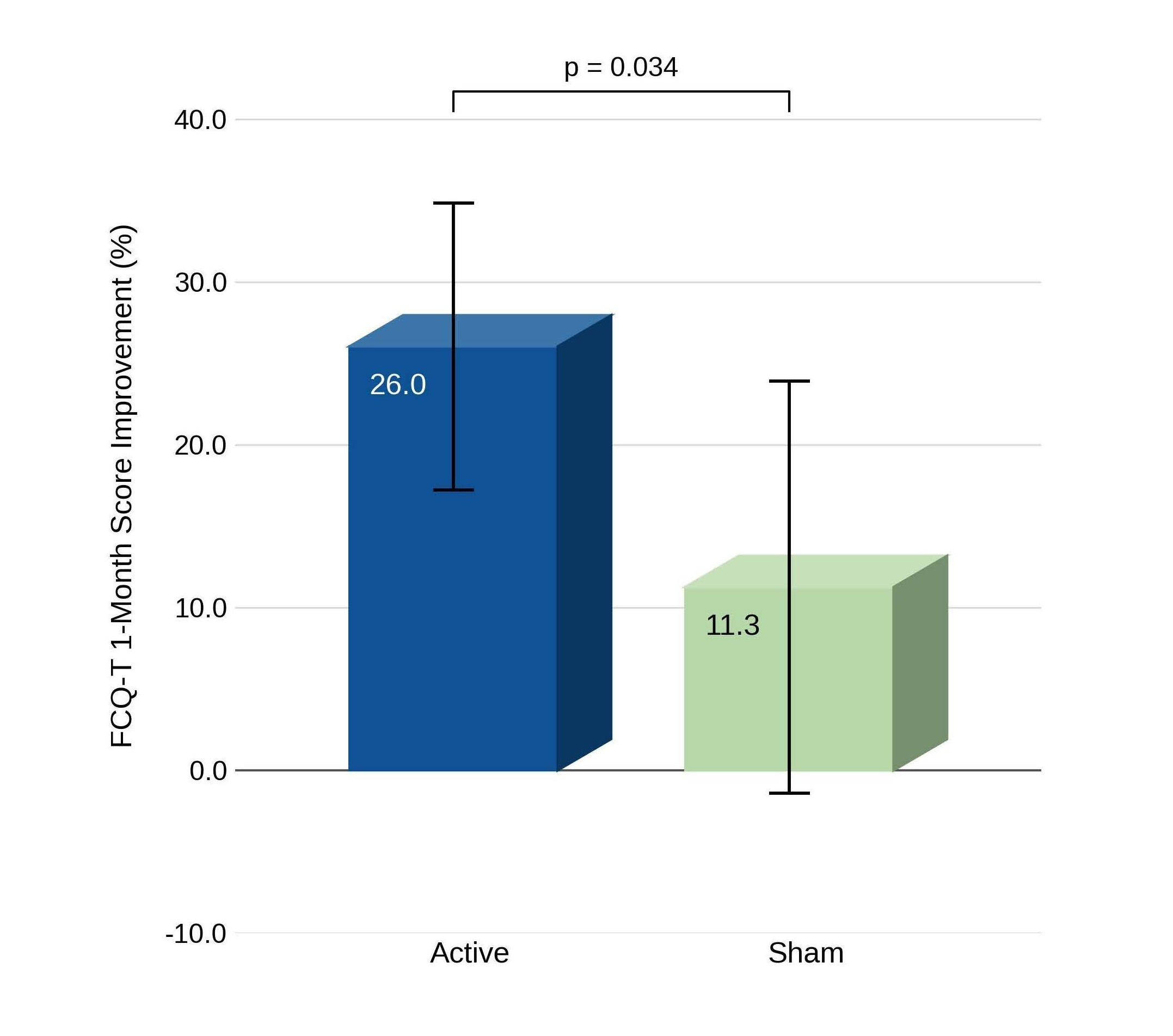
The initial FCQ-T score across all participants was 134.0 ± 35.5, with scores of 136.4 ± 36.6 in the active group and 127.5 ± 32.5 in the sham group. Following treatment, pronounced reductions in FCQ-T scores were observed in the active group, where a decrease in score indicated improvement. Specifically, the active group showed a statistically significant (p < 0.001) 34.7 ± 34.2 decrease at the final treatment (to 101.7 ± 29.8) and a 38.1 ± 34.3 decrease at the 1-month follow-up (to 98.2 ± 33.2). In comparison, the sham group showed non-significant (p = 0.16) reductions of 9.9 ± 12.8 (to 117.6 ± 26.8) at the final treatment and 16.5 ± 24.7 (to 111.0 ± 26.5) at 1 month. For the illustration of the results, see Figure 3.
Notably, “Lack of control over eating” improved by 31.8% in the active group (vs. 14.1% sham), “Guilt from cravings and/or giving into them” by 25.6% (vs. 10.5%), “Thoughts and preoccupation with food” by 27.3% (vs. 13.3%), and “Cues that may trigger food cravings” by 32.3% (vs. 16.9%), “Anticipation of positive reinforcement from eating” improved by 25.6% (vs. 11.0%), “Anticipation of relief from negative states and feelings” improved by 15.2% (vs. –1.5%). Lastly, “Emotions experienced before or during food cravings or eating” improved by 32.5% (vs. 6.9%).
The 1-month percentage reduction in FCQ-T was significantly greater in the active group (26.0%, 95% CI 17.2 to 34.8) than in the sham group (11.3%, 95% CI−1.4 to 23.9; mean difference 14.8 percentage points, 95% CI 0.3 to 29.2; Hedges’ g = 0.66; Mann–Whitney U = 174.0, p = 0.034; Figure 3).
Regression analysis
Linear regression analysis revealed a significant positive correlation between the 1-month percentage change in BSCS and the 1-month percentage FCQ-T improvement (R² = 0.215, F(1,27) = 7.403, β = 0.507, p = 0.011) within the active group. Because this analysis was adequately powered only for correlations of r ≥ 0.50, it should be considered exploratory.
Subjects satisfaction and therapy comfort
Across all Subjects Satisfaction Questionnaire statements, the active group showed a higher proportion of participants in agreement with the statements relating to improvement in self-control, willpower and eating habits.
After the final treatment, a higher proportion of participants in the active group reported agreement with the positive statements from the Subject Satisfaction Questionnaire compared to those in the sham group. Specifically, 69.0% of participants in the active group agreed with the statement “My willpower has improved after the treatment,” compared to 50.0% in the sham group. The same proportion (69.0%) of active subjects reported improvements in self-control, whereas only 37.5% of sham subjects agreed with this statement. Similarly, 65.5% of active participants stated that they were better able to resist temptations following the treatment, in contrast to just 25.0% of those in the sham group. Improvements in coping with setbacks were reported by 72.4% of active participants, compared to 25.0% in the sham group. Additionally, 58.6% of active subjects felt they adapted well to their surroundings after treatment, while this was the case for only 25.0% of sham subjects. Confidence in one’s ability to overcome challenges was expressed by 62.1% of active participants versus 50.0% of sham participants. Regarding dietary behaviors, 58.6% of active participants indicated that they were better able to choose healthier options instead of giving in to cravings, compared to 37.5% in the sham group. Finally, 65.5% of active subjects reported thinking about food less frequently during the day after the treatments, compared to 37.5% in the sham group.
At the One-month follow-up, these trends remained consistent, with a greater proportion of active group participants continuing to report improvements across all measured domains. Agreement with the statement “My willpower has improved after the treatment” was reported by 72.4% of active participants and 62.5% of sham participants. Similarly, 75.9% of active participants stated that their self-control had improved, while this was true for 62.5% of those in the sham group. The ability to resist temptations was reported by 65.5% of active participants, compared to 50.0% in the sham group. Improvements in handling setbacks were reported by 62.1% of participants in the active group and 37.5% in the sham group. The sense of adaptability to one’s surroundings was endorsed by 72.4% of active participants and 37.5% of sham participants. Likewise, confidence in overcoming challenges was reported by 62.1% of active participants versus 37.5% in the sham group. The ability to choose healthier options instead of giving into cravings was noted by 65.5% of the active group and 37.5% of the sham group. Finally, 62.1% of active participants reported thinking about food less often during the day, compared to 37.5% of those in the sham group.
Based on the Therapy Comfort Questionnaire, 26 of 29 active participants (89.7%) agreed that the treatment was comfortable; of the remaining three, two disagreed (6.9%) and one (3.4%) was neutral. In the sham group, 7 of 8 participants (87.5%) agreed that the treatment was comfortable, and one disagreed (12.5%). All participants reported the treatment as painless (NRS score of 0). The only adverse event was mild headaches in one participant. No serious adverse events were reported.
Discussion
This study examined the efficacy of Transcranial Magnetic Stimulation (TMS) technology for enhancing self-control, utilizing the Brief Self-Control Scale (BSCS) and changes in the Food Cravings Questionnaire–Trait (FCQ-T) as behavioral indicators of self-regulation related to eating behaviors. Participants in the active stimulation group demonstrated significant improvements in both measures: BSCS scores increased by 6.0 points, while FCQ-T scores decreased by 38.1 points. In contrast, no statistically significant changes were observed in the sham (control) group. Compared with the sham group, the mean percentage improvement in the active group was approximately 3.0-fold larger for BSCS and 2.3-fold larger for FCQ-T; however, only the FCQ-T difference reached statistical significance.
Self-reported outcomes further supported these findings. A majority of participants in the active group reported enhanced self-control, greater willpower, and improved ability to resist temptations following the intervention. Moreover, the treatment was well-tolerated, with 89.7% of participants indicating that the therapy was comfortable, and none reporting any level of pain.
Linear regression analysis revealed that increases in BSCS scores were significantly associated with improvements in FCQ-T scores, in line with greater self-control over food cravings, which is consistent with prior research linking higher self-control to healthier dietary patterns [4,5,24]. Improvements in the FCQ-T subscale "Lack of control over eating" paralleled the enhanced self-control observed through the BSCS. Declines in the Guilt subscale suggest lower rates of indulgent eating and, therefore, enhanced impulse control. Moreover, reductions in subscales such as "Thoughts and preoccupation with food" and "Cues that may trigger food cravings," along with participants' agreement with the statement "I think about food less often during the day after the treatments," indicate that TMS stimulation had a beneficial effect on reducing eating-related intrusive thoughts, often referred to as “food noise” [25].
These findings offer further behavioral insight into the possible mechanisms of Dorsolateral Prefrontal Cortex (DLPFC) TMS stimulation in regulating food cravings, suggesting that increased self-control and reduced “food noise” contribute to its therapeutic effect in managing disordered eating behaviors; confirming the underlying neural mechanisms will require neuroimaging or neurophysiological evidence.
While the current study focused on eating behavior, the implications of enhanced self-control may extend beyond dietary outcomes to broader psychological functioning. Given that self-control is a multifaceted construct involving a complex network of psychological processes [3], neuromodulation of the DLPFC may target a key component of this broader regulatory network. Extensive prior research has shown that improved self-control is associated with a range of long-term benefits, including better physical health, stronger interpersonal relationships, and enhanced psychological well-being [2,5]. It is therefore plausible that the self-control improvements observed in the present study could contribute to broader improvements in quality of life. Future studies are recommended to explore these potential long-term outcomes.
Importantly, unlike traditional behavioral or psychological interventions, the ExoTMS-based approach requires only six sessions and minimal active effort from participants. This may make it particularly advantageous for individuals with low baseline self-control, who are typically less able to adhere to conventional therapeutic protocols [26].
Finally, the study limitations must be acknowledged. The sample was small and imbalanced, and no a priori power calculation was performed; the findings should therefore be regarded as hypothesis-generating. The single-blind design and self-reported outcomes are susceptible to expectancy and reporting biases. The numerical improvement in the sham group suggests placebo effects related to study participation, such as expectations of benefit and repeated contact with study staff [27,28], which may also have contributed to the improvement in the active group. Follow-up was limited to 1 month, and external validity is restricted because individuals with eating disorders were excluded and environmental influences on food craving, such as food advertising, were not controlled [12]. Larger, double-blind, multicenter trials with longer follow-up in populations with eating or impulse-control disorders should control for such influences and include objective measures (e.g., food intake monitoring, cognitive inhibition tasks, body composition, ecological behavioral tracking, and neuroimaging).
A key strength of this study was its sham-controlled design, which reduces the likelihood that the observed effects are attributable to placebo. Moreover, the use of validated instruments, such as the Brief Self-Control Scale (BSCS) and the Food Cravings Questionnaire–Trait (FCQ-T), combined with self-reported experiences, enabled a comprehensive evaluation of both objective and subjective treatment effects. To the authors' knowledge, this is the first study to investigate the impact of ExoTMS stimulation on enhancing self-control, thereby expanding the therapeutic potential of this non-invasive brain stimulation technique. Furthermore, the observed correlation between improvements in BSCS and FCQ-T scores suggests that improved self-control contributes to the reduction in food cravings following ExoTMS stimulation.
Conclusion
The preliminary findings suggest that the novel ExoTMS targeting the dorsolateral prefrontal cortex could enhance self-control, noted by significant improvements in Brief Self-Control Scale (BSCS) scores among participants in the active stimulation group. Importantly, this increase in self-control was accompanied by a reduction in food cravings, used here as a measurable behavioral proxy for self-regulation. Collectively, these preliminary findings indicate that ExoTMS holds promise as a viable method for enhancing self-control and willpower, reinforcing its potential as a non-invasive tool for promoting behavioral change.
Funding
This study was an IRB approved clinical trial sponsored by BTL Industries, which provided the study device. However, no funding for the research, authorship, or publication of this article was provided.
Disclosure of Interest
Dr. Cady, Dr. Nanda, and Dr. Eberwein are clinical investigators and speakers for BTL Industries, the study sponsor. Dr. Johnston III is a clinical investigator, and Nick Tvrdik is a speaker for BTL Industries.
Author Contributions
Dr. Cady, Dr. Nanda, Dr. Eberwein, and Dr. Johnston III conducted the study, including patient recruitment, data collection, and data analysis. Dr. Cady prepared the manuscript draft with intellectual input from Dr. Nanda, Dr. Eberwein, Dr. Johnston III, and Nick Tvrdik. All authors have reviewed and approved the manuscript.
Acknowledgements
The authors have no acknowledgments to declare.
References
2. Cobb-Clark DA, Dahmann SC, Kamhöfer DA, Schildberg-Hörisch H. The Predictive Power of Self-Control for Life Outcomes. J Econ Behav Organ. 2022 May 1;197:725–44.
3. Hofmann W, Friese M, Strack F. Impulse and self-control from a dual-systems perspective. Perspect Psychol Sci. 2009 Mar;4(2):162–76.
4. De Ridder DT, Lensvelt-Mulders G, Finkenauer C, Stok FM, Baumeister RF. Taking stock of self-control: a meta-analysis of how trait self-control relates to a wide range of behaviors. Pers Soc Psychol Rev. 2012;16(1):76–99.
5. Tangney JP, Baumeister RF, Boone AL. High self-control predicts good adjustment, less pathology, better grades, and interpersonal success. J Pers. 2004 Apr;72(2):271–324.
6. Kane MJ, Engle RW. The role of prefrontal cortex in working-memory capacity, executive attention, and general fluid intelligence: an individual-differences perspective. Psychon Bull Rev. 2002 Dec;9(4):637–71.
7. Nejati V, Majdi R, Salehinejad MA, Nitsche MA. The role of dorsolateral and ventromedial prefrontal cortex in the processing of emotional dimensions. Sci Rep. 2021 Jan 21;11(1):1971.
8. Wood SMW, Schembre SM, He Q, Engelmann JM, Ames SL, Bechara A. Emotional eating and routine restraint scores are associated with activity in brain regions involved in urge and self-control. Physiol Behav. 2016 Oct 15;165:405–12.
9. Zheng L, Yu Y, Wu X, Hu J, Gan Y. Effective non-invasive brain stimulation over dorsolateral prefrontal cortex for modulation of food craving and consumption: A systematic and meta-analytic review. Prog Neuropsychopharmacol Biol Psychiatry. 2025 Mar 20;137:111271.
10. Wu M, Hartmann M, Skunde M, Herzog W, Friederich HC. Inhibitory control in bulimic-type eating disorders: a systematic review and meta-analysis. PLoS One. 2013 Dec 31;8(12):e83412.
11. Boswell RG, Kober H. Food cue reactivity and craving predict eating and weight gain: a meta-analytic review. Obes Rev. 2016 Feb;17(2):159–77.
12. Boyland EJ, Nolan S, Kelly B, Tudur-Smith C, Jones A, Halford JC, et al. Advertising as a cue to consume: a systematic review and meta-analysis of the effects of acute exposure to unhealthy food and nonalcoholic beverage advertising on intake in children and adults. Am J Clin Nutr. 2016 Feb;103(2):519–33.
13. Ekhtiari H, Tavakoli H, Addolorato G, Baeken C, Bonci A, Campanella S, et al. Transcranial electrical and magnetic stimulation (tES and TMS) for addiction medicine: A consensus paper on the present state of the science and the road ahead. Neurosci Biobehav Rev. 2019 Sep 1;104:118–40.
14. Sabé M, Hyde J, Cramer C, Eberhard AL, Crippa A, Brunoni AR, et al. Transcranial Magnetic Stimulation and Transcranial Direct Current Stimulation Across Mental Disorders: A Systematic Review and Dose-Response Meta-Analysis. JAMA Netw Open. 2024 May 22;7(5):e2412616.
15. Klomjai W, Katz R, Lackmy-Vallée A. Basic principles of transcranial magnetic stimulation (TMS) and repetitive TMS (rTMS). Ann Phys Rehabil Med. 2015 Sep;58(4):208–13.
16. Su H, Liu Y, Yin D, Chen T, Li X, Zhong N, et al. Neuroplastic changes in resting-state functional connectivity after rTMS intervention for methamphetamine craving. Neuropharmacology. 2020 Sep 15;175:108177.
17. Dalhuisen I, Ackermans E, Martens L, Mulders P, Bartholomeus J, de Bruijn A, et al. Longitudinal effects of rTMS on neuroplasticity in chronic treatment-resistant depression. Eur Arch Psychiatry Clin Neurosci. 2021 Feb 1;271(1):39–47.
18. Lefaucheur JP, André-Obadia N, Antal A, Ayache SS, Baeken C, Benninger DH, et al. Evidence-based guidelines on the therapeutic use of repetitive transcranial magnetic stimulation (rTMS). Clin Neurophysiol. 2014 Nov 1;125(11):2150–206.
19. Borckardt JJ, Smith AR, Hutcheson K, Johnson K, Nahas Z, Anderson B, et al. Reducing Pain and Unpleasantness During Repetitive Transcranial Magnetic Stimulation. J ECT. 2006 Dec;22(4):259–64.
20. Pánek D, Gerla V, Dees M, Halaas Y, McCoy JD, Cady L, et al. Innovations in repetitive transcranial magnetic stimulation: a review of clinical evidence and patient-reported outcomes for ExoTMS. Front Psychiatry. 2026 Jul 20;17:1850212.
21. Cepeda-Benito A, Gleaves DH, Williams TL, Erath SA. The development and validation of the state and trait food-cravings questionnaires. Behav Ther. 2000 Dec 1;31(1):151–73.
22. Vander Wal JS, Johnston KA, Dhurandhar NV. Psychometric properties of the State and Trait Food Cravings Questionnaires among overweight and obese persons. Eat Behav. 2007 Apr;8(2):211–23.
23. Meule A, Hermann T, Kübler A. A short version of the Food Cravings Questionnaire-Trait: the FCQ-T-reduced. Front Psychol. 2014 Mar 4;5:190.
24. Hankonen N, Kinnunen M, Absetz P, Jallinoja P. Why do people high in self-control eat more healthily? Social cognitions as mediators. Ann Behav Med. 2014 Apr;47(2):242–8.
25. Hayashi D, Edwards C, Emond JA, Gilbert-Diamond D, Butt M, Rigby A, Masterson TD. What Is Food Noise? A Conceptual Model of Food Cue Reactivity. Nutrients. 2023 Nov 17;15(22):4809.
26. Strayhorn Jr. JM. Self-control: Theory and research. J Am Acad Child Adolesc Psychiatry. 2002;41(1):7–16.
27. Burke MJ, Romanella SM, Mencarelli L, Greben R, Fox MD, Kaptchuk TJ, et al. Placebo effects and neuromodulation for depression: a meta-analysis and evaluation of shared mechanisms. Mol Psychiatry. 2022 Mar;27(3):1658–66.
28. McCambridge J, Witton J, Elbourne DR. Systematic review of the Hawthorne effect: new concepts are needed to study research participation effects. J Clin Epidemiol. 2014 Mar;67(3):267–77.