
Abstract
Background: Up to 40% of adult individuals with Cystic Fibrosis (CF) develop a condition known as Cystic Fibrosis Diabetes (CFRD). This co morbid condition, is secondary to insulin deficiency as a result of pancreatic islet cell damage subsequent to the underlying genetic mutation in CF. CFRD is associated with the development of microvascular complications however, little is known about the prevalence of neuropathic dysfunction in the form of cardiac autonomic neuropathy (CAN). This study examined the extent of CAN in an adult population with CF dysglycemia compared to a population with CF and normal glucose tolerance.
Methods: We performed a cross-sectional study comparing three parasympathetic function tests on 71 adults with CF, 46 of whom had CF dysglycemia. Healthy volunteers were the control group.
Results: There was no significant difference between the CF cohort with normal glucose tolerance and the CF cohort with dysglycemia in all three measures of parasympathetic function. Older individuals with dysglycemia were more likely to demonstrate a lower heart rate variability only in the deep breathing measurement (p<0.01) compared to the healthy control group. The presence of dysglycemia was not an influential factor in heart rate variability in the Valsalva maneuver and standing compared to CF individuals with normal glucose tolerance.
Conclusion: Based on these findings, the presence of dysglycemia in CF may not be a major influential factor in the development of parasympathetic cardiac dysfunction in CF. However, heart rate variability during deep breathing was lower in CF dysglycemia compared to those with normal glucose tolerance and was significantly reduced compared to healthy controls. This suggests longitudinal studies are needed to evaluate the long-term impact of dysglycemia in cardiac autonomic neuropathy in Cystic Fibrosis.
Keywords
Diabetic complications, Diabetic neuropathy, Epidemiology of diabetes
Introduction
Cystic Fibrosis-Related Diabetes (CFRD) occurs in up to 40% of the CF population and the prevalence increases with age [1,2]. There are a number of theories behind the pathogenesis of CFRD. A possible mechanism is secondary to the defective sodium and chloride channels leading to viscous secretions and fatty deposition within the pancreatic ducts [3]. Subsequently there is scarring and damage to the pancreatic ductal epithelium leading to dysfunction of the pancreatic islet cells and a reduction in insulin secretion. This is associated with pancreatic exocrine insufficiency in people with the delta F508 genotype [4]. There is also an element of insulin resistance in CFRD due to recurrent respiratory infections and use of steroid therapy [2]. Evidence has also shown that defects in the islet beta cells prior to the clinical development of CFRD, suggesting the CFTR mutation may lead to changes in pancreatic islet cell development at an early stage [5]. Thus, the condition has similarities to both Type 1 (T1DM) and Type 2 diabetes mellitus (T2DM) with a combination of insulin deficiency and insulin resistance [6,7]. However, unlike T1DM there is no clear link with autoimmune pathophysiology [8]. The condition is associated with an increased mortality, due to an increased catabolic state and recurrent infections due to increased inflammation and a decline in the individual’s lung function [4,7]. Microvascular complications occur in CFRD, with some studies suggesting a prevalence which is similar to T1DM [9,10].
Although microvascular changes in the form of nephropathy and retinopathy occur in CFRD, there remains a paucity of information on neuropathic complications in CFRD [9,10]. This remains an under-represented area of research, despite the presence of diabetic Cardiac Autonomic Neuropathy (CAN) being associated with high morbidity and mortality [11,12]. However, there is limited evidence examining the prevalence of CAN in the adult CF population.
Animal studies have demonstrated the presence of the CFTR protein channel within neuronal cells [13]. There is also evidence of autonomic dysfunction in CF which may be due to defects inherent in the CFTR channel mutation [14–16]. This suggests autonomic disease may be more prevalent in the presence of CF with normal glucose tolerance (CFNGT). It is also clear that dysglycemia can lead to microvascular changes within the nervous system leading to autonomic neuropathy [16]. Proposed mechanisms for the pathophysiology of neuropathy in diabetes include advanced glycation end products, oxidative damage and changes in neuronal blood flow [17]. Changes in heart rate variability are an early clinical manifestation of cardiac autonomic neuropathy (CAN) [18,19]. The condition has a prevalence of up to 20–40% people living with T1DM and T2DM [20,21]. It is possible that the combination of people living with CF (pwCF) and the presence of dysglycemia may lead to an increased risk of the development of CAN.
We investigated whether the presence of whether CF with dysglycemia (CFD) confers a greater risk of development of CAN, compared to pwCF and normal glucose tolerance (CFNGT), using healthy volunteers as a baseline control group.
Materials and Methods
Participants in the study
Adults with a formal diagnosis of CF based on genetic criteria and a positive sweat test were recruited from a population of 220 individuals attending the All-Wales Adult Cystic Fibrosis Centre (AWACFC). The diagnosis of CFD was based on the 75-gram oral glucose tolerance test followed up by a period of capillary glucose monitoring as part of confirmation [22]. We assessed baseline clinical characteristics of the individuals according to their glycemic status. No individuals were taking CFTR modulator therapy, as the study pre-dated the wide introduction of these. Healthy volunteers, who were healthcare workers based at the AWACFC, were recruited as a control group. Patients who had an active infective exacerbation of bronchiectasis and pregnant individuals were excluded.
General measurements
We measured height, weight with a calculated BMI (kg/m2) and lung function expressed as FEV1% predicted in all individuals on the day of the study. Baseline blood pressure was measured in all groups with an OMRON cuff.
Measurement of cardiac autonomic function
Cardiac autonomic function, namely, Heart rate variability (HRV) during deep breathing for one minute, change in HRV during the Valsalva maneuver and standing, was assessed based on the methodology from Ewing and colleagues [23]. Heart rate variability during deep breathing was measured by electrocardiagraph (ECG) as the mean between the longest and shortest R-R interval over 6 breaths in one minute, represented as beats per minute (bpm). Valsalva maneuver was recorded as the longest R-R interval post maneuver, compared with the shortest R-R interval during the maneuver. The heart rate response to standing was recorded as a ratio of R-R interval on the 30th beat and 15th beat [23].
Deep breathing exercise
In the deep breathing exercise, electrocardiograph electrodes were attached to the seated subject and a rhythm strip was recorded. After initiating the rhythm strip recording, the study participant was asked to breathe in slowly over 5 seconds, the start of which was marked on the ECG strip. The participant was then asked to breathe out slowly over 5 seconds and again, the beginning of this was marked on the rhythm strip.
The deep breathing cycles were conducted over a duration of one minute whence the beginning of each inspiratory and expiratory breath was marked. The participant was instructed to terminate the deep breathing following one minute of the exercise.
The R-R interval was calculated using a calibrated ruler. The heart rate was measured by recording the shortest R-R interval of the inspiratory and the longest expiratory component of each breathing cycle using a ruler. There were 6 breathing cycles within the 1-minute duration of the exercise.
The difference between the maximum and minimum R-R interval in each cycle of breathing was calculated. In total there were 6 breathing cycles per participant. The mean of the 6 readings based on the difference between maximum and minimum heart rate was calculated and represented as beats per minute (beats/min). The R-R interval during deep breathing was classified as normal, borderline or abnormal depending on the degree of reduction in the interval. This was based on the criteria defined by Ewing and colleagues [23].
Valsalva maneuver
An ECG was recorded with the seated participant at rest. A device consisting of a piece of rubber tubing was connected to a manometer. The other end of the tube was attached to a plastic hollow tube from a positive expiratory pressure mask (PEP) mask with holes that were covered to assist in generating a positive intra-thoracic pressure when the individual blew into the device. A viral filter and cardboard mouth-piece were attached to the PEP device.
The subject exhaled into the mouth-piece to generate a pressure of 40 mmHg on the manometer for 15 seconds. If the participant was not able to generate a pressure of 40 mmHg, then their maximum pressure over that period of time was used as a target instead. The beginning and end of the procedure was marked with a coloured pen on the rhythm strip of the ECG recording. The ECG was recorded for up to 15 seconds following cessation of the exercise. The exercise was repeated a further two times.
The R-R interval was measured using a calibrated ruler. The longest R-R interval following the maneuver was divided by the shortest R-R interval during the exercise. In patients with damage to the ANS, there is a reduction in the ratio in the heart rate response to the Valsalva maneuver.
Heart rate response to standing
An ECG monitor recorded the HR and rhythm of the subject who was semi-recumbent. The subject was then asked to stand up slowly as the HR was recorded for a further 30 seconds following standing.
The ratio of the longest R-R interval around 30th beat after standing with the R-R interval on the 15th beat of standing was calculated. This was represented by the 30:15 ratio.
A reduction in the Heart Rate Variability (HRV), as demonstrated by the Ewing’s test after changing position, represents disturbance of the Parasympathetic Nervous System (PNS). Although heart rate variability can be examined with the patient supine, a greater difference is seen following changes in posture, allowing more accurate interpretation of results when investigating autonomic neuropathy [23].
Statistical analysis
R statistical software R version 4.6.3 (2023-03-15) (https://www.R-project.org/>) and GraphPad Prism were used for statistical analysis. Kruskal-Wallis and Mann-Whitney tests were used to compare baseline clinical characteristics. Multiple linear regression was performed to examine the effects of CF status, glycemic status, and BMI, Forced Expiratory Volume in one second (FEV1), sex, and heart rate on the three parasympathetic function tests. The logarithm of the variable measuring the heart rate variability during the three exercises was used rather than the untransformed variable to maintain normality of the regression residuals. The outcomes of all three parasympathetic tests were logged in the regression model. An interaction variable between the glycemic status and age of participant was created to determine whether these combined clinical factors influence HRV in the three parasympathetic tests. Healthy volunteers were the baseline Healthy Control (HC) group in the analysis
Results
In this pilot study, 71 adult individuals living with CF, of whom 46 pwCF had CF dysglycemia (CFRD and CF with impaired glucose tolerance analyzed together) were recruited into the study. The duration of CFD ranged from 1 to 16 years and four individuals had a previous heart/lung transplant. Of these, 9 were receiving insulin therapy. There were 37 individuals who were Delta F508 homozygous, 26 of whom had CFD and 30 individuals were compound heterozygous for the F508 mutation, whilst the remainder had an unknown mutation. The baseline clinical characteristics are demonstrated in Table 1. There were 35 HC who formed the baseline comparison group.
|
|
CFNGT |
CFD/IGT |
Healthy volunteers |
P-value |
|
Number of patients |
25 |
46 |
35 |
|
|
Male (M): Female (F) |
19M:16F |
23M:23F |
11M:24F |
|
|
Mean age in years (±SD), Range |
27.7 (±7.7) 18–50 |
29.8 (±10.2) 18–53 |
34.3 (±8.9) 22–56 |
0.009 |
|
Mean FEV1 % predicted (±SD), Range |
61.6 (±7.7) 18–103 |
62.9 (±23.7) 16–112 |
100 (±12.6) 79–125 |
<0.0001 |
|
HbA1c % (Mean mmol/mol ± SD)
|
5.7% (39±4.15) |
7.4% (57±18.8) |
|
<0.001 |
|
Mean BMI kg/m2 (±SD) |
22.2 (±3.3) |
22.9 (±3.9) |
23.6 (±2.7) |
0.23 |
|
The participants with either CFD or Cystic Fibrosis and impaired glucose tolerance (CFIGT) are shown in the column CFRD/IGT (CF dysglycemia). Nine individuals had diabetes for more than 10 years. In the dysglycemic group, 8 people were classed as CFIGT and were not on treatment but underwent an annual OGTT as part of monitoring. Kruskal Wallis test was used to compare age, FEV1% predicted, and BMI between groups. Mann-Whitney U test was used to compare HbA1c between groups. P-values <0.05 were considered to be statistically significant. |
||||
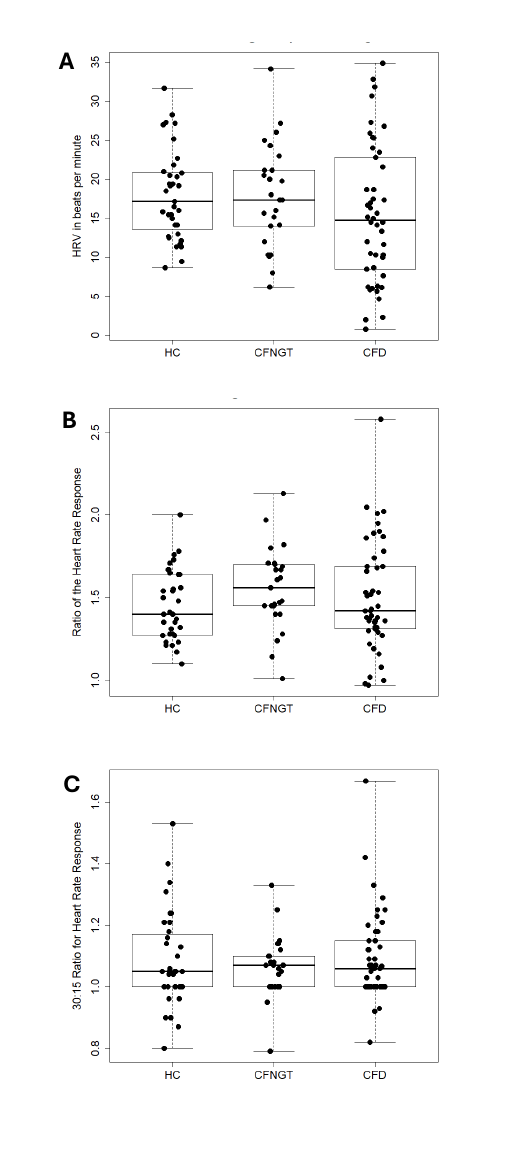
The median HRV during deep breathing was lower in the CFD group compared to the CFNGT and HC group (14.75 vs 17.34, 17.17 respectively), although this did not reach statistical significance (p=0.17). The median Valsalva ratio was similar between all three groups (1.42, 1.56, 1.40 in the CFD, CFNGT and HC respectively (p=0.19). The median ratio of the HRV during standing was 1.06, 1.07 and 1.05 between all three groups which did not reach statistical significance (p=0.89). Figures 1A-1C, is a boxplot which illustrates the outcome of the median value of the three different measures of parasympathetic tests in the three groups.
A regression model with the log (deep breathing) as the outcome variable had an adjusted R squared of 0.62 which was significant (P<0.001) (Table 2). In the deep breathing exercise, the regression model showed that the presence of CFD was not a significant influential factor in HRV in deep breathing compared to those with CFNGT (P>0.05) as a baseline category. In contrast, there was a significant difference between the CFD group and the HC group when comparing HRV during deep breathing. With all other variables held constant, the presence of dysglycemia was associated with a drop in heart rate variability by 22% compared to the healthy controls (P<0.05) for a person of 30 years (the average age of the sample). For an individual with CFNGT, there was a drop in HRV by 12% compared to a healthy control which was not significant (p>0.05) (Table 2). The interaction variable between age of individual and glycemic status was significant in the deep breathing variable, suggesting an inverse relationship between logarithm of HRV and the age of a person with CFD (P<0.01) compared to HC. In the CFD group, the HRV fell by an estimated additional 2.7% for every extra year of age (p<0.01). In contrast, the CFNGT group the HRV fell by an estimated additional 2.2% for every extra year of age (p>0.05). The change in HRV with age during deep breathing exercise is shown in Figure 2.
|
|
Deep breathing Variation in heart rate Log estimate |
Valsalva maneuver (Valsalva ratio) Log estimate |
Heart rate response to standing Log estimate |
||
|
Intercept |
2.39 |
*** |
0.452 |
** |
1.022e-01 |
|
Age (mean centered) |
- 0.014 |
|
-0.005 |
|
-4.264e-03 |
|
Sex (female baseline) |
0.078 |
|
0.138 |
*** |
-6.069e-03 |
|
BMI |
-0.018 |
|
0.0005 |
|
-4.783e-03 |
|
Resting heart rate |
0.006 |
|
-0.002 |
|
9.026e-05 |
|
FEV 1 |
0.005 |
* |
0.0001 |
|
8.430e-04 |
|
CFNGT |
-0.133 |
|
0.008 |
|
7.863e-03 |
|
CFD |
-0.250 |
* |
0.022 |
|
3.614e-02 |
|
Interaction of Age with CFNGT |
-0.021 |
|
0.002 |
|
3.844e-03 |
|
Interaction of Age with CFD |
-0.027 |
** |
-0.005 |
|
2.181e-03 |
|
History of Transplantation |
-1.252 |
*** |
-0.146 |
|
-8.138e-02 |
|
Adjusted R-squared |
0.62 |
|
0.33 |
|
0.015 |
|
Regression F-test 10 and 92 df |
F=17.68 p-value: < 2.2e-16 |
|
F=5.935 p-value: 7.077e-07 |
|
F=1.151 p-value: 0.3343 |
|
BMI: Body Mass Index (kg/m2); FEV1: Forced Expiratory Value per one second. P values considered to be statistically significant: * ≤0.05 ** ≤0.01, ***≤0.001, *** <0.0001. Healthy controls (HC) were the baseline comparator group in the regression analysis. |
|||||
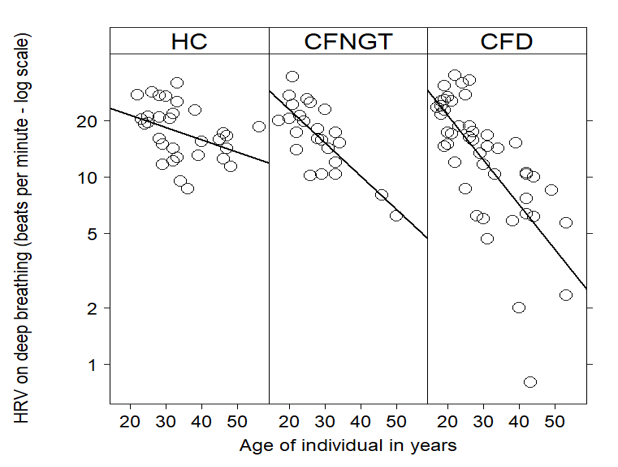
Figure 2. A comparison of HRV in deep breathing with age of individual in the three groups. Each of the panels shows a bivariate plot of the logarithm of HRV against the age of the individual together with a linear trend. There are pronounced differences between the slopes for each of these groups, which implies the interaction between HRV and CFD grouping variable which is taken account of in the regression described in Table 2.
The presence of organ transplantation, and FEV1 were also significant influential factors in deep breathing (p<0.001 and 0.05 respectively). As this was a multiple log-linear multiple regression, all other variables in the analysis were controlled, thus avoiding the effect of confounding factors. Neither the presence of CF dysglycemia or CF status were influential variables in the outcomes of the Valsalva maneuver or HRV during standing (Table 2). Both regression models for the deep breathing test and Valsalva maneuver were significant in the adjusted R squared, highlighting the robustness of both tests, in contrast to the test examining change in heart rate during standing.
A secondary analysis examined the prevalence of adults with severe autonomic dysfunction. This was adapted from Ewing’s criteria in which the presence of definite parasympathetic dysfunction was based on an individual having two or more test results within the abnormal range [23]. The group with CFD had the highest proportion of people with evidence of definite parasympathetic dysfunction (8 out of 46 people), with at least two abnormal test results, compared to one individual in the CFNGT and HC groups respectively (P=0.06 based on Fisher’s exact test) (Table 3).
|
|
Normal or borderline parasympathetic dysfunction |
Definite parasympathetic dysfunction |
|
CFD
|
38 (83) |
8 (17) |
|
CFNGT
|
24 (96) |
1 (4) |
|
HC
|
34 (97) |
1 (3) |
|
Subject numbers with percentages within each subject group in brackets are shown. (P= 0.06 Fisher’s exact test) CFD, CF dysglycemia; CFNGT, CF with normal glucose tolerance; HC, Healthy Controls. |
||
Discussion
In this cross-sectional study, we found no significant difference between the CFD and CFNGT groups in all three tests of cardiac autonomic function. In contrast, the presence of an organ transplant, and lung function measured as FEV1 were significant influential factors in the deep breathing measurement. This was not the case with HRV during standing or when performing Valsalva maneuver. Interestingly, the male population appeared to demonstrate a higher Valsalva ratio compared to females (Table 2). Overall, our results suggest cardiac autonomic function may be more likely to be influenced by factors such as organ transplantation and an individual’s lung function, primarily in the deep breathing measurement. However, we have also demonstrated that an individual living with CF who has dysglycemia will have a significantly lower HRV in deep breathing, a validated measurement of parasympathetic function, compared to HC. This effect is also present in CFD populations with increasing age.
In contrast to limited evidence in this area, our study has undertaken a more detailed assessment of autonomic function comparing three populations. The use of a Log-linear regression model to adjust for confounding factors contributes to the robustness of our results in the different parameters used to measure parasympathetic cardiac function. Our results suggest dysglycemia in CF may not exert a major influence on CAN. Other studies have also noted non-significant trend in the prevalence of AN in CFRD, with milder neuropathy being predominant, although there was a variation in the study populations [9,10]. For example, Schwarzenberg and colleagues examined autonomic neuropathy in a subset of patients with CFRD only [9]. We noted the presence of dysglycemia was associated with more severe forms of CAN but this did not reach statistical significance. It is possible that the shorter duration of diabetes and early initiation of insulin treatment to optimize glycemic control may be a reason for the lack of impact on dysglycemia in CAN. Van den berg and colleagues compared 79 individuals with CFRD and T1DM, in their assessment of microvascular complications [10]. Parasympathetic function tests were not assessed due to clinical concerns, which has the potential to miss people with altered HRV who may be at risk of increasing morbidity in the future. Our results have demonstrated the three tests of autonomic function can be undertaken in an adult population with CF. This may help with future cardiac risk stratification for populations living with CF.
Dysfunction of the autonomic nervous system is associated with increased mortality [24,25]. Although we observed a significant difference in HRV in the CFD group with dysglycemia compared to healthy controls in the deep breathing test but not between Valsalva and standing, it has been suggested that measurement of deep breathing is a stand-alone reliable test for CAN based on Ewing’s criteria [26]. The lack of significant findings when comparing the CFD and CFNGT group may also reflect the small population size recruited for the study. In addition, some individuals developed CFD within 5 years and thus may not have developed autonomic changes within this time, as duration of diabetes has an impact on the development of CAN [21].
We note several limitations in our study. Although we aimed for performance of tests at the same time of day, our study was limited by the time of the day at which assessments could be practically performed. Whilst it may be preferable to use consistent research setting and times at which the tests are undertaken, autonomic testing in controlled and uncontrolled conditions have produced similar results [27,28]. In addition, the effect of underlying lung disease on performing the Valsalva maneuver may have had an impact on the individual’s ability to undertake this test, thus underestimating the outcome of the test and making it less reliable in this setting.
In recent years, with improved treatments, life expectancy of individuals with CF has increased. Our cross-sectional study pre-dated the use of CF modulator therapy, a life-changing treatment that has been postulated to have a potential beneficial impact on glycemic control [29]. The introduction of CFTR modulator therapies, which are potentiators of the CFTR channel, may reduce long term diabetes-related comorbidities in individuals living with CF due to potential improvements in glycemic control. Although there is evidence to suggest metabolic syndrome may predominate in relation to CF modulators [30]; an improvement in glycemic excursion during OGTT following initiation of modulator therapy also occurs [31]. Thus, it remains to be seen whether CFTR modulators will lead to a reduction in CFD and microvascular changes such as CAN in comparison to our pre-CFTR modulator study period.
Parasympathetic impairment that may occur at an earlier stage in CF, in contrast to non-CF populations, may become an important factor determining cardiovascular health in individuals with CF with increased longevity. Although we did not demonstrate that dysglycemia has a significant impact on parasympathetic dysfunction, there is a trend towards a reduction in HRV during deep breathing, which was magnified by the age of the individual. This may suggest additional effect of dysglycemia in combination with aging and declining lung function on certain measures of parasympathetic function; however, longitudinal studies are required to explore the impact of dysglycemia on the development of autonomic neuropathy. It may be that factors such as chronic inflammation and organ transplantation may exert a larger contribution toward autonomic neuropathy in CF, which requires future exploration. With improvements in therapy in pwCF, there is a potential to reduce complications such as CFD and thus microvascular complications, although this requires further exploration.
Ethical Approval
The study was granted ethical approval from SE Wales ethics and research committee.
Declarations
The authors declare no conflicts of interest.
References
2. Moran A, Becker D, Casella SJ, Gottlieb PA, Kirkman MS, Marshall BC, et al. Epidemiology, pathophysiology, and prognostic implications of cystic fibrosis-related diabetes: a technical review. Diabetes Care. 2010 Dec;33(12):2677–83.
3. Moheet A, Moran A. New concepts in the Pathogenesis of Cystic Fibrosis-Related Diabetes. Journal of Clinical Endocrinology and metabolism.2022 May 17;107(6): 1503–9.
4. Lewis C, Blackman SM, Nelson A, Oberdorfer E, Wells D, Dunitz J. Diabetes-related mortality in adults withg cystic fibrosis. Role of genotype and sex. Am J Respir Crit Care Med. 2015 Jan 15;191(2):194–200.
5. Bogdani M, Blackman SM, Ridaura C, Bellocq JP, Powers A, Aguilar-Bryan L. Structural abnormalities in islets from very young children with cystic fibrosis may contribute to cystic fibrosis-related diabetes. Nat Sci rep. 2017; 7:17231.
6. Granados A, Chan CL, Ode KL, Moheet A, Moran A, Holl R. Cystic fibrosis related diabetes: Pathophysiology, screening and diagnosis. J Cyst Fibros. 2019 Oct;18 Suppl 2: S3–9.
7. Sandouk Z, Khan F, Khare S, Moran A. Cystic fibrosis related diabetes (CFRD) prognosis. J Clin Transl Endocrinol. 2021 Nov 19; 26:100278.
8. Konrad K, Scheuing N, Badenhoop K, Borkenstein MH, Gohlke B, Schöfl C, et al. Cystic fibrosis-related diabetes compared with type 1 and type 2 diabetes in adults. Diabetes Metab Res Rev. 2013 Oct;29(7):568–75.
9. Schwarzenberg SJ, Thomas W, Olsen TW, Grover T, Walk D, Milla C, et al. Microvascular complications in cystic fibrosis-related diabetes. Diabetes Care. 2007 May;30(5):1056–61.
10. van den Berg JM, Morton AM, Kok SW, Pijl H, Conway SP, Heijerman HG. Microvascular complications in patients with cystic fibrosis-related diabetes (CFRD). J Cyst Fibros. 2008 Nov;7(6):515–19.
11. Maser RE, Mitchell BD, Vinik AI, Freeman R. The association between cardiovascular autonomic neuropathy and mortality in individuals with diabetes: a meta-analysis. Diabetes Care. 2003 Jun;26(6):1895–901.
12. Pop-Busui R, Braffett BH, Zinman B, Martin C, White NH, Herman WH, et al. Cardiovascular Autonomic Neuropathy and Cardiovascular Outcomes in the Diabetes Control and Complications Trial/Epidemiology of Diabetes Interventions and Complications (DCCT/EDIC) Study. Diabetes Care. 2017 Jan;40(1):94–100.
13. Reznikov LR, Dong Q, Chen JH, Moninger TO, Park JM, Zhang Y, et al. CFTR-deficient pigs display peripheral nervous system defects at birth. Proc Natl Acad Sci U S A. 2013 Feb 19;110(8):3083–88.
14. Niu N, Zhang J, Guo Y, Yang C, Gu J. Cystic fibrosis transmembrane conductance regulator expression in human spinal and sympathetic ganglia. Lab Invest. 2009 Jun;89(6):636–44.
15. Davis PB, Kaliner M. Autonomic nervous system abnormalities in cystic fibrosis. J Chronic Dis. 1983;36(3):269–78.
16. Mirakhur A, Walshaw MJ. Autonomic dysfunction in cystic fibrosis. J R Soc Med. 2003;96 Suppl 43(Suppl 43):11–7.
17. Vinik AI, Erbas T, Casellini CM. Diabetic cardiac autonomic neuropathy, inflammation and cardiovascular disease. J Diabetes Investig. 2013 Jan;4(1):4–18.
18. Spallone V. Update on the Impact, Diagnosis and Management of Cardiovascular Autonomic Neuropathy in Diabetes: What Is Defined, What Is New, and What Is Unmet. Diabetes Metab J. 2019 Feb;43(1):3–30.
19. Bernardi L, Spallone V, Stevens M, Hilsted J, Frontoni S, Pop-Busui R, et al. Methods of investigation for cardiac autonomic dysfunction in human research studies. Diabetes Metab Res Rev. 2011 Oct;27(7):654–64.
20. Dyrberg T, Benn J, Christiansen JS, Hilsted J, Nerup J. Prevalence of diabetic autonomic neuropathy measured by simple bedside tests. Diabetologia. 1981 Mar;20(3):190–4.
21. Martin CL, Albers JW, Pop-Busui R, DCCT/EDIC Research Group. Neuropathy and related findings in the diabetes control and complications trial/epidemiology of diabetes interventions and complications study. Diabetes Care. 2014;37(1):31–8.
22. WHO 2006. Definition and Diagnosis of Diabetes Mellitus and Intermediate Hyperglycaemia. WHO and international Diabetes Federation. Geneva. Available from https://www.who.int/publications/i/item/definition-and-diagnosis-of-diabetes-mellitus-and-intermediate-hyperglycaemia
23. Ewing DJ, Clarke BF. Diagnosis and management of diabetic autonomic neuropathy. Br Med J (Clin Res Ed). 1982 Oct 2;285(6346):916–8.
24. Chowdhury M, Nevitt S, Eleftheriadou A, Kanagala P, Esa H, Cuthbertson DJ, et al. Cardiac autonomic neuropathy and risk of cardiovascular disease and mortality in type 1 and type 2 diabetes: a meta-analysis. BMJ Open Diabetes Res Care. 2021 Dec;9(2):e002480.
25. Katz A, Liberty IF, Porath A, Ovsyshcher I, Prystowsky EN. A simple bedside test of 1-minute heart rate variability during deep breathing as a prognostic index after myocardial infarction. Am Heart J. 1999 Jul;138(1 Pt 1):32–8.
26. Stranieri A, Abawajy J, Kelarev A, Huda S, Chowdhury M, Jelinek HF. An approach for Ewing test selection to support the clinical assessment of cardiac autonomic neuropathy. Artif Intell Med. 2013 Jul;58(3):185–93.
27. Keet SW, Bulte CS, Sivanathan A, Verhees L, Allaart CP, Boer C, et al. Cardiovascular autonomic function testing under non-standardised and standardised conditions in cardiovascular patients with type-2 diabetes mellitus. Anaesthesia. 2014 May;69(5):476–83.
28. Spallone V, Bellavere F, Scionti L, Maule S, Quadri R, Bax G, et al. Recommendations for the use of cardiovascular tests in diagnosing diabetic autonomic neuropathy. Nutr Metab Cardiovasc Dis. 2011 Jan;21(1):69–78.
29. Gaines H, Jones KR, Lim J, Medhi NF, Chen S, Scofield RH. Effect of CFTR modulator therapy on cystic fibrosis-related diabetes. J Diabetes Complications. 2021 Jun;35(6):107845.
30. Ratti G, Rueschohoff A, Reisch J, Lowe K, Jian S, Cohen L, et al. Development of metabolic syndrome after initiation of elexcaftor/tezacaftor/ivacaftor. Journal of Cystic Fibrosis. 2021;20:S9.
31. Cohen A, Mass A, Reiter J, Zangen DH, Cohen-Cymberknoh M. Long-term therapy with CFTR modulators consistently improves glucose metabolism in adolescents and adults with cystic fibrosis. Respir Med. 2024 Jul; 228:107664.