

Abstract
The emergence of transcatheter valve-in-valve (ViV) procedures has fundamentally changed the management of bioprosthetic valve degeneration, providing a less invasive alternative to high-risk surgical reoperation. However, the long-term clinical success of future transcatheter interventions is largely predetermined at the time of the initial surgical valve replacement. This commentary discusses how initial prosthetic choice—type, design, and intraoperative sizing—impacts the patient’s lifelong therapeutic journey. While contemporary consensus guidelines present comprehensive frameworks balancing patient age, desire for pregnancy, frailty, and contraindications to oral anticoagulation, we emphasize an important geometric link. In patients with small annular anatomy, where the size of the implanted heart valve prosthesis is already borderline for severe prosthesis-patient mismatch (PPM), mechanical valves remain a reasonable, evidence-based alternative to maintain long-term hemodynamic stability when anticoagulation is feasible and tolerated. Conversely, larger rings foster a bioprosthetic approach focused on future transcatheter horizons. By integrating hydrodynamic evidence with international clinical guidelines, we present a conceptual strategic framework to guide modern heart teams.
Keywords
Bioprosthetic valve degeneration, Transcatheter valve-in-valve, Valve size selection, Clinical cardiology, Mechanical prosthesis, Prosthesis-patient mismatch
Introduction
The therapeutic landscape for structural valvular heart disease has undergone a major paradigm shift over the last two decades. Historically, the implantation of a biological prosthesis carried an implicit, predictable countdown toward a mandatory, high-risk surgical reoperation due to structural valve degeneration. Today, transcatheter valve-in-valve (ViV) implantation offers a minimally invasive lifeline for selected patients, significantly mitigating the morbidity and mortality associated with traditional redo sternotomies [4].
However, a critical clinical paradox has emerged in modern cardiology: while ViV therapy is executed as a transcatheter procedure late in the patient's disease course, its ultimate feasibility, hemodynamic performance, and anatomical safety are fundamentally conditioned years prior during the primary surgical intervention [4,5].
While several recent publications have introduced the overarching concept of lifetime valve management, this commentary specifically addresses an underemphasized aspect: how the true internal hydrodynamic geometry and structural mechanics of the primary implant serve as the decisive limiting factor for future sequential transcatheter nesting [4,5]. Initial valve selection must therefore be treated not as an isolated index treatment, but as a carefully planned step in a sequential, lifelong therapeutic journey.
Breaking the Cycle of Restenosis: Lessons from Hydrodynamic Models
In recent bench evaluations exploring sequential ViV feasibility [4], it became clear that the hydrodynamic performance of transcatheter valves sequentially deployed inside a degenerated bioprosthesis is highly variable and heavily constrained by the primary platform. When a transcatheter valve is deployed within a biological frame, the residual internal diameter of the initial surgical valve acts as the absolute physical boundary for hemodynamic efficacy [4,5].
From a clinical cardiology standpoint, a patient who receives a surgical bioprosthesis that is inherently restrictive or prone to high gradients will experience severe prosthesis-patient mismatch (PPM) if a ViV procedure is realized. PPM occurs when the effective orifice area (EOA) of a functioning prosthetic valve is less than that of the native human valve, and it is formally diagnosed using the indexed Effective Orifice Area (EOAi), which is the EOA indexed by the body surface area. Moderate PPM is generally defined as an EOAi < 0.85cm²/m² (< 0.90cm²/m² in obese patients), whereas severe PPM is classified as an EOAi < 0.65cm²/m² (< 0.70cm²/m² in obese patients) [6].
Data from Pibarot et al. [6] underscore that pre-existing PPM drastically impairs survival and clinical outcomes following aortic ViV interventions. If the initial surgical valve frame is small, an eventual transcatheter valve cannot expand fully, leading to elevated post-procedural residual gradients, incomplete leaflet coaptation, and potentially accelerated secondary degeneration [4,6]. Therefore, to minimize the risk of severe uncorrectable PPM, a rigorous assessment of true intraoperative internal geometric dimensions—rather than commercial labeling—is required during index surgery [5].
The Small Annulus Dilemma and Shared Decision Guidelines
Current major valvular heart disease guidelines, including both the ACC/AHA [1] and the ESC/EACTS [2] frameworks, dedicate detailed recommendations to guide the selection between mechanical and biological prostheses based on patient-specific factors. These include standard criteria such as chronological age, life expectancy, bleeding risks, frailty, compliance with vitamin K antagonist (VKA) anticoagulation, surgical risk, and patient preference [1,2].
Anatomy, however, should play an equally decisive role in shared decision-making. When a patient presents with small annular anatomy (in either the aortic or mitral position), the structural footprint of a standard stented bioprosthesis leaves very little geometric room for future transcatheter interventions [4,5].
To bypass this geometric restriction in the aortic position, surgical aortic root enlargement (ARE) or widening techniques (e.g., Nicks, Manouguian, or Y-incision) are optioned to permit the implantation of larger bioprostheses [7]. In high-volume centers with experienced surgical teams, ARE has been demonstrated to be a safe procedure that does not significantly increase operative mortality [8]. It represents a validated surgical strategy for patients at high risk of severe PPM [7,8].
Nonetheless, broader registry data and meta-analyses suggest that ARE can prolong cardiopulmonary bypass and aortic cross-clamp times, carrying a learning curve and potential increases in perioperative bleeding or conduction disturbances in unaccustomed hands [9]. Submitting a patient to a more complex surgical reconstruction solely to enable a speculative transcatheter procedure decades later requires careful risk-benefit consideration [5,9].
In narrow anatomical scenarios where ARE is deemed high-risk or unfeasible, mechanical valves remain a factual, evidence-based choice when oral anticoagulation is acceptable and safe for the patient [3]. Landmark data from Goldstone et al. [3] highlight that mechanical prostheses offer a significant survival advantage, particularly in younger patient cohorts (up to 70 years for the mitral position and under 50–55 years for the aortic position). Selecting a mechanical valve in a small annulus avoids both immediate surgical root reconstruction and the structural constraints of a small biological frame, providing long-term hemodynamic stability without the threat of early bioprosthetic failure [3,5].
Design Considerations, Bioprosthetic Valve Fracture, and ViV Limitations
If a biological prosthesis is strategically selected due to patient preference or contraindications to anticoagulation, initial surgical planning should favor larger annular profiles or expansion-friendly frame designs [4,10].
Modern interventional techniques include bioprosthetic valve fracture (BVF) or remodeling, which utilize high-pressure inflations with non-compliant balloons to crack or stretch the surgical valve ring during ViV procedures [10]. Although BVF can achieve high procedural success rates and significantly decrease post-procedural gradients, as outlined by Allen et al. [10], its applicability depends heavily on valve design. Certain surgical metallic frames resist fracture even at 30 atm, whereas specific polymer rings fracture predictably [10].
Furthermore, BVF carries inherent risks of major complications, including ring recoil, coronary artery occlusion, acute aortic root rupture, and severe heart block requiring permanent pacemaker implantation [10]. BVF is generally contraindicated in root-reconstructed anatomies, heavily calcified sinotubular junctions, or when using non-fracturable metallic stents [10].
Additionally, clinicians must recognize that future ViV feasibility is not solely a function of annular internal diameter [6,10]. Several anatomical and clinical parameters may limit transcatheter ViV success, including:
- Coronary Obstruction Risk: Low coronary ostial height (<10 mm) and narrow sinuses of Valsalva (<30 mm) substantially increase the risk of fatal coronary sinus sequestration during transcatheter deployment [10].
- Thrombosis and Endocarditis: Bioprosthetic frames—especially in nested ViV configurations—present altered local fluid dynamics, raising the potential risk of hypo-attenuating leaflet thickening (HALT), subclinical leaflet thrombosis, and infective endocarditis [4,6].
- Patient Survival vs. Durability: The expected clinical longevity of the patient relative to the anticipated durability of both the index and secondary transcatheter valves must be weighed during initial selection [1,3].
An Integrated Conceptual Strategic Framework
To synthesize these hydrodynamic considerations with real-world clinical decision-making, we propose an integrated decision-making framework (Figure 1). Crucially, this framework is conceived to complement—rather than override or supersede—established clinical practice guidelines from the ACC/AHA [1] and ESC/EACTS [2].
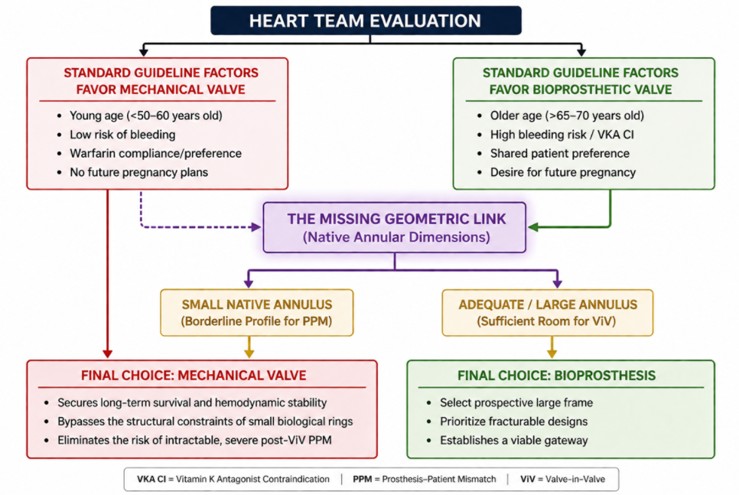
Figure 1. Conceptual Framework for Patient-Centered Strategic Prosthetic Valve Selection. The decision-making process integrates established consensus parameters (chronological age, bleeding risk, frailty, and anticoagulation tolerance) with the geometric footprint of the patient's native anatomy [1–3]. In small native rings where future ViV interventions carry an elevated risk of severe prosthesis-patient mismatch (PPM), mechanical platforms represent an evidence-based endpoint to support long-term survival and hemodynamic stability when anticoagulation is feasible [3,5]. Conversely, in adequate or large annular dimensions, a biological approach provides a forward-looking option, provided that expansion-friendly or fracturable frames are prospectively selected to facilitate future transcatheter interventions [4,10].
Note: This algorithm serves as a proposed conceptual framework and requires further prospective clinical validation. (Source: Designed and created by the authors).
In this patient-centered approach, individual clinical characteristics—including chronological age, life expectancy, bleeding risk, frailty, ability to tolerate long-term anticoagulation, and patient preference—remain the essential foundation of shared decision-making [1–3]. Anatomical footprint is then evaluated as a critical geometric link: in adequate or large annuli, a bioprosthetic approach offers a suitable gateway for future transcatheter options, provided that expansion-friendly or fracturable platforms are selected prospectively [4,10]. Conversely, in small native rings where a primary bioprosthesis poses a high risk of severe PPM or rendered ineffective for sequential ViV [4,6], a mechanical valve represents a rational, evidence-based alternative to secure long-term hemodynamic stability whenever anticoagulation is feasible [3,5].
We emphasize that this algorithm represents a proposed conceptual framework derived from hydrodynamic models and observational clinical data; as such, prospective clinical validation remains necessary to evaluate its long-term efficacy and impact on patient-centered outcomes.
Conclusion
Surgical valve replacement and transcatheter interventions should be viewed as sequential, complementary chapters in a patient's lifelong cardiovascular care. To maximize the effectiveness of transcatheter ViV procedures, the primary surgical choice must be strategically selected. Heart Teams should collaborate closely to ensure that the primary prosthetic footprint implanted today—whether a mechanical valve in a small annulus or an expansion-friendly bioprosthesis in a larger annulus—establishes a hemodynamically viable foundation for potential future interventions. Prospective clinical studies remain necessary to formally validate the long-term clinical outcomes of this conceptual framework.
Declarations
Ethics approval and consent to participate
Not applicable.
Consent for publication
Not applicable.
Availability of data and materials
Data sharing is not applicable to this article as no new primary empirical datasets were generated or analyzed during the current study.
Competing interests
The authors declare that they have no competing interests.
Funding
No funding was received for this study.
Authors' contributions
CCC, JLO Jr, and SOC conceptualized the study, performed the literature review, drafted the original manuscript, and critically revised the text. All authors read and approved the final manuscript.
Acknowledgements
None.
References
2. Vahanian A, Beyersdorf F, Praz F, Milojevic M, Baldus S, Bauersachs J, et al. 2021 ESC/EACTS Guidelines for the management of valvular heart disease. Eur Heart J. 2022 Feb 12;43(7):561–632.
3. Goldstone AB, Chiu P, Baiocchi M, Lingala B, Patrick WL, Fischbein MP, et al. Mechanical or Biologic Prostheses for Aortic-Valve and Mitral-Valve Replacement. N Engl J Med. 2017 Nov 9;377(19):1847–57.
4. Cardoso CC, Gaia DF, Palma JH, Oliveira Jr JL. The End of Repeated Reoperations for Degenerated Bioprosthesis? Hydrodynamic In-Vitro Analysis for Sequential Valve-in-Valve Feasibility. J Clin Exp Cardiolog. 2024 Sep;15:912.
5. Cardoso CC. Should the cardiac heart valve prosthesis type choice also consider the valve size at the intraoperatively? Commentary on recent researches about sequential valve-in-valve. Int J Cardiol Cardiovasc Dis.2025;5(1):6–8.
6. Pibarot P, Simonato M, Barbanti M, Linke A, Kornowski R, Rudolph T, et al. Impact of Pre-Existing Prosthesis-Patient Mismatch on Survival Following Aortic Valve-in-Valve Procedures. JACC Cardiovasc Interv. 2018 Jan 22;11(2):133–41.
7. Truesdell W, Ghita C, Green C, Knauer H, Yang B, Burris NS. Changes in aortic root dimensions post aortic root enlargement with Y-incision and modified aortotomy. Ann Cardiothorac Surg. 2024 May 31;13(3):266–74.
8. Rocha RV, Manlhiot C, Feindel CM, Yau TM, Mueller B, David TE, et al. Surgical Enlargement of the Aortic Root Does Not Increase the Operative Risk of Aortic Valve Replacement. Circulation. 2018 Apr 10;137(15):1585–94.
9. Tanaka D, Vervoort D, Mazine A, Elfaki L, Chung JCY, Friedrich JO, et al. Early and mid-term outcomes of aortic annular enlargement: a systematic review and meta-analysis. Ann Cardiothorac Surg. 2024 May 31;13(3):187–205.
10. Allen KB, Chhatriwalla AK, Saxon JT, Huded CP, Sathananthan J, Nguyen TC, Whisenant B, Webb JG. Bioprosthetic valve fracture: a practical guide. Ann Cardiothorac Surg. 2021 Sep;10(5):564–70.