

Abstract
This commentary outlines the research background of the paper “Berufliche Identitätsarbeit als subjektzentrierter Paradigmenwechsel einer transformativen Berufsbildung für nachhaltige Entwicklung (BBNE)” [Vocational identity work as a subject-centered paradigm shift in transformative VET for ESD] and examines its implications for health promotion in vocational education and training (VET). It focuses on the health-promoting potential of identity-based VET didactics within dual systems such as in Germany and introduces relevant theoretical, methodological, and didactic approaches. Identity development is understood as the reflection and shaping of the dynamic relationship between individuals and their social environment, which influences sustainable and health-related behavior.
Theoretically, the author demonstrates the compatibility of key VET concepts such as vocational action competence and vocational identity with Aaron Antonovsky’s concept of the salutogenic sense of coherence. Empirically, she highlights the challenges young people face in achieving a satisfactory person–environment fit during the transition to working life. Based on evidence that a strong person–environment fit enhances well-being, she argues that identity-based didactics can support learners in managing these developmental tasks. Considering current approaches to health promotion in VET regulations, institutions, research, and didactics, the commentary assesses prospects for systematic implementation. It concludes with an outlook on a forthcoming design-based research program on mental health in VET, aimed at developing health-promoting didactics within teacher education and preparing future multipliers for VET schools.
Keywords
Career guidance, Education for sustainable development (ESD), Identity development, School-to-work-transition, Vocational education and training (VET), Youth mental health
Theoretical Approach: A Salutogenetic Approach and Identity-Based Didactics
In Germany, VET curricula define vocational action competence as the overarching goal of vocational education and training. It refers to an individual’s willingness and capacity to act reflectively and in a socially responsible manner in vocational, societal, and private contexts [37]. Accordingly, learners must not only perform professional tasks but also internalize norms, rules, and moral principles guiding their actions in everyday life, including responsibility for their own health and well-being [37].
The World Health Organization (WHO) defines mental health as a state of physical, psychological, and social well-being rather than merely the absence of disease [38]. Its action plan promotes a holistic, multi-level approach addressing policy, everyday environments such as workplaces and schools, target groups, competencies, and the healthcare system. It emphasizes that both individual behavior and structural conditions must be considered. Pedagogically, this highlights the need to reflect on and shape the person–environment fit, thereby supporting identity development.
Traditional medicine and work psychology seek to identify environmental and individual determinants of health and illness [39], for example in studies by the Bundesanstalt für Arbeitsschutz und Arbeitsmedizin (BAuA) [40]. These inform evidence-based prevention and health promotion strategies. While prevention aims to avoid illness, health promotion fosters self-determined, health-oriented behavior [41]. Accordingly, programs either improve working conditions and/or strengthen individual resilience [22]. However, such approaches are criticized for often neglecting environmental factors [41]. A sole focus on behavior and resilience can frustrate learners or increase pressure to self-optimize when they face unhealthy conditions but cannot change them [42,43]. Such dynamics partly explain the discrepancy between health-related knowledge and intentions and observable behavior [16].
Moreover, health promotion strategies are often standardized and insufficiently tailored to specific occupations [22], although health risks differ across sectors such as business, nursing, or crafts and require specific expertise. At the same time, potential health-promoting effects of core VET concepts are often overlooked. Expanding vocational action competence can help individuals cope with challenges and reduce stress [44]. Career guidance can lay the foundation for a life design that fits subjective needs and ambitions [45], while social competencies enable individuals to assert and negotiate their interests, improving the person–environment fit [46,47].
Against this background, salutogenic approaches are particularly suitable, as they explain health differences through biographical development. Aaron Antonovsky introduced a paradigm shift by focusing on how health is generated rather than how illness is prevented [48]. Studying individuals who remained healthy despite adversity–for example holocaust survivors–he identified a biographically shaped sense of coherence, enabling people to perceive their environment as comprehensible, manageable, and meaningful [18,48]. This sense of coherence is grounded in personal resources, attitudes, and coping strategies developed over the life course.
Salutogenesis provides a suitable foundation for health-promoting VET didactics for three reasons. First, VET and work are key socialization contexts that can foster a sense of coherence. Second, vocational action competence reflects its core components: VET enables individuals to comprehend and manage their professional field. This is also a source of meaning as VET supports people to assume a vocational role in society. Third, salutogenic coherence aligns with identity-based didactics. Identity work helps individuals understand and manage the relationship between self and environment [2], establish coherence across life domains [18], and construct a biographical self-project perceived as meaningful [49]. Thus, strong links exist between salutogenic coherence, identity, and vocational action competence.
Selecting an appropriate identity theory is essential, as different approaches emphasize different aspects (for more details cf. [3,19]). For VET and mental health, interactionist approaches are particularly relevant because they focus on the interplay between individuals and their social environments. George Herbert Mead conceptualized identity as emerging through social interaction [50]. Building on this, Lothar Krappmann and Erving Goffman highlight that the quality of interactions shapes the extent to which individuals can express and develop their identity [46,47]. The better the alignment between a person’s abilities, aspirations, and values and their environment, the more likely they are to use their talents in meaningful ways [2–6,18].
Figure 1 [1, p. 282] illustrates how individuals interact with their environment. They are expected to present a socially accepted self-concept (Figure 1, left column), which is required for recognition and social integration. Individuals observe and perceive whether their behavior and possible options are socially valued and receive feedback on their fit with the environment. However, this social self-concept may differ considerably from the personal self-concept (Figure 1, right column), which comprises abilities, values, aspirations, and dispositions [2,3]. To navigate this tension, individuals must reflect on their interactions and develop competencies that enable them to balance both sides of the self-concept, for example self-knowledge and knowledge about the world of work, clear goals, realism, self-esteem, and coping strategies (Figure 1, middle column; [51]). Lothar Krappmann emphasizes social competences such as self-presentation, role distance, tolerance of ambiguity, and empathy, alongside linguistic and social skills that allow individuals to shape interactions constructively. These processes operate not only cognitively but also at motivational and agentic levels (Figure 1; [51]).
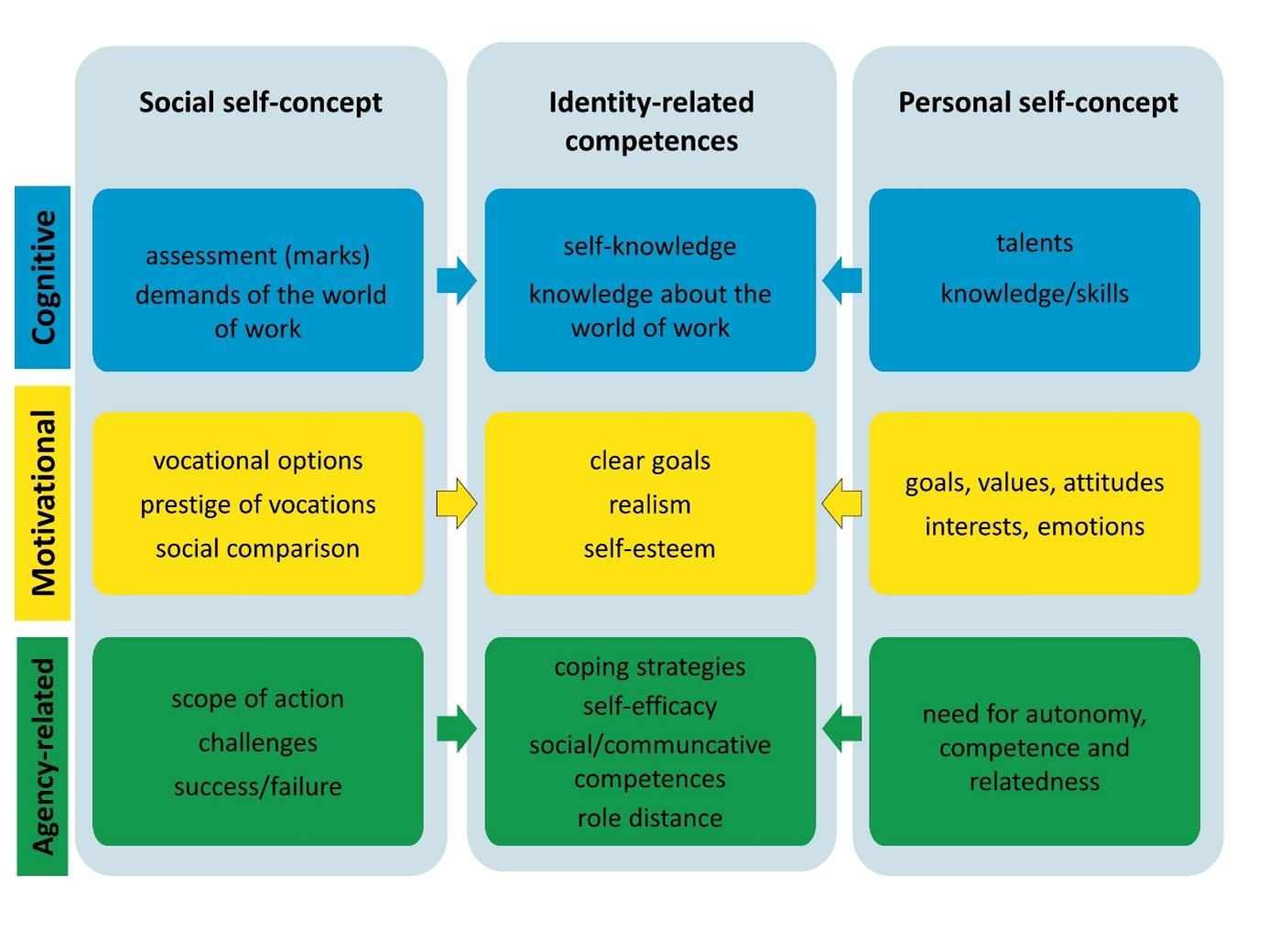
At the beginning of a career, young people experience major changes in roles and living conditions, such as leaving the parental home or earning their own income. This often creates a substantial gap between social and personal self-concepts. VET learners and teachers, thus face key developmental tasks aimed at reducing and balancing this gap. Qualitative studies across VET contexts consistently identify four central challenges [1,6–8,52,53].
Identification
Career starters must decide whether to remain in their chosen occupation or adjust their career path.
Shaping
If they remain, they need to actively shape their work environment and career trajectory to align professional demands with personal aspirations. This includes negotiating working conditions, managing work–life balance, choosing suitable workplaces, and developing a vocational self-concept and professional ethos that allow role distance while maintaining authenticity.
Competence development
Addressing these challenges requires professional, methodological, and personal competencies that expand individuals’ scope of action and enable creative problem-solving.
Recognition
Successfully managing these tasks increases the likelihood of recognition from supervisors, colleagues, customers, and peers. Conversely, lack of recognition e.g., due to envy, power abuse, or disregard can hinder the development of a stable vocational identity, making it necessary either to assert one’s need for recognition or to change workplaces.
Empirical studies provide illustrative case studies of these challenges among apprentices [1–3,6]. Case studies show that support needs vary depending on individual developmental problems: difficulties in shaping self-concepts, experiences of exploitation or stigmatization, lack of recognition of prior knowledge, searching for niches in demanding labor markets, or repeated failure and rejection [1–3,6]. Overall, qualitative research indicates that apprentices are often left to cope with these tasks largely on their own [1,6–10]. Awareness of discrepancies between personal and social self-concepts, along with identity-related competencies, can help learners manage stressors more consciously and develop individualized coping strategies. It may also enable them to articulate their needs and influence their social environment, or to initiate change within it [54,55]. Supporting learners in mastering these developmental tasks should therefore be a central objective of VET [1,2,6]. However, full alignment between social expectations and personal self-concepts is rarely achievable; identity balancing remains a lifelong process. In a dynamic world of work, learning to navigate these challenges is essential not only for entering employment but also for shaping long-term career trajectories [1].
This raises the question of how VET practice can be transformed to realize the health-promoting potential of identity-based approaches. The following chapter addresses this issue.
Introduction: The Health-Promoting Potential of Vocational Education and Training
The author is a German vocational education and training (VET) pedagogue and researcher with a particular interest in vocational identity development. She conceptualizes identity as a complex mental construct of the self, formed through meta-reflection on sequential situational experiences. Identity is understood as an essential prerequisite for action [1,2]. Identity development (also referred to as identity work or identity balance) denotes the lifelong process through which individuals reflect on their relationship with their environment and seek a meaningful place in society [2].
The author has investigated how apprentices in the retail sector cope with workplace challenges [1–6]. Consistent with other qualitative studies, her findings indicate that apprentices face significant challenges that require didactic support in order to prevent dropouts and reduce mental stress [7–10]. As it is not possible to present all arguments and findings in this commentary, readers are referred to the cited publications for further details and relevant references.
VET for sustainable development is a field of research and practice that relates to the United Nations’ Sustainable Development Goals (SDGs) [11]. Education (SDG 4) is regarded as both a driver and a prerequisite of sustainable development, which depends on responsible and skilled individuals [11]. In this context, VET plays a crucial role, as many sustainability risks originate from economic activities. Sustainability encompasses not only ecological concerns but also economic and social dimensions. Mental health as part of the social dimension of sustainability is explicitly addressed in SDG 3 [11]. There is substantial evidence that sustainable behavior affects not only ecological and economic outcomes but also individual well-being [12].
While attending a conference on sustainability in VET, the author analyzed the current state of sustainability-oriented didactics [4]. She observed that didactic principles developed through various model projects have shifted from traditional action-oriented approaches toward more identity-based ones [13]. One explanation for this shift is a phenomenon also identified in health promotion: the gap between knowledge of sustainable or healthy behavior and actual behavior [14–16]. Hübner [16] argues that the relationship between the individual and their environment i.e., identity development is decisive for behavioral outcomes. Only when individuals experience incentives, rewards, or positive feedback are they likely to internalize sustainable or healthy behaviors as part of their identity [4]. In VET discourse, identity-based didactics are often described as subject-oriented; however, this term lacks precision, as virtually all didactic approaches claim to be subject-oriented. In this commentary, the term identity-based didactics is used to describe approaches that explicitly focus on the relationship between the individual and their environment [17]. Key characteristics of such approaches will be outlined in the methodological section.
The author assumes that identity-based didactics are also beneficial for mental health, as they enable learners to cope with conflicts, challenges, and crises that may lead to stress, anxiety, and alienation. Empirical findings by Keupp indicate strong correlations between well-being and identity development [18]. Numerous studies show that strong identification with one’s profession, organization, or work activity is associated with positive outcomes such as improved performance, greater well-being, better mental health, and higher customer satisfaction [1,19,20]. Identification can thus be seen as an indicator of person–environment fit. If VET succeeds in fostering learners’ identification with their occupation, it is likely to promote their mental health in a sustainable way. However, studies in VET also reveal that identification is often low across many occupations and tends to decline over the course of an apprenticeship [1,21]. To date, health promotion concepts have played only a minor role in German VET for sustainable development [22]. At the same time, mental health among young people is deteriorating. Even in general education, approximately half of all adolescents report psychosomatic complaints such as headaches, stomachaches, back pain, low mood, irritability, nervousness, sleep difficulties, and dizziness [23,24]. Studies indicate that 20–25% of adolescents experience serious mental health problems, such as anxiety or depression, with an increasing trend [24,25]. Currently, anxiety related to multiple crises and increasing loneliness are contributing to this development [23–25]. Female and gender-diverse adolescents show significantly higher prevalence rates [23–25]. Research also demonstrates strong links between socioeconomic disadvantage and health problems [26,27], a finding of particular relevance for VET schools, where learners from diverse backgrounds are represented. Upon entering dual vocational training, many encounter demanding working conditions characterized by high rates of sick leave and staff shortages, potentially creating a cycle of stress [28]. In addition, intergenerational tensions regarding issues such as pension systems, climate policy, compulsory service, and work ethics further shape young people’s experiences [29–32].
The situation is further compounded by the fact that many teachers, student teachers, and trainee teachers also experience health problems due to academic and occupational stress. Teachers face multiple stressors, and learners’ behavior in increasingly heterogeneous classrooms is often perceived as particularly challenging [33,34]. Although teachers are expected to develop inclusive teaching competencies, many feel insufficiently prepared [33]. As a result, the quality of interaction between teachers and learners plays a crucial role in the well-being of all involved [35].
This commentary aims to explore the health-promoting potential of identity-based VET didactics. This issue is particularly relevant for stakeholders in teacher education and didactics, policymakers responsible for health promotion, and professionals in adolescent psychiatry. The German dual VET system is internationally recognized for its effectiveness in meeting labor market demands, as comprehensive, multi-purpose qualifications contribute to low youth unemployment rates [36]. Moreover, dual VET systems provide structured opportunities to reflect on workplace experiences within vocational schools. The author assumes that this may also offer specific health-related benefits that are not yet sufficiently addressed in existing health promotion concepts.
To examine this potential, the author draws on theoretical connections between identity development, vocational action competence, and Antonovsky’s salutogenic approach. The commentary then outlines the current state of health promotion and identity-based didactics in VET and concludes with a discussion of the opportunities and limitations associated with implementing identity-based health promotion in this context.
Methodological Approach: Possible Implementation of Health-Promoting VET Didactics
For this purpose, different systemic levels must be considered: curricula and regulations, VET institutions, as well as research and didactics [38].
VET curricula and regulations
As noted, VET curricula already include health promotion [37], and the Federal Institute for Vocational Education and Training (BIBB) requires its integration into new curricula [56]. Companies in the dual system must also comply with the Arbeitsschutzgesetz [57]. However, health promotion is still largely understood as preventing accidents and occupational diseases. A broader understanding, aligned with the WHO [38], is needed. Although current regulations do not fully reflect this, they do not prevent stakeholders from adopting more holistic approaches.
VET institutions
VET schools and training companies can receive funding for prevention programs aimed at becoming “healthy organizations” [58,59]. However, funding structures are complex, and requirements set by statutory health insurance providers are often rigid and demanding [22,58]. This can create additional burdens, particularly for already stressed participants. As a result, few schools engage in such programs, which are typically limited in duration and scope [22]. Consequently, the transfer of evidence-based concepts into practice remains limited. Embedding health promotion directly into curricula appears more sustainable and less burdensome.
VET research
There is still little evidence on mental health and health promotion in VET [22]. Youth health studies rarely provide separate data for VET learners, and new didactic approaches are seldom evaluated for health effects. Even scholars in related fields such as sustainable development rarely develop comprehensive health promotion concepts or collaborate with disciplines like psychology or occupational medicine [22].
At the same time, VET research already employs methodologies suited to practical change. Design-based research (DBR) is widely used in VET model projects and involves iterative, collaborative mixed-methods research in real-world settings [60,61]. Interventions are theory-driven, empirically tested, and continuously refined, aiming at both practical impact and theoretical advancement.
VET didactics
In the dual system, didactics often focus on vocational competencies and objective occupational demands, reflecting an objectified understanding of action theory. Subjective dimensions of agency receive less attention [1,2,6–10], although they are increasingly important in a dynamic labor market with rapidly changing demands. At the same time, dropout rates remain high, and many school leavers do not meet entry requirements for apprenticeships [62]. These learners often enter preparatory programs, where mental health problems are particularly prevalent [44,63,64], reflecting broader links between socio-economic disadvantage and health according to existing evidence [26,27]. Identity-based didactics are mainly applied in such preparatory contexts, extending career guidance from general education [44,63–65].
However, these approaches may also help learners in the dual system cope with workplace challenges. The author therefore proposes several recommendations [1, 6]: workplace challenges should be treated as learning opportunities, allowing reflection on critical incidents such as conflicts or lack of recognition. Greater attention must be paid to learners’ biographies, especially when they enter occupations involuntarily–a known risk factor for dropout [66]. Learners need opportunities to reflect on the subjective value of their training and to develop strategies for pursuing professional goals, for instance through expansive learning goals that broaden their scope of action [55]. Social competencies, though central in work contexts, are rarely addressed in relation to identity. Learners should experience them as resources for pursuing their own interests and maintaining well-being [1,6]. In addition, learning environments must foster trustful interaction and constructive feedback among all participants. The author proposes Theme-Centered Interaction (TCI) as a group-based pedagogical approach that balances individual needs, group dynamics, and task requirements [1,2,67]. Originally developed in psychotherapy, TCI can support the discussion of real-life challenges and expand learners’ scope of action.
Discussion
VET is a key field for promoting youth mental health and sustainable working lives. As many school leavers already face mental health challenges, both preventive and therapeutic approaches are necessary. However, many VET scholars feel insufficiently qualified to address these issues, making interdisciplinary collaboration essential particularly with psychotherapy, occupational psychology, and occupational medicine. Identity-based approaches are promising as lined out in this commentary but require empirical backing to reinforce their application in real-world settings.
Accordingly, a new interdisciplinary research team funded by the Federal Ministry of Labour and Social Affairs (BMAS, FOGA program) will be established at Leuphana University Lüneburg to develop health-promoting identity-based didactics and train future teachers [22]. The focus will be on intra-curricular approaches and teacher education. This is crucial because prospective teachers themselves are affected by mental health challenges [33,34], yet can act as multipliers if they learn to support both their own well-being and that of their students [22]. From a research perspective, a major goal is to produce empirical backing for the health-promoting effect of identity-based didactics by means of a complex mixed-methods design including scoping reviews, qualitative case studies, quantitative cross-sectional studies, curriculum mapping, cluster-randomized trials and focus groups.
To address existing research gaps, youth and health studies should report separate data for VET learners, and health-related outcomes should be routinely evaluated in VET research. Established well-being measures are readily available through research and clinical practice and might be adapted to VET purposes. Although identity-based didactics are increasingly applied, they are rarely assessed in terms of health effects. While DBR findings are context-dependent, they still provide valuable evidence for designing health-promoting VET environments. Compared to short-term projects, evidence-based curriculum development and didactics are likely to be more sustainable and cost-effective.
For therapeutic purposes, closer cooperation between therapists and VET teachers is needed to support career paths that foster identification and build on individual strengths. Case studies could help identify success factors and barriers for health-orientated career guidance and multiprofessional cooperation.
Overall, the proposed measures aim to initiate a continuous process in which VET stakeholders develop greater awareness of health issues. This is a key prerequisite for building the expertise required to ensure that VET contributes to the long-term mental health of both learners and teachers.
Author Contribution Statement
Christiane Thole is the sole author of this article.
Conflicts of Interest
The author declares there are no conflicts of interest.
Funding Statement
This research received so far no funding. The planned research group will be funded by the FOGA-Program (Forschung zur Gesundheit in der Arbeit) funded by the Bundesministerium für Arbeit und Soziales in Berlin/Bonn.
AI Statement
The content of this text has been conceived and written without any AI-tools. For linguistic and stylistic revision, the free browser version of Chat GBT has been applied with the following prompt: Please correct Germanisms in the following text and use academic language like a native speaker.
References
2. Thole CE, Tafner G. Fostering Vocational Identity Development in VET. International Journal of Vocational Education Studies. 2025 Sep 23;2(2):95–131.
3. Thole C. Theme-centered interaction and developmental tasks as research method and pedagogical tool regarding identity development in VET. Frontiers in Psychology. 2023 Oct 10;14:1201305.
4. Thole C. Berufliche Identitätsarbeit als subjektzentrierter Paradigmenwechsel einer transformativen Berufsbildung für nachhaltige Entwicklung (BBNE). In: Innovative Ansätze für die Nachhaltigkeitslehre und Forschung in der Hochschulbildung. Berlin, Heidelberg: Springer; 2025. pp. 39–55.
5. Tafner G, Thole C, Hantke H, Casper M. Paradoxien und Spannungsfelder in Beruf und Wirtschaft wirtschaftspädagogisch nutzen. In: Kögler K, Weyland U, Kremer H-H, editors. Jahrbuch der berufs-und wirtschaftspädagogischen Forschung 2022 [Yearbook of Vocational and Business Education Research 2022]. Opladen, Berlin, Toronto: Barbara Budrich; 2022. pp. 13–36
6. Thole C. ET2020: Vocational identity development as remaining major challenge. Berufs- und Wirtschaftspädagogik online 2020 [cited 2026 Feb 15]; (39):1–33. Available from: https://www.bwpat.de/ausgabe39/thole_bwpat39.pdf
7. Kutscha G, Besener A, Debie SO. Probleme der Auszubildenden in der Eingangsphase der Berufsausbildung im Einzelhandel - ProBE: Abschlussbericht und Materialien zum Forschungsprojekt. [Problems faced by trainees in the initial phase of vocational training in the retail sector - ProBE: Final report and materials on the research project.] Essen: Univ. Duisburg-Essen; 2009 [cited 2026 Apr 23]. Available from: https://duepublico2.uni-due.de/servlets/MCRFileNodeServlet/duepublico_derivate_00023467/media/bericht/Projektbericht.pdf
8. Duemmler K, Caprani I, Felder A. Berufliche Identität von Lernenden im Detailhandel: Studienergebnisse und Schlussfolgerungen für die Berufsbildung - ein Ratgeber für Lehrpersonen und Berufsbildner/-innen. [Professional identity of learners in the retail trade: Study results and conclusions for vocational education - a guide for teachers and vocational trainers.] Eidgenössisches Hochschulinstitut für Berufsbildung; 2017 [cited 2026 Aug 23]. Available from: http://www.ehb.swiss/Ratgeber_BI
9. Lange S. Die Berufsausbildungseingangsphase. Anforderungen an Azubis und ihre Bewältigungsstrategien am Bsp. des Kfz-Mechatronikerhandwerks. [The initial phase of vocational training: Requirements for trainees and their coping strategies, using the automotive mechatronics trade as an example.] Bielefeld: wbv Publikation; 2019.
10. Arianta K. Zwischen Bleibe- und Ausstiegsintentionen. Die Entwicklung pflegeberuflicher Aspirationen bei Pflegeauszubildenden im ersten Ausbildungsjahr. [Between intentions to stay and intentions to leave: The development of nursing career aspirations among nursing trainees in their first year of training.] Wiesbaden: Springer Fachmedien Wiesbaden; 2024.
11. United Nations – General Assembly. Transforming our world: the 2030 Agenda for Sustainable Development: Resolution adopted by the General Assembly on 25 September 2015. New York; 2015 A/RES/70/1 [cited 2024 Nov 8]. Available from: https://documents.un.org/doc/undoc/gen/n15/291/89/pdf/n1529189.pdf
12. Zawadzki, SJ, Steg L, Bouman T. Meta-analytic evidence for a robust and positive association between individuals' pro-environmental behaviors and their subjective wellbeing. Environmental Research Letters. 2020;15:123007.
13. Schütt-Sayed S, Casper M, Vollmer T. Mitgestaltung lernbar machen – Didaktik der Berufsbildung für nachhaltige Entwicklung. [Making participation learnable – Didactics of vocational education for sustainable development.] In: Melzig C, Kuhlmeier W, Kretschmer S, editors. Berufsbildung für nachhaltige Entwicklung: Die Modellversuche 2015-2019 auf dem Weg vom Projekt zur Struktur. [Vocational education for sustainable development: The model projects 2015-2019 on the way from project to structure. ] Bonn: Bundesinstitut für Berufsbildung; 2021. p. 200–30.
14. McGinty EE, Alegria M, Beidas RS, Braithwaite J, Kola L, Leslie DL, et al. The Lancet Psychiatry Commission: transforming mental health implementation research. Lancet Psychiatry. 2024;11(5):368–96.
15. Rebmann K, Slopinski A. Zum Diskrepanztheorem der (Berufs-)Bildung für eine nachhaltige Entwicklung. [On the discrepancy theorem of (vocational) education for sustainable development.] In: Schlicht J, Moschner U, editors. Berufliche Bildung an der Grenze zwischen Wirtschaft und Pädagogik: Reflexionen aus Theorie und Praxis. [Vocational education at the border between business and pedagogy: Reflections from theory and practice.] Wiesbaden: Springer VS; 2018. p. 73–90.
16. Hübner G. Vom Wissen zum Handeln: Strategien zur Förderung naturverträglichen Verhaltens. [From knowledge to action: Strategies for promoting environmentally friendly behavior.] In: Erdmann K-H et al., editor. Natur zwischen Wandel und Veränderung: Ursachen, Wirkungen, Konsequenzen. [Nature between change and transformation: causes, effects, consequences] Berlin, Heidelberg, New York, Barcelona, Hongkong, London, Mailand, Paris, Singapur, Tokio: Springer; 2002. p. 193–212.
17. Tafner G, Thole C. Subjektorientierung in der Wirtschaftspädagogik. [Subject orientation in business education.] In: Stock M, Slepcevic-Zach P, Tafner G, Riebenbauer E, editors. Wirtschaftspädagogik. [cited 2026 Apr 20], p. 527–36. Available from: https://static.uni-graz.at/fileadmin/_files/_sowi_sites/_wirtschaftspaedagogik/Wipaedbuch/wirtschaftspaedagogik_lehrbuch_3-aufl_stock_slepcevic-zach_tafner_riebenbauer.pdf
18. Keupp H. Gesundheitsförderung als Identitätsarbeit. [Health promotion - an issue of active identity formation.] ZBBS. 2006;7(2):217–36.
19. Heinrichs K, Wuttke E, Kögler K. Berufliche Identität, Identifikation und Beruflichkeit – Eine Verortung aus der Perspektive einer theoriegeleiteten empirischen Berufsbildungsforschung. [Vocational identity, identification and professionalism – A positioning from the perspective of theory-driven empirical vocational education research.] bwp@ Berufs- und Wirtschaftspädagogik - online 2022 [cited 2026 Jan 9]; (Profil 7):1–29. Available from: https://www.bwpat.de/profil7_minnameier/heinrichs_etal_profil7.pdf
20. Nerdinger FW. Psychologie der Dienstleistung. [Psychology of Service.] Göttingen: Hogrefe; 2011.
21. Heinemann L, Maurer A, Rauner F. Engagement und Ausbildungsorganisation - Einstellungen Bremerhavener Auszubildender zu ihrem Beruf und ihrer Ausbildung: Eine Studie im Auftrag der Industrie und Handelskammer. [Engagement and training organization - Bremerhaven trainees' attitudes towards their profession and their training: A study commissioned by the Chamber of Industry and Commerce.] Bremerhaven: Universität Bremen i:bb; 2009 [cited 2026 Apr 23]. Available from: https://www.researchgate.net/publication/285740129_Engagement_und_Ausbildungsorganisation_-_Einstellungen_Bremerhavener_Aus-_zubildender_zu_ihrem_Beruf_und_ihrer_Ausbildung
22. Thole C, Kähler A-F, Pargmann J, Kick C. Gesundheitsförderung als Berufsbildung für nachhaltige Entwicklung – ein noch zu elaborierendes Konzept. [Health promotion as vocational training for sustainable development – a concept that still needs to be elaborated.] Berufs- und Wirtschaftspädagogik online 2026 im Erscheinen; (Spezial Hochschultage Berufliche Bildung Paderborn).
23. Hanewinkel R, Hansen J, Neumann C. Gesundheit und Gesundheitsverhalten von Kindern und Jugendlichen in Deutschland – Ausgewählte Ergebnisse des Präventionsradar 2024/2025. [Health and health behavior of children and adolescents in Germany – Selected results of the Prevention Radar 2024/2025.] Kiel; 2025 [cited 2025 Apr 26]. Available from: https://caas.content.dak.de/caas/v1/media/146450/data/57c4360d8a2b6b8ec5ac94c98f07e7ab/praeventionsradar-ergebnisbericht-2024-2025.pdf
24. Reiß F, Behn S, Erhart M, Strelow L, Kaman A, Ottova-Jordan V, et al. Subjective health and psychosomatic complaints of children and adolescents in Germany: Results of the HBSC study 2009/10–2022. In: Ziese T, Saß A-C, Groth M, Gutsche, Johanna: Hintzpeter, Birte, Ryl L, editors. The World Health Organization's Health Behaviour in School-aged Children (HBSC) Study – Survey Results from Germany 2022 and Trends. Berlin: Robert Koch-Institut; 2024. p. 7–22.
25. Kaman A, Devine J, Napp A-K, Reiss F, Moeller S, Zoellner F et al. Youth Mental Health in Times of Global Crises: Evidence from the Longitudinal COPSY Study: PREPRINT 2024. Available from: ssrn.com/abstract=5043077.
26. Moor I, Herke M, Markert J, Böhm M, Reiß F, Bilz L et al. Trends in health inequalities in childhood and adolescence in Germany: Results of the HBSC study 2009/10– 2022. In: Ziese T, Saß A-C, Groth M, Gutsche, Johanna: Hintzpeter, Birte, Ryl L, editors. The World Health Organization's Health Behaviour in School-aged Children (HBSC) Study – Survey Results from Germany 2022 and Trends. Berlin: Robert Koch-Institut; 2024. p. 79–98.
27. Dahlgren G, Whitehead M. Policies and strategies to promote social equity in health: Background document to WHO - Strategy paper for Europe. Stockholm: Institute for FUTURES STUDIES; 1991 [cited 2026 Apr 26]. Available from: https://www.iffs.se/en/publications/working-papers/policies-and-strategies-to-promote-social-equity-in-health/
28. Hildebrandt S, Dehl T, Zich K, Nolting H-D. Analyse der Arbeitsunfähigkeiten: Gesundheitsrisiko Personalmangel: Arbeitswelt unter Druck. [Analysis of work incapacity: Health risk of staff shortages: Working world under pressure.] medhochzwei Verlag GmbH; 2023. [cited 2026 Apr 23] Available from: https://caas.content.dak.de/caas/v1/media/34600/data/3bf3cdb115a277d604678cf6e8661d0b/gesundheitsreport2023-ebook.pdf
29. Aprea C, Baginski, Ronja, Schütz, Jana, Übelmesser S. Verständnis, Haltungen, und Reformpräferenzen zur Altersvorsorge in Deutschland: Gibt es einen Generationenkonflikt? [Understanding, attitudes, and reform preferences regarding retirement provision in Germany: Is there a generational conflict?] [Working Paper]. Mannheim: Universität Mannheim; 2025. [cited 2026 Apr 26] Available from: https://www.uni-mannheim.de/media/Lehrstuehle/bwl/Aprea/Dokumente/Aprea_et_al._2025_Gibt_es_einen_Generationenkonflikt.pdf
30. Schalin A. An inevitable conflict? A scoping review of climate change and generations. Environmental Sociology. 2025; 1–13.
31. Dollmann J, Jacobsen J, Köhler J, Boerschmann V, Lietz A, Zimmermann S. Rückkehr zur Wehrpflicht?: Wie junge Menschen über Wehrpflicht, Dienstbereitschaft und alternative Gesellschaftsdienste denken. [Return to conscription?: How young people think about conscription, readiness for service and alternative social services.] Berlin; 2025. DeZIM Data.insights [cited 2026 Jan 10]. Available from: https://www.dezim-institut.de/fileadmin/user_upload/fis/publikation_pdf/FA-6463.pdf
32. Hellwagner T, Weber E. Generation Z – noch ein Klischee weniger. [Generation Z – one less cliché.] Nürnberg: Institut für Arbeitsmarkt- und Berufsforschung; 2025. IAB-Forum. Available from: https://doi.org/10.48720/IAB.FOO.20250217.01
33. Jude N, Klusmann U, Richter D, Selcik F, Sichma A. Deutsches Schulbarometer – Befragung Lehrkräfte_2025. [German School Barometer – Survey of Teachers_2025.] Stuttgart; 2025 [cited 2025 Sep 19]. Available from: https://www.bosch-stiftung.de/sites/default/files/documents/2025-06/Deutsches%20Schulbarometer_Lehrkr%C3%A4fte_2025.pdf
34. Sappa V, Aprea C, Barabasch A. Widrigkeiten standhalten – Eine Schweizer Studie zur Resilienz von Lehrkräften in der beruflichen Bildung. [Withstanding adversity – A Swiss study on the resilience of teachers in vocational education.] BWP. 2018;(5):43–7.
35. Baumann E, Greiner-Döchert F, Rauschenbach A-L, Saalbach H, Schmitz J. Deutsches Schulbarometer: Befragung Schüler:innen. Ergebnisse von 8-17-jährigen und ihren Erziehungsberechtigten zu Wohlbefinden, Unterrichtsqualität, Partizipationsmöglichkeiten und (Cyber-)Mobbing. [German School Barometer: Survey of students. Results from 8-17 year olds and their parents/guardians on well-being, teaching quality, participation opportunities and (cyber)bullying.] Stuttgart: Robert Bosch Stiftung; 2026 [cited 2026 Apr 20]. Available from: https://www.bosch-stiftung.de/sites/default/files/documents/2026-03/Deutsches%20Schulbarometer%20Sch%C3%BCler_innen%202025_26_.pdf
36. Frick, F./Wieland, C./Thies, L. Zukunft unsicher - Jugendarbeitslosigkeit im Europäischen Vergleich. [Uncertain future - youth unemployment in European comparison.] Bertelsmann Stiftung; 2014 [cited 2026 Apr 23]. Available from: http://www.bertelsmann-stiftung.de/fileadmin/files/BSt/Publikationen/GrauePublikationen/GP_Zukunft_unsicher.pdf
37. Kultusministerkonferenz (KMK). Handreichung für die Erarbeitung von Rahmenlehrplänen der Kultusministerkonferenz für den berufsbezogenen Unterricht in der Berufsschule und ihre Abstimmung mit Ausbildungsordnungen des Bundes für anerkannte Ausbildungsberufe. [Guidelines for the development of framework curricula of the Standing Conference of the Ministers of Education and Cultural Affairs for vocational education in vocational schools and their coordination with federal training regulations for recognized training occupations.] KMK; 2021 [cited 2022 Oct 22]. Available from: https://www.kmk.org/fileadmin/veroeffentlichungen_beschluesse/2021/2021_06_17-GEP-Handreichung.pdf
38. World Health Organization (WHO). Comprehensive Mental health action plan 2013-2030: Department of Mental Health and Substance Use; 2021 [cited 2024 Aug 13]. Available from: https://www.who.int/publications/i/item/9789240031029
39. Vinje HF, Langeland E, Bull T. The Handbook of Salutogenesis: Aaron Antonovsky’s Development of Salutogenesis, 1979 to 1994. In: Mittelmark MB, Sagy S, Eriksson M, Bauer G, Pelikan JM, Lindström B et al., editors. The handbook of salutogenesis. Cham: Springer; 2017. p. 25–40.
40. Rothe I, Adolph L, Beermann B, Schütte M, Windel A, Grewer A et al. Mental health in the working world: Determining the current state of scientific evidence. Dortmund/Berlin/Dresden: Bundesanstalt für Arbeitsschutz und Arbeitsmedizin; 2017 [cited 2024 Nov 8]. Available from: https://www.baua.de/DE/Angebote/Publikationen/Berichte/Psychische-Gesundheit
41. Gerlinger T. Präventionsgesetz. [Prevention Act.] In: Bundesinstitut für Öffentliche Gesundheit [Federal Institute für public health], editor. Leitbegriffe der Gesundheitsförderung und Prävention: Glossar zu Konzepten, Strategien und Methoden. [Key terms in health promotion and prevention: Glossary of concepts, strategies and methods.] Köln; 2025.
42. Honneth A. Organisierte Selbstverwirklichung: Paradoxien der Individualisierung. [Organized self-realization: Paradoxes of individualization.] In: Honneth A, editor. Befreiung aus der Mündigkeit: Paradoxien des gegenwärtigen Kapitalismus. [Liberation from Maturity: Paradoxes of Contemporary Capitalism.] Frankfurt/Main [u.a.]: Campus-Verl.; 2002. p. 141–58.
43. Hiestand S, Giessler W, Wegemann F, Nothstein N. Zwischen Verlust und Fortschrittsparadigma – berufspädagogische Implikationen für eine nachhaltige Entwicklung in der Langzeitpflege. [Between loss and the progress paradigm – vocational education implications for sustainable development in long-term care.] In: Schlicht J, Kaiser S, Schwehm F, editors. Innovation für Nachhaltigkeit durch berufs- und wirtschaftspädagogische Forschung. [Innovation for sustainability through vocational and business education research.] Bielefeld: wbv; 2025. p. 317–32.
44. Sturm H. Berufsvorbereitung: eine komplexe Entwicklungsaufgabe. [Career preparation: a complex developmental task.] Impulse 2008 [cited 2026 Apr 23]; (45):30–3. Available from: https://daten2.verwaltungsportal.de/dateien/seitengenerator/2dfbfa463a4d7f71be425968cfed6a22203482/impulse45-web.pdf
45. Savickas M. Life Design: A Paradigm for Career Intervention in the 21st Century. Journal of Counseling & Developing 2012;90(January):13–9.
46. Krappmann L. Soziologische Dimensionen der Identität: Strukturelle Bedingungen für die Teilnahme an Interaktionsprozessen. [Sociological dimensions of identity: Structural conditions for participation in interaction processes.] 4. Aufl., Erstauflage 1969. Stuttgart: Klett-Cotta; 1975.
47. Goffman E. The presentation of self in everyday life. 1st Anchor books edition. New York: Anchor Books; 1959.
48. Antonovsky, A. Unraveling the mystery of health: How people manage stress and stay well. 1987. San Francisco: Jossey-Bass.
49. Giddens A. Modernity and self-identity: Self and society in the late modern age. repr. Cambridge: Polity Press; 1991.
50. Mead GH. Mind, self, and society: From the standpoint of a social behaviorist. Paperback ed. 1967. Chicago: Univ. of Chicago Press; 1934.
51. Driesel-Lange K, Hany E, Kracke B, Schindler N. Berufs- und Studienorientierung Erfolgreich zur Berufswahl. Ein Orientierungs- und Handlungsmodell für Thüringer Schulen: Berufs- und Studienorientierung. [Career and Study Orientation: Successful Career Choice. An orientation and action model for Thuringian schools: Career and Study Orientation.] 2010 [cited 2026 Apr 23]. Available from: https://www.schulportal-thueringen.de/media/detail?tspi=2049
52. Gruschka A. Wie Schüler Erzieher werden: Studie zur Kompetenzentwicklung und fachlichen Identitätsbildung in einem doppeltqualifizierenden Bildungsgang des Kollegschulversuchs NW. [How students become educators: Study on competence development and professional identity formation in a dual-qualification educational program of the NW college school experiment.] Wetzlar: Büchse der Pandora; 1985.
53. Hericks U. Professionalisierung als Entwicklungsaufgabe: Rekonstruktionen zur Berufseingangsphase von Lehrerinnen und Lehrern. [How students become educators: Study on competence development and professional identity formation in a dual-qualification educational program of the NW college school experiment.] Habil.-Schr. Hamburg, 2005. Wiesbaden: VS Verl. für Sozialwiss; 2006.
54. Giddens A. The Constitution of Society: Outline of the Theory of Structuration. Malden MA USA: Polity Press; 2017.
55. Holzkamp K. Lernen: Subjektwissenschaftliche Grundlegung. [Learning: Subject-scientific foundations.] Frankfurt/Main: Campus-Verl; 1995.
56. BIBB-Hauptausschuss. Erläuterungen zu den modernisierten Standardberufsbildpositionen. [Explanations regarding the modernized standard occupational profile positions.] 2021 [cited 2026 Apr 23]. Available from: https://www.bibb.de/dokumente/pdf/HA_Erlaeuterungen-der-integrativ-zu-vermittelnden-Fertigkeiten-Kenntnisse-und-Faehigkeiten.pdf
57. Gesetz über die Durchführung von Maßnahmen des Arbeitsschutzes zur Verbesserung der Sicherheit und des Gesundheitsschutzes der Beschäftigten bei der Arbeit. [Law on the implementation of occupational safety and health measures to improve the safety and health of employees at work.] (Arbeitsschutzgesetz - ArbSchG); 1996 [cited 2026 Jan 10]. Available from: https://www.bgbl.de/xaver/bgbl/start.xav?start=%2F%2F*%5B%40attr_id%3D%27I_1996_43_inhaltsverz%27%5D#/text/bgbl196s1246.pdf?_ts=1768301479532
58. Gesetz zur Stärkung der Gesundheitsförderung und der Prävention. [Law to strengthen health promotion and prevention.] (Präventionsgesetz): PrävG; 2015 [cited 2024 Sep 11]. Available from: https://www.bgbl.de/xaver/bgbl/start.xav?startbk=Bundesanzeiger_BGBl&jumpTo=bgbl115s1368.pdf#__bgbl__%2F%2F*%5B%40attr_id%3D%27bgbl115s1368.pdf%27%5D__1726056834410
59. GKV-Spitzenverband, Referat Prävention – Jens Hupfeld, Dr. Volker Wanek. Leitfaden Prävention – Handlungsfelder und Kriterien nach § 20 Abs. 2 SGB V zur Umsetzung der §§ 20, 20a und 20b SGB V. [Prevention guidelines – fields of action and criteria according to § 20 para. 2 SGB V for the implementation of §§ 20, 20a and 20b SGB V.] Berlin: GKV-Spitzenverband; 2025 [cited 2026 Jan 9]. Available from: https://www.gkv-spitzenverband.de/media/dokumente/krankenversicherung_1/praevention__selbsthilfe__beratung/praevention/praevention_leitfaden/20251218_Leitfaden_Pravention_2025_barrierefrei.pdf
60. McKenney S, Reeves TC. Educational design research for relevant & robust scholarship. J Comput High Educ 2025;37(2):614–38.
61. Reinmann G, Herzberg D, Brase A. Research through design in higher education. 2025. Available from: https://doi.org/10.25592/uhhfdm.17833
62. Bundesministerum für Bildung, Familie, Senioren, Frauen und Jugend. Berufsbildungsbericht 2025. [Vocational Training Report 2025.] 2025: BMBFSFJ Bundesministerum für Bildung, Familie, Senioren, Frauen und Jugend; Berlin [cited 2025 Feb 16]. Available from: https://www.bmbfsfj.bund.de/resource/blob/273880/f5330ba9181acb9f5bd87a69da672848/berufsbildungsbericht-2025-data.pdf
63. Kranert H-W, Stein R. Psychische Belastungen in der Berufsbiografie Konsequenzen für die berufliche Bildung. [Psychological stress in professional biography: Consequences for vocational training.] bwp@ Berufs- und Wirtschaftspädagogik - online 2023 [cited 2025 Mar 26]; (Spezial PH-AT2):1–23. Available from: https://www.bwpat.de/ausgabe/spezial-ph-at2/kranert-stein
64. Koch, M./Steuber, A./Meyer, R./Struck, P. "Inklusive Beruflichkeit" Zeitgenössische Anforderungen an eine lebensweltorientierte Berufliche Förderpädagogik. ["Inclusive Vocational Education": Contemporary requirements for a life-world-oriented vocational support pedagogy.] bwp@ Berufs- und Wirtschaftspädagogik - online 2017; (Spezial 15):1–28. Available from: https://www.bwpat.de/spezial15/koch_steuber_meyer_struck_spezial15.pdf
65. Kremer H-H, Frehe-Halliwell P, Laubenstein D, Kundisch H, editors. Didaktik in der Ausbildungsvorbereitung: Selbstinszenierungspraktiken als subjektorientierter Zugang (aus-) bildungsbenachteiligter Jugendlicher.[Didactics in vocational preparation: Self-presentation practices as a subject-oriented approach for educationally disadvantaged young people]. Bielefeld: Eusl, wbv Media; 2025.
66. Böhn S, Deutscher V. Dropout from initial vocational training – A meta-synthesis of reasons from the apprentice's point of view. Educational Research Review. 2022;35:100414.
67. Cohn RC. Von der Psychoanalyse zur themenzentrierten Interaktion: Von der Behandlung einzelner zu einer Pädagogik für alle. [From psychoanalysis to theme-centered interaction: From the treatment of individuals to a pedagogy for all.] 17. Aufl. 2013. Stuttgart: Klett-Cotta; 1975.