
Abstract
The death of a psychotherapy school founder offers unique insights into the relationship between theoretical constructs and lived experience. Dr. Nossrat Peseschkian, founder of Positive Psychotherapy, died peacefully in his sleep on April 27, 2010, at his home in Wiesbaden (Germany)—a death that reflected his Baha’i convictions, Balance Model, and transcultural life approach in a remarkable way. This study is based on personal conversations with Dr. Nossrat Peseschkian between 2003 and 2010, as well as an extensive interview with his son Dr. Hamid Peseschkian after his father's death. The study suggests that Peseschkian's dying was neither accidental nor purely biological, but probably represented the completion of a consciously lived life philosophy.
Keywords
Positive psychotherapy, Death and dying, Baha’i Faith, Transcultural psychotherapy, Balance model
Introduction
Positive psychotherapy (PPT after Peseschkian since 1977) has been in development since 1968 by Dr. Nossrat Peseschkian, based on the ideas of Abraham Maslow and Carl Rogers [1]. Being one of the first integrative and transcultural approaches, this novel approach entered popular use around the globe. In 1997, Peseschkian and colleagues were able to provide evidence for its effectiveness [2]. Till this day, this approach is in wide use, being recognized as a transcultural and unique modality, applied in Germany and used in other European countries like Bulgaria since 1992 and in China since 2014 [1].
Considering its wide-spread application, the death of Dr. Nossrat Peseschkian on April the 27th, 2010, shocked the academic world. As a "wanderer between two worlds" [3,p10], born in 1933 in Kashan, Iran and emigrated to Germany in 1954, the Bahai believer and psychotherapist spent his entire life trying to connect Eastern and Western wisdom [4]. His death might be interpreted as to complete this integration.
Thus, this article will explore Positive Psychotherapy (PPT) and will provide an overview of the Balance Model. This is followed by an exploration of the methods, a discussion, and the conclusion.
Overall, this paper will draw on Peseschkian’s biography and his spiritual influence on PPT to identify whether and to what extent a connection between Peseschkian's life philosophy and the way he died can be drawn.
Literature Review
Positive Psychotherapy (PPT)
PPT was one of the first modalities to include spirituality in its model as well as rejecting the biomedical approach to locating disorders within the individual [5]. It is founded on the latin word “positum”, meaning “reality”, factual, real, the whole [6]. Through this, Peseschkian established a theoretical foundation that included reality in its entirety – including the painful.
Based on humanistic philosophy [6, 7], the person as a whole is emphasised within its cultural environment through which conflicts, rather than disorders, are aimed to be solved [6]. Here, Peseschkian rejected the notion of diagnoses by rather placing emphasis on examining and mobilizing the individual with their personal strengths, resources, and capabilities [7]. Therefore, Peseschkian aimed to identify the reasons behind symptomatology and what they are trying to communicate rather than eliminating them [6]. In turn, within this modality, an individual’s conflict is perceived and reframed as a positive aspect that fosters growth and maturation (an introduction). Through this, positive qualities are fostered within the individual, ultimately fostering their capability to self-help [5,6].
The Balance Model
A central diagnostic tool utilized in PPT is the Balance Model, also referred to as the “diamond model” or “four dimensions of life” [8,p 161]. These are namely: Body and Health, Achievement and Work, Contact and Relationships, and Future, Meaning, and Spirituality (Figure 1) [8]. The first dimension refers to the relationship between the individual and their body as essential for their spiritual life [5]. The second dimension is defined as the success area, referring to their occupational success. Contact and Relationships is foregrounding the social relationships, while the last dimension – Future, Meaning, and Spirituality – refers to anything in the inner world [6]. Here, inner subconscious conflicts can cause symptoms [1], hence highlighting an orientation towards solutogenesis. This concept refers to the assumption of health being on a continuum, rather than a dichotomy between “health” and “disease” [9], showing overlap with the positive psychology approach by Martin Seligman [1]. Despite the overlap, clear distinctions remain, chiefly because PPT is applied as a transcultural, mental health, and psychosomatic treatment method based on humanistic backgrounds with a structured therapy process [1].
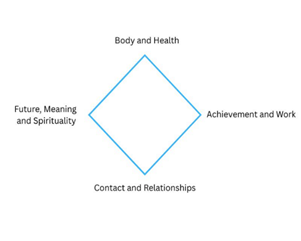
Figure 1. Balance Model. Adapted from: Gross W. Wie man lebt, so stirbt man: Vom Leben und Sterben großer Psychotherapeuten. Springer Verlag; 2021. Figure 1, Balance Model; p. 4.
It is theorized that an individual reaches well-being, resilience and life-satisfaction once the four dimensions are balanced [6–8]. If these, however, are imbalanced, inner conflict is caused, ultimately leading to illness [8]. Therefore, the Balance Model takes a vital role in counselling individuals through visualizing and exploring life patterns permitting introspection [7,8]. Today, it is used within one-on-one and family therapy, self-help and psychosomatic approaches, and counselling [1].
Baha’i belief and PPT
The Baha’i faith is the youngest monotheistic world religion and reports to have the most culturally diverse community around the globe [10]. It centralizes the aim of unifying humankind in diversity, establishing harmony between science and religion and prioritizes the importance of realization [10]. This establishes that happiness comes from helping others [10]. Similar to PPT, the Baha’i view of human nature is described as positive, resource–oriented, and salutogenic, highlighting commonalities between this belief and Peseschkian’s PPT [8]. This is further enshrined in Peseschkian’s theory of human nature. He proposed that every human is naturally born with two basic capacities: to love and to know. The former refers to emotionality, while the latter refer to rationality which was inspired by the Baha’i faith tradition [1].
Peseschkian’ s understanding
The principles of the Bahai faith permeated Peseschkian's life and work. Particularly relevant to his understanding of death are, according to Peseschkian and Peseschkian (2025):
- The fundamental dignity of human nature: "Regard man as a mine, rich in gems of inestimable value" (Bahá'u'lláh) [8,p 159].
- The harmony between science and religion.
- The unity of humanity across cultures and faiths.
- Death as transition to continued spiritual development.
These principles shaped his therapeutic approach of seeking abilities ("gems"), allowing him to distance himself from the biomedical model of pathology [7].
Baha’i practice prescribes that the deceased should be buried near the place of death, ideally not transported over long distances—a symbol for the integration of death into daily life rather than its segregation.
Transcultural dimension of death
Western psychotherapy views death predominantly through the lens of anxiety, loss, and finitude, exemplified in early theories [11,12] surrounding death and current research focusing on death anxiety [13–16]. Inter alia, Freud saw death as the ultimate antagonist of life which permeated his book “Beyond the pleasure principle” [12]. Contrastingly, existential therapists like Irvin Yalom emphasize death anxiety as a fundamental source of mental suffering [17–19]. Both highlight the influence of cultural values attached to death in their theories.
In contrast, Eastern philosophical traditions—including the Baha’i faith—understand death as transformation, as transition, as continuation of consciousness in another form [20]. The Baha’i writings state: "The next world differs from this world as much as this world differs from the child in the mother's womb." [18,19]. Consequently, death is birth into a new dimension—not an end.
Peseschkian’ s PPT integrated both perspectives. He acknowledged Western concerns about mortality but simultaneously integrated Eastern acceptance and transcendent understanding [4]. His therapeutic use of stories [1,7]—especially Oriental parables—often addressed death and transience in a way that transformed anxiety into acceptance [18,19].
Transcultural approach in PPT
Peseschkian made extensive use of stories, parables, and aphorisms in his therapeutic practice [1,7]. He believed that using stories and proverbs can change the worldview of the client, change how they perceive their situation, and how they perceive their symptomatology [1,21]. This is exemplified in the story: "Truth and the Parable" [22]. It illustrates how truth, clothed in colorful narrative form, gains reception that is denied to naked assertion. Another story—the Gardener and Death—depicts a gardener who flees Death, only to meet Death precisely where he sought refuge—reframing death anxiety through narrative recontextualization [22].
These stories serve a clinical as much as a personal function, as they aid in the association to the unconscious core, permitting the exploration and change of views, belief systems, and defense mechanisms [21]. This pedagogical choice itself manifests his theoretical principle: truth about mortality. Subsequently, acceptance, and meaning reaches deeper psychological levels when conveyed through narrative than through logical exposition alone. Henceforth, the narrative preparation for mortality occurred through stories about death, acceptance, and continuation of life create psychological preparation that is less threatening than direct intellectual confrontation with mortality [18,19,23].
Methodology
This paper aimed to identify Peseschkian's life philosophy and his own perception of his mortality, in terms of passing.
As I have known the Peseschkian family for a long time, I have engaged in many in-depth conversations with Dr. Nossrat Peseschkian between 2003 to 2010, his wife Manije and his son Hamid Peseschkian. One of these interviews was recorded on tape (2019).
This study was designed as qualitative exploratory research, utilizing interviews from the Peseschkian family to explore how Dr. Nossrat Peseschkian views and understandings of the world reflected in his teachings to compare it to his passing.
The accumulated data was then compared to the literature concerned with his teachings, philosophies, and biography. For this purpose, English and German sources were reviewed on the academic database Google Scholar. During the process of scanning articles, keywords relevant to the study were used and only fully accessible texts were included in the review. The inclusion criteria were: (1) published within the last 5 years, (2) addressing Peseschkian’s theories and biography, (3) having conceptual content related to Positive Psychotherapy, (4) being in peer-reviewed journals, (5) being reviewed books or book chapters. Exclusion criteria were publications that lacked scientific quality, and studies for which the full text was not accessible.
The appropriateness of the sources was established through a systematic screening process based on the key concepts. This ensured a comprehensive and consistent evaluation of the gathered literature. The literature was thoroughly read and afterwards summarised into bullet points. Following this, I colour-coded based on the following overarching keywords: (1) Positive Psychotherapy, (2) Balance Model, (3) Baha’i belief, and (4) Death. All steps were carried out transparently. Hence, the validity accuracy, and integrity have been strengthened.
Discussion
Peseschkian’s biography and his spiritual influence on PPT highlight a connection between his life’s philosophy and the way he died.
The Balance Model and the final years of life
Body and health
In 2001, Peseschkian suffered a heart attack during a seminar in Vienna, after which he had a stent inserted. Around 2005, he experienced a minor stroke during a lecture in Stuttgart. Characteristically, he discharged himself from the hospital, delivered his planned lecture, and then voluntarily returned for treatment.
Despite these heart problems, he refused to take medication regularly. He continued to eat normally, did his gymnastics daily, and went for walks. His son Hamid reported to me: "His enthusiasm remained intact until the end." [24].
This sounds irresponsible at first glance. But it reflects Peseschkian’ s philosophy of "Positum"—accepting what is [6]. He did not fight doggedly against age and illness but accepted the reality of his body. At the same time, he continued to use it—not as a performance machine, but as a lived body. This was supplemented by Hamid’s statement: "his health for his age was essentially in order"—suggesting that Peseschkian maintained realistic awareness without morbid preoccupation, a balance consistent with his therapeutic teachings about present—moment engagement despite mortality awareness” [18,19,24].
Achievement and work
On the evening of April 26, 2010, his last evening, Peseschkian sat with colleagues until 10 p.m. at dinner, discussing future projects. His last phone call was with an Austrian psychotherapist about therapeutic questions.
Until the last hour, he remained engaged in his life's work. By 2010, PPT existed in over 50 countries, his 26 books had been translated, in part, into 23 languages [25]. The Wiesbaden Academy of Psychotherapy, which he founded in 2000, was state recognized [26]. Both his sons, Hamid and Navid, had become psychiatrists and psychotherapists and were continuing his work [18,19,24]. This highlights that Peseschkian had created something that outlasted his own existence – a concept that Erik Erikson called “generativity”.
Peseschkian had achieved through multiple channels [18,19]:
- Institutional: The Wiesbaden Academy of Psychotherapy continues as a state-recognized training institute [26].
- Familial: Both sons became physicians and psychotherapists; Hamid took over leadership of WIAP
- International: By 2010, PPT training existed in over 50 countries [26].
- Literary: His 26 books remain in print and continue to be translated [25].
- Organizational: The World Association for Positive and Transcultural Psychotherapy (WAPP) continues his work [26].
This extensive generativity may have contributed to his peaceful death. Unlike Wilhelm Reich, who died witnessing the destruction of his life's work [27], Peseschkian died knowing that his contributions would continue through established institutions, trained practitioners, and family members – leaving him with a sense of satisfaction [18,19].
Contact and relationships
The emphasis on family and community, rooted in his Persian origins and Baha’i faith, remained central throughout his life. His marriage to Manije lasted from 1961 until his death—49 years. The close involvement of his sons in his professional work exemplified the integration of family and profession that he taught.
This is further highlighted in the famous New Year’s evening story, when Peseschkian sheltered a female patient who had been put out by her husband in his living room—while the family celebrated New Year's [24]. For orthodox psychoanalysts inviting a client into one’s house would have been a taboo violation. However, for Peseschkian, it was self-evident: Therapeutic relationships are human relationships [18,19].
Future, meaning, and spirituality
It can be assumed that the Baha’i faith fundamentally shaped Peseschkian's understanding of death and dying. As highlighted through the usage of stories, Peseschkian used his stories and belief for preparing for mortality. When he taught that people should "accept what is" while remaining engaged, he often illustrated this through stories and parables, rather than abstract theory. As highlighted in the theory “terror management”, people utilize their cultural beliefs, reducing said assumed unconscious fear of dying [28]. Here, the Baha’i writings state: "The soul will continue to progress after its separation from the body until it reaches the presence of God" [18,19]. Death is not an end, but a transition. Through this, Peseschkian integrated the Eastern perspective: Death as transformation. This is exemplified in his saying: "Don't be sad that it's over; be happy that it happened" [18,19,24].
Even on his last evening, he was making plans for new projects. He lived with future orientation, not with morbid death anxiety, what Viktor Frankl called "tragic optimism" [18,19,29]. This concept refers to making suffering meaningful and turn the transitoriness of life into a motivating factor to find meaning, despite the “tragic triad”—pain, guilt, and death [29].
Dying styles of psychotherapy founders
When one compares Peseschkian's death with other psychotherapy school founders, characteristic patterns emerge that correlate with theoretical orientations and life philosophies.
Contrasting death patterns
Sigmund Freud fought for 16 years against oral cavity cancer until he requested euthanasia [30]. His stoic endurance and rational control reflected his emphasis on the death drive and the reality principle.
Alfred Adler suffered a sudden heart attack during a walk [31]. His active, social, outward-directed death reflected his emphasis on community feeling and inferiority compensation.
Carl Gustav Jung experienced gradual decline and consciously prepared for his death [32]. His mystical anticipation and symbolic understanding reflected his work on the collective unconscious and individuation.
Fritz Perls [33] refused treatment and died in opposition to medical care. His autonomous, oppositional attitude reflected his emphasis on personal responsibility and the here-and-now.
Nossrat Peseschkian died peacefully in sleep [24]. His accepting, transcultural approach reflected his emphasis on balance, acceptance, and transcendence.
Peseschkian’ s death most closely resembles that of C. G. Jung in its preparation and transcendent orientation but differs through its suddenness and the absence of an extended preparatory phase. Unlike Freud's controlled euthanasia or Perls's resistant death, Peseschkian's death involved neither active control nor resistance, but rather a letting go—consistent with his teaching of acceptance [18,19].
The "As One Lives, So One Dies" Hypothesis
The hypothesis that dying style reflects lifestyle and theoretical orientation finds confirmation in Peseschkian's case. His theoretical emphasis on:
- Balance across the life domains—reflected in his active engagement in all four areas until death.
- Acceptance of reality—manifested in his non-resistant approach to age and heart problems.
- Transcultural integration—evident in his synthesis of Eastern acceptance and Western activity.
- The "Positum" (the whole, including death)—demonstrated in his integration of death into life rather than its denial.
These theoretical constructs were for Peseschkian not merely intellectual positions, but embodied practices that shaped his final years and his death itself [18,19].
Limitations of this analysis
This study, however, has limitations. It was conducted retrospective, meaning that the analysis was not confirmed with Dr. Nossrat Peseschkian himself. This furthermore means that the analysis might have engaged in posthumous idealization, especially threatened through the possibility of selective memory and the absence of objective data, such as medical records.
Future research directions
Future studies should investigate the proposed hypothesis “as one lives, so one dies” further. This can be conducted through longitudinal research designs with prominent figures of psychological theories. This would include gathering objective data during the longitudinal research, as well as recorded interviews.
Conclusion
Nossrat Peseschkian's peaceful death in sleep on April 27, 2010, represented a remarkable consonance between his life philosophy, theoretical framework, and final transition.
His death can, theoretically, be connected to the principles he taught: maintaining balance across life domains until the end, accepting reality without resistance, transcultural integration of Eastern and Western death philosophies, and trust in the larger process of existence.
The analysis shows that Peseschkian’ s manner of dying was neither accidental nor merely biological but reflected a life of conscious philosophical and spiritual development. His death demonstrates what he called "Positum"—the integration of all aspects of existence, including its final transition, into a coherent whole [18,19,23,34].
For practitioners and students of PPT, Peseschkian's death serves as a final lesson: The principles of acceptance, balance, and transcultural wisdom apply not only to psychological symptoms and life crises, but also to the ultimate human experience of mortality itself. In this sense, his death in sleep does not represent an escape from death, but an acceptance of it, perhaps the most profound application of his therapeutic philosophy.
The consistency between Peseschkian’ s theoretical contributions and his manner of dying suggests that psychotherapeutic theories are not merely intellectual constructs, but—at their best—embodied wisdom, tested against the full spectrum of human experience, including its final chapter [18,19].
Conflicts of Interest
The author declares that there is no conflict of interest.
Funding Statement
Not applicable.
References
2. Christ C, Mitterlehner F, Raisch S. Recover your balance: Effectiveness research of positive psychotherapy. The Global Psychotherapist. 2021;1(2):12–21.
3. Kornbichler T, Peseschkian M. Nossrat Peseschkian: Morgenland-Abendland; Positive psychotherapie im dialog der kulturen. Frankfurt am Main: Fischer Taschenbuch Verlag; 2003.
4. Messias E, Peseschkian H, editors. Positive psychotherapy: An introduction. In: Positive Psychiatry, Psychotherapy and Psychology: Clinical Applications for Positive Mental Health. 2nd ed. Cham: Springer Nature Switzerland; 2025. p. 11–32.
5. Baysal M. Positive psychology and spirituality: A review study. Spiritual Psychology and Counseling. 2022 Sep 1;7(3):359–88.
6. Uncu S. The Functionality of the Balance Model, one of the Positive Psychotherapy Inventories, on Panic Disorder in The Context of a Case. The Global Psychotherapist. 2024;4(1):104–14.
7. Öztürkler As M, Çalışır M. A perspective on the mindfulness applied balance model in positive psychotherapy. 2025;2(3).
8. Peseschkian H, Peseschkian F. Human beings are a mine rich in gems: The conception of human nature in the Bahá’í faith and its influence on positive psychotherapy and psychotherapeutic practice. 2025;5(2).
9. Joseph S, Sagy S. Positive psychology and its relation to salutogenesis. In: Mittelmark MB, Bauer GF, Vaandrager L, Pelikan JM, Sagy S, Eriksson M, et al. The Handbook of Salutogenesis. 2nd ed. Cham (CH): Springer; 2022.
10. Poddar K, Famador M, Sharma S, Gogineni RR. Spirituality and Religion in Positive Psychology and Positive Psychiatry. In: Messias E, Peseschkian H, editors. Positive Psychiatry, Psychotherapy and Psychology: Clinical Applications for Positive Mental Health. Cham: Springer Nature Switzerland; 2025 Oct 17. pp. 473–91.
11. Ispas N. Existential Perspectives on the Fear of Death. 2025 May 20 [accessed 2026 Mar 3]. Available at: https://zenodo.org/doi/10.5281/zenodo.15474925.
12. Freud S. Beyond the pleasure principle. Standard Edition. 1920.
13. Dursun P, Alyagut P, Yılmaz I. Meaning in life, psychological hardiness and death anxiety: individuals with or without generalized anxiety disorder (GAD). Current Psychology. 2022 Jun;41(6):3299–317.
14. Özgüç S, Kaplan Serin E, Tanriverdi D. Death anxiety associated with coronavirus (COVID-19) disease: A systematic review and meta-analysis. OMEGA-Journal of Death and Dying. 2024 Feb;88(3):823–56.
15. Bianco S, Testoni I, Palmieri A, Solomon S, Hart J. The psychological correlates of decreased death anxiety after a near-death experience: The role of self-esteem, mindfulness, and death representations. Journal of Humanistic Psychology. 2024 May;64(3):343–66.
16. Li Y, Dong W, Tang H, Guo X, Wu S, Lu G, et al. Correlates of death anxiety for patients with cancer: A systematic review and meta‐analysis. Journal of Clinical Nursing. 2024 May;33(5):1933–47.
17. Wong PTP. Positive Existential Psychotherapy and Pathways to Death Acceptance. Wedding D, editor. PsycCRITIQUES. 2009 [accessed 2026 Mar 3];54(8). Available at: http://access.portico.org/stable?au=phzpbgv28.
18. Gross W. "Wie man lebt, so stirbt man.“ Vom Leben und Sterben großer Psychotherapeuten. Springer Verlag; 2022.
19. Gross W. As one lives, so one dies - On the life and death of great psychotherapists. 1st ed. Berlin/Heidelberg: Springer-Verlag; 2024.
20. Sergeev M. Progress of the Soul: Life after death. In: Stockman RH, Editor. The World of the Bahá'í Faith. Routledge; 2022. p. 269–81.
21. Remmers A. How do traditional stories work in the process of solving unconscious, interpersonal and cultural conflict? A contribution to narrative ethics. The Global Psychotherapist. 2022;2(2):77–85.
22. Peseschkian N. Oriental stories as tools in psychotherapy: The merchant and the parrot. Berlin: Springer Verlag; 1986.
23. Peseschkian N. Positive psychotherapy: Theory and practice of a new method. Springer; 1987.
24. Peseschkian H. Personal interview with Werner Gross. 2010.
25. Dr. Hamid Peseschkian: Positive Psychotherapy. [accessed 2026 Mar 2]. Available at: https://www.peseschkian.com/en/positive-psychotherapy.html.
26. Peseschkian H. History. World Association for Positive and Transcultural Psychotherapy. 2026 [accessed 2026 Mar 3]. Available at: https://www.positum.org/history/.
27. Adelstein DB. Memories of a Chaotic World: Growing Up as the Daughter of Annie Reich and Wilhelm Reich. Journal of the American Psychoanalytic Association. 2025;73(4):249–58.
28. Solomon S, Greenberg J, Pyszczynski T. A terror management theory of social behaviour: The psychological functions of self-esteem and cultural worldviews. Advances in experimental Social Psychology. 1991;24(93):159.
29. Frankl V. The case for a tragic optimism. In: Man's search for meaning. 4th ed. Boston: Beacon Press; 2006.
30. Larsen K, Zachrisson A. Sigmund Freud and Suicide—In His Life and in His Writings. American Imago. 2023;80(2):247–77.
31. Hoffmann E. Alfred Adler - ein Leben für die Individualpsychologie. München: Reinhard Verlag; 1979.
32. Hannah B. C.G. Jung - sein Leben und sein Werk. Fellbach-Oeffingen: Bonz-Verlag; 1982.
33. Gaines J. Fritz Perls-here and now. Millbrae/California: Celestial Arts Verlag; 1979.
34. Peseschkian N. Positive Psychotherapie. 1977.