

Abstract
Background/Aim: Matrix metalloproteinase-9 (MMP-9) is considered to be implicated in progression of dental diseases such as dentin caries and erosion. In this study, the effects of some metal salts composed of any of Mg2+, Ca2+, Zn2+ and either lactate ion or acetate ion on MMP-9 activity were examined.
Materials and Methods: Enzymatic activity of MMP-9 was measured by using a MMP-9 Colorimetric Drug Discovery Kit. Gelatinolysis by MMP-9 was revealed by gelatin zymography using a Gelatin-Zymography Kit.
Results: Enzymatic activity of MMP-9 was found to be inhibited by two zinc salts, zinc lactate (Zn-Lac) and zinc acetate (Zn-Ac). Effect of each zinc salt was concentration-dependent. These two compounds had comparable inhibitory effects, and enzymatic activities of MMP-9 were reduced by approximately 90% at 1 mM. Furthermore, both zinc salts down-regulatedgelatinolysis.
Conclusion: These findings suggest that application of Zn-Lac and Zn-Ac may become a new strategy for preventing progression of dentin caries and erosion.
Keywords
Matrix metalloproteinase-9, Inhibition, Enzymatic activity, Gelatinolysis, Zinc lactate, Zinc acetate, Dentin caries and erosion
Introduction
Matrix metalloproteinases (MMPs) are a family of structurally related zinc-dependent endopeptidases that mediate the degradation of extracellular matrix [1,2]. MMPs are implicated in many biological and pathologic processes, such as tumor invasion and metastasis, wound healing, angiogenesis, inflammation [3–6]. MMPs are also known to be involved in several dental diseases such as caries, pulpitis, and periodontitis [7–9]. MMPs have been classified into subgroups such as collagenases, gelatinases, stromelysins, matrilysins, membrane-type MMPs, and other MMPs. Gelatinases consist of matrix metalloproteinase-2 (MMP-2) and matrix metalloproteinase-9 (MMP-9), that are known to be active in the degradation of denatured fibrillary collagens, type IV collagen that constitutes basement membrane, and several other components of extracellular matrix [10–13]. MMP-9 is known to be involved in progression of tumor invasion and metastasis, several neurological diseases and inflammatory processes, rheumatoid arthritis [14–16]. Besides, in oral environment, MMP-9 is considered to be implicated in progression of dental diseases such as dentin caries and erosion [17]. Previous studies have revealed that MMP-9 can promote the destruction of dentin collagen in carious lesions and have suggested MMP-9 plays an important role in caries progression [18–20]. Therefore, regulation of MMP-9 activity is of current interest in clinical dentistry.
Numerous organic compounds classified into some types of compounds such as arylamide, hydroxamate, arylsulfonyl acetamide and quinoxaline have been developed as MMP-9 inhibitor mainly for the purpose of prevention of tumor invasion and metastasis [21]. In clinical dentistry, several types of metal inorganic salts such as NaF, [Ag(NH3)2]F, SnCl2, CuSO4, HgSO4, ZnSO4 have been found to exhibit inhibitory effect on MMP-9 activity [19,22–26]. But there have been few reports about the effects of metal salts on organic acids.
In the present study, I therefore examined the effects of some metal salts composed of any of Mg2+, Ca2+, Zn2+ and either lactate ion or acetate ion on MMP-9 activity.
Materials and Methods
Chemicals
Magnesium lactate (Mg-Lac) trihydrate, zinc lactate (Zn-Lac) trihydrate, and zinc acetate (Zn-Ac) dihydrate were purchased from Fujifilm Wako Pure Chemical Co. (Tokyo, Japan) and calcium lactate (Ca-Lac) pentahydrate was from Nacalai Tesque, Inc. (Tokyo, Japan). Recombinant human MMP-9 (rhMMP-9) (proenzyme, 92 kDa) was obtained from Sigma-Aldrich (St. Louis, MO, USA).
Measurement of enzymatic activity
Enzymatic activity of MMP-9 was measured by using a MMP-9 Colorimetric Drug Discovery Kit (Enzo Life Science, Plymouth, PA, USA). Measurement procedure was performed according to the manufacturer’s recommendation. Briefly, MMP-9 enzyme was incubated with a test compound in assay buffer for 30 min at 37°C, then a chromogenic substrate peptide (Acetyl-Pro-Leu-Gly-[2-mercapto-4-methylpentanoyl]-Leu-Gly-OC2H5) was added. Absorbance at 405 nm was measured continuously for 30 min in a microplate reader. Enzymatic activity was evaluated based on cleavage of the chromogenic substrate peptide.
Gelatin zymography
Gelatinolysis by MMP-9 was revealed by gelatin zymography using a Gelatin-Zymography Kit (Cosmo Bio type) (Cosmo Bio Co., Ltd., Tokyo, Japan). Precast polyacrylamide gel blended with gelatin, sample preparation buffer, electrophoresis buffer, washing buffer, reaction buffer and staining solution were provided in the kit. Zymography procedure was performed according to the manufacturer’s recommendation. Briefly, rhMMP-9 was diluted in phosphate-buffered saline, and resulting rhMMP-9 solution was mixed with equal volume of sample preparation buffer, then electrophoresed on precast gel at 15 mA constant current. The loaded amount of MMP-9 was 1 ng per lane. Gels were cut into strips, each containing one lane of rhMMP-9, and washed. Each gel strip was incubated separately in reaction buffer containing a test compound at 37°C for 24 hrs. Gel strips were stained in staining solution for 60 min. After gel strips were destained, gelatinolytic activity was detected as clear bands in the background of uniform staining.
Statistical analysis
Data are presented as the mean ± S.D. Statistical analysis was performed using one-way analysis of variance (ANOVA) to compare all specific group means so as to detect overall differences, followed by Student’s t-test to determine whether difference between any two specific groups is statistically significant. A p value of less than 0.05 was considered statistically significant.
Results
I first examined the effects of Mg-Lac, Ca-Lac and Zn-Lac on enzymatic activity of MMP-9. As shown in Figure 1, 1 mM Zn-Lac was found to exhibit potent inhibitory effect on enzymatic activity of MMP-9, whereas Mg-Lac and Ca-Lac did not have any significant effect at same concentration.
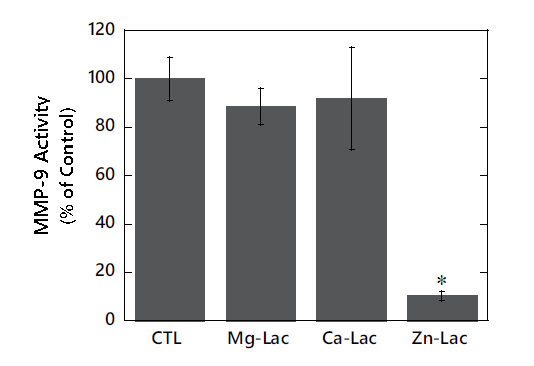
Figure 1. Effects of Mg-Lac, Ca-Lac, and Zn-Lac on enzymatic activity of MMP-9. Measurement of enzymatic activity of MMP-9 was conducted in the absence (control) or presence of 1 mM Mg-Lac, 1 mM Ca-Lac, or 1 mM Zn-Lac by using a MMP-9 Colorimetric Drug Discovery Kit as described under “Materials and Methods”. Data are expressed as the mean ± S.D. of triplicate samples (n = 3). *: p < 0.01 compared with control. CTL: Control; Mg-Lac: Magnesium Lactate; Ca-Lac: Calcium Lactate; Zn-Lac: Zinc Lactate; MMP-9: Matrix Metalloproteinase-9.
This result implied that some other zinc salts could possibly inhibit enzymatic activity of MMP-9, subsequently the effect of another zinc salt, zinc acetate (Zn-Ac) was also examined.
As shown in Figure 2, each of Zn-Lac and Zn-Ac reduced enzymatic activity of MMP-9 in a concentration-dependent manner between 0.001 mM and 1 mM. The two compounds had comparable inhibitory effects and enzymatic activities of MMP-9 were reduced by approximately 90% at 1 mM.
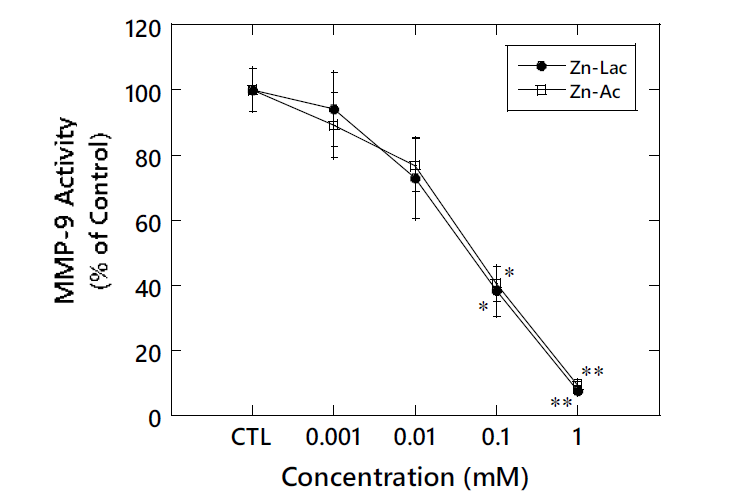
Figure 2. Concentration response of the effects of Zn-Lac and Zn-Ac on enzymatic activity of MMP-9. Measurement of enzymatic activity of MMP-9 was conducted in the absence (control) or presence of indicated concentration of Zn-Lac or Zn-Ac by using a MMP-9 Colorimetric Drug Discovery Kit as described under “Materials and Methods”. Data are expressed as the mean ± S.D. of triplicate samples (n = 3). *: p < 0.05 and **: p < 0.01 compared with control. CTL: Control; Zn-Lac: Zinc Lactate; Zn-Ac: Zinc Acetate; MMP-9: Matrix Metalloproteinase-9.
Effects of Zn-Lac and Zn-Ac on gelatinolysis by MMP-9 were demonstrated using gelatin zymography. As shown in Figure 3, a band migrated at 92 kDa that corresponded to pro-MMP-9 enzyme was diminished by treatment with 0.1 mM Zn-Lac or 0.1 mM Zn-Ac, thus both of Zn-Lac and Zn-Ac clearly down-regulated the gelatinolysis by rhMMP-9.
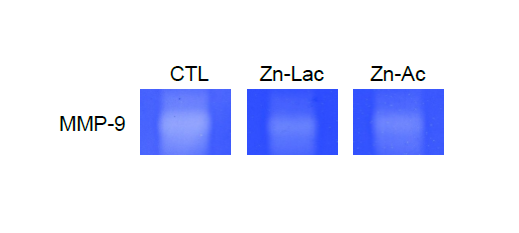
Figure 3. Effects of 0.1 mM Zn-Lac and 0.1 mM Zn-Ac on gelatinolysis by MMP-9. Gelatin zymography was conducted using a Gelatin-Zymography Kit as described under “Materials and Methods”. After electrophoresis of rhMMP-9, gels were cut into strips, each containing one lane of rhMMP-9. Each gel strip was subjected to gelatinolytic reaction in the absence (control) or presence of 0.1 mM Zn-Lac or 0.1 mM Zn-Ac. CTL, control; Zn-Lac, zinc lactate; Zn-Ac, zinc acetate; MMP-9, matrix metalloproteinase-9.
Discussion
Activation of MMPs is known to be involved in several dental diseases such as caries, pulpitis, and periodontitis [7–9]. Among MMPs, MMP-9 has emerged as one of the important therapeutic targets in caries treatment. Previous studies have revealed that MMP-9 can promote the destruction of dentin collagen in carious lesions, therefore plays an important role in caries progression [18–20]. In dental carious lesions, MMP-9 is known to be the predominant MMP, and is found to be much activated [17]. Dentinal fluid samples from teeth that possessed carious lesions had significantly higher MMP-9 levels than those from clinically healthy teeth [18].
Zinc has been widely used in clinical dentistry [27]. It is an important component of dental materials such as dental cements and restorative materials, and it is also included in toothpaste and mouthwash as an active ingredient. Zinc in excess was found to reduce MMP-mediated collagen degradation, was thereby expected to prevent progression of dentin caries and erosion [28].
In the present study, enzymatic activity of MMP-9 was found to be potently inhibited by two zinc salts of organic acids, Zn-Lac and Zn-Ac. Furthermore, gelatinolysis was attenuated by these zinc salts as demonstrated by gelatin zymography. The decrease in gelatinolysis is conceivably mediated by inhibition of enzymatic activity of MMP-9. These two zinc salts might have been useful in preventive dentistry. Zn-Lac has been used as a component of toothpaste and mouth rinse, whereas Zn-Ac has been used as plaque-inhibiting agent [29,30].
The precise mechanism underlying MMP-9 inactivation by Zn-Lac and Zn-Ac remains to be clarified. It is possible to speculate that Zn2+ binds to specific sites to induce conformational changes, thereby inactivating the enzyme. The mechanism by which carboxypeptidase A, a zinc-dependent metalloproteinase, is inhibited by zinc has been well studied [31]. A second Zn2+ binds to the active site of the enzyme and forms ZnOH+ complex that bridges the catalytic Zn2+ to a side chain of the active site, resulting in inactivation of the enzyme. Similar mechanisms might work in the inhibition of MMP-9 by Zn-Lac and Zn-Ac.
There are limitations to the present study. For measurement of enzymatic activity of MMP-9, synthetic substrate peptide was used. Although it is of interest to explore whether matrix degradation in dentin specimens could also be inhibited by Zn-Lac and Zn-Ac, dentin substrate experiments have not yet been carried out. Furthermore, the effects of Zn-Lac and Zn-Ac have not been validated in vivo. Studies on the effects of Zn-Lac and Zn-Ac in vivo are certainly necessary for future clinical application of Zn-Lac and Zn-Ac for the treatment of dentin carious lesion.
Application of Zn-Lac and Zn-Ac may become a new strategy for preventing progression of dentin caries and erosion.
Conclusion
Enzymatic activity of MMP-9 was found to be potently inhibited by two zinc salts of organic s, Zn-Lac and Zn-Ac. Furthermore, gelatinolysis was attenuated by these zinc salts. The decrease in gelatinolysis is conceivably mediated by inhibition of enzymatic activity of MMP-9. Application of Zn-Lac and Zn-Ac may become a new strategy for preventing progression of dentin caries and erosion.
Conflicts of Interest
The author has no conflict of interest to declare.
Acknowledgment
The author is grateful to professor Toyonobu Maeda (Ohu University School of Dentistry) for his technical instruction.
References
2. de Almeida LGN, Thode H, Eslambolchi Y, Chopra S, Young D, Gill S, et al. Matrix Metalloproteinases: From Molecular Mechanisms to Physiology, Pathophysiology, and Pharmacology. Pharmacol Rev. 2022 Jul;74(3):712–68.
3. Emonard H, Grimaud JA. Matrix metalloproteinases. A review. Cell Mol Biol. 1990;36(2):131–53.
4. Liotta LA, Steeg PS, Stetler-Stevenson WG. Cancer metastasis and angiogenesis: an imbalance of positive and negative regulation. Cell. 1991 Jan 25;64(2):327–36.
5. Mullins DE, Rohrlich ST. The role of proteinases in cellular invasiveness. Biochim Biophys Acta. 1983 Dec 29;695(3-4):177–214.
6. Stetler-Stevenson WG. Type IV collagenases in tumor invasion and metastasis. Cancer Metastasis Rev. 1990 Dec;9(4):289–303.
7. Chaussain-Miller C, Fioretti F, Goldberg M, Menashi S. The role of matrix metalloproteinases (MMPs) in human caries. J Dent Res. 2006 Jan;85(1):22–32.
8. Gusman H, Santana RB, Zehnder M. Matrix metalloproteinase levels and gelatinolytic activity in clinically healthy and inflamed human dental pulps. Eur J Oral Sci. 2002 Oct;110(5):353–7.
9. Sapna G, Gokul S, Bagri-Manjrekar K. Matrix metalloproteinases and periodontal diseases. Oral Dis. 2014 Sep;20(6):538–50.
10. Collier IE, Wilhelm SM, Eisen AZ, Marmer BL, Grant GA, Seltzer JL, et al. H-ras oncogene-transformed human bronchial epithelial cells (TBE-1) secrete a single metalloprotease capable of degrading basement membrane collagen. J Biol Chem. 1988 May 15;263(14):6579–87.
11. Fessler LI, Duncan KG, Fessler JH, Salo T, Tryggvason K. Characterization of the procollagen IV cleavage products produced by a specific tumor collagenase. J Biol Chem. 1984 Aug 10;259(15):9783–9.
12. Murphy G, McAlpine CG, Poll CT, Reynolds JJ. Purification and characterization of a bone metalloproteinase that degrades gelatin and types IV and V collagen. Biochim Biophys Acta. 1985 Sep 20;831(1):49–58.
13. Salo T, Liotta LA, Tryggvason K. Purification and characterization of a murine basement membrane collagen-degrading enzyme secreted by metastatic tumor cells. J Biol Chem. 1983 Mar 10;258(5):3058–63.
14. Mondal S, Adhikari N, Banerjee S, Amin SA, Jha T. Matrix metalloproteinase-9 (MMP-9) and its inhibitors in cancer: A minireview. Eur J Med Chem. 2020 May 15;194:112260.
15. Grillet B, Yu K, Ugarte-Berzal E, Janssens R, Pereira RVS, Boon L, et al. Proteoform Analysis of Matrix Metalloproteinase-9/Gelatinase B and Discovery of Its Citrullination in Rheumatoid Arthritis Synovial Fluids. Front Immunol. 2021 Nov 29;12:763832.
16. Vafadari B, Salamian A, Kaczmarek L. MMP-9 in translation: from molecule to brain physiology, pathology, and therapy. J Neurochem. 2016 Oct;139 Suppl 2:91–114.
17. Tjäderhane L, Larjava H, Sorsa T, Uitto VJ, Larmas M, Salo T. The activation and function of host matrix metalloproteinases in dentin matrix breakdown in caries lesions. J Dent Res. 1998 Aug;77(8):1622–9.
18. Ballal V, Rao S, Bagheri A, Bhat V, Attin T, Zehnder M. MMP-9 in Dentinal Fluid Correlates with Caries Lesion Depth. Caries Res. 2017;51(5):460–65.
19. Bora P, Saxena A, Goswami M. Effect of 38% Silver Diamine Fluoride on Salivary Matrix Metalloproteinase-9 Levels in Children with Early Childhood Caries: A Clinical Study. Int J Clin Pediatr Dent. 2023 Aug;16(Suppl 1):S51–6.
20. Sulkala M, Wahlgren J, Larmas M, Sorsa T, Teronen O, Salo T, et al. The effects of MMP inhibitors on human salivary MMP activity and caries progression in rats. J Dent Res. 2001 Jun;80(6):1545–9.
21. Rashid ZA, Bardaweel SK. Novel Matrix Metalloproteinase-9 (MMP-9) Inhibitors in Cancer Treatment. Int J Mol Sci. 2023 Jul 28;24(15):12133.
22. Cvikl B, Lussi A, Carvalho TS, Moritz A, Gruber R. Stannous chloride and stannous fluoride are inhibitors of matrix metalloproteinases. J Dent. 2018 Nov;78:51–8.
23. de Souza AP, Gerlach RF, Line SR. Inhibition of human gingival gelatinases (MMP-2 and MMP-9) by metal salts. Dent Mater. 2000 Mar;16(2):103–8.
24. Kato MT, Bolanho A, Zarella BL, Salo T, Tjäderhane L, Buzalaf MA. Sodium fluoride inhibits MMP-2 and MMP-9. J Dent Res. 2014 Jan;93(1):74–7.
25. Mei ML, Li QL, Chu CH, Yiu CK, Lo EC. The inhibitory effects of silver diamine fluoride at different concentrations on matrix metalloproteinases. Dent Mater. 2012 Aug;28(8):903–8.
26. Souza AP, Gerlach RF, Line SR. Inhibition of human gelatinases by metals released from dental amalgam. Biomaterials. 2001 Jul;22(14):2025–30.
27. Fatima T, Haji Abdul Rahim ZB, Lin CW, Qamar Z. Zinc: A precious trace element for oral health care? J Pak Med Assoc. 2016 Aug;66(8):1019–23.
28. Osorio R, Yamauti M, Osorio E, Ruiz-Requena ME, Pashley DH, Tay FR, et al. Zinc reduces collagen degradation in demineralized human dentin explants. J Dent. 2011 Feb;39(2):148–53.
29. Srisilapanan P, Roseman J, Likitsatian T. Clinical effect of toothpaste and mouth rinse containing zinc lactate on oral malodor reduction. J Clin Exp Dent. 2019 Apr 1;11(4):e346–52.
30. Giertsen E, Svatun B, Saxton A. Plaque inhibition by hexetidine and zinc. Scand J Dent Res. 1987 Feb;95(1):49–54.
31. Larsen KS, Auld DS. Carboxypeptidase A: mechanism of zinc inhibition. Biochemistry. 1989 Dec 12;28(25):9620–5.