

Abstract
The rapid advancement in genetic research and the proliferation of genetic testing technologies have sparked significant ethical debates regarding privacy, ownership, and the repercussions of genetic data misuse. This commentary evaluates the ethical landscape surrounding genetic information in light of recent technological developments, ongoing research, and upcoming challenges.
Commentary
Such a fast rising trend in genetic study, together with the mushrooming access to genetic testing has prompted a deep-seated debate on the issue of ethics, privacy, and the consequences of genetic data in the world. Due to the growing availability of technologies such as CRISPR and next-generation sequencing, the issue of who owns genetic data, its usage, and possible outcomes of its abuse is becoming more and more relevant in terms of ethics [1]. This discussion commentary examines the ethical environment of genetic information and privacy within the context of the newest developments, the current research, and the new challenges.
The Territory of Genetic Testing
Rising accessibility
Genetic testing has gained great accessibility and is relatively affordable in the past few years. Direct-to-consumer (DTC) genetic testing services have become an overnight sensation as they allow people to find out about their ancestry, health risks, and genetic predispositions. Recent statistics indicate that a large percentage of the population has already obtained genetic testing or shown interest in the same [2]. The increase in personal genetic testing is raising concerns regarding the consequences of genetic data sharing not only to the individual but also to the rest of society.
Informed consent and autonomy
As genetic testing has grown, there has been a growing interest in the question of informed consent, or how people consent to the testing once they have learned about its consequences. Genetic information is too complicated and requires a solid informed consent mechanism that goes beyond the risks and benefits of testing. It should contain talks on the way the information could be stored, shared, and utilized in future.
New practices, including custom consent models where individuals can provide specifications of how their data may be used (e.g., to research, commercial use, etc.), are being created [3]. These new methods are supposed to empower people and at the same time maintain their wishes concerning the way they want to use the data.
Genetic Data Ownership
Personal vs. Community rights
The issue of who owns genetic data is a dilemma most of the time. People can treat their genetic data as the personal identity, and scientists and business organizations can consider it an excellent source of innovation and knowledge about health factors. This stress poses critical questions on who owns rights to genetic information.
There are those who claim that people must be allowed to exercise full control of their genetic information, and they should be allowed to have the right to access and limit its application. Other people indicate that genetic information must be regarded as a common good, particularly in cases where public health is considered, sharing such information may result in major discoveries that would benefit the entire society.
Commercialization and profit
Commercialization of genetic information also makes ownership complicated. Genetic testing companies usually incorporate provisions in their consent forms that authorize the use of aggregated data by the company to a commercial advantage. This is ethically questionable in terms of making profits out of the personal information of individuals without their express permission that the information be used in other ways. Continuous debates should be held to define where commercial interests and individual rights start and end.
Privacy Concerns
Data breach risks
On the one hand, the risk of data breach grows as the genetic data is digitized and stored in databases. The issue of cybersecurity threats is quite complicated, and breach may result in unauthorized access to sensitive genetic data. The possible outcomes of these violations may be very serious, affecting not only the privacy of people but also their psychological health and social status.
Recent high-profile data breaches in the healthcare industry cause concern over the susceptibility of genetic data. The key to curbing these risks is to ensure that there are robust data protection measures put in place, and that the organizational structures that deal with genetic data put in place governance mechanisms to ensure that such data protection is achieved [4].
Anonymity versus identifiability
The issue of the possibility of genetic data being anonymous is becoming controversial. Although researchers usually combine information to conceal the identities of individuals, genomic data may remain exposed to identification using sophisticated algorithms and analysis software. This raises ethical concerns on the need to safeguard the individual identities in research, particularly when the associated data has the potential of disclosing sensitive health information.
New developments in data anonymization methods are looking at generating data that is actually de-identified. Nevertheless, there is still the worry that even anonymized data may still be reverse-engineered to reveal the individuals, and it may still need further examination and the evolution of the best practices [5].
Discrimination and insurance problems
Another serious ethical issue is the possibility of discrimination on the basis of genetic information. Genetic information may be used to deny access to insurance or employment opportunities, which would further widen health disparities. Some jurisdictions, including the Genetic Information Nondiscrimination Act (GINA), offer limited protection against discrimination, although there are still gaps in its coverage and application.
Recent researches have also shown that the fear of discrimination can push people off genetic testing, which points to the necessity of correcting the policy and conducting educational work to reassure the population. Ethical issues should not be confined to how the data is handled but also the implications of genetic testing to society.
The Role of AI and Big Data
Genetic data and AI
A major frontier in molecular biology is the intersection of genetic information and artificial intelligence. AI algorithms are able to process vast data sets to learn patterns which could be obscured by human researchers. This has far-reaching consequences in terms of forecasting health risks and customization of treatment plans.
Nevertheless, ethical considerations arise when using AI in genetic studies, especially with regard to algorithm discrimination. When genetic datasets are not diverse, AI models will not reflect all populations, which results in health disparities in its recommendations and treatments. There should be constant endeavor to make sure that AI models are inclusive and representative.
Research implications on public health
By using genetic information in the context of public health, one can spearhead major advancement in the mechanisms of disease and health policy. Joint studies involving genetic data on a wide range of populations can shed light on genetic inclinations to some diseases, which could be used as part of preventative efforts.
However, the ethical issue is the way such data are collected and distributed. To ensure the integrity of partnering and ensure that people provide their real consent to share their genetic data, transparency of these collaborations is essential to guarantee the trust of the population.
Continuing Research and Ethics Systems
Developing ethical guidelines
With the fast-growing sphere of genetics, it is essential to develop a set of overall ethical principles that should be followed when using genetic information. Different organizations and institutions are striving to establish systems that give importance to individual rights, consent and privacy and encourage innovation.
There are more recent efforts to educate researchers and industry professionals in ethics, with a focus not on regulation, but also on the ethical obligations that accompany the use of genetic data. The debates surrounding ethical by design models strive to incorporate the issue of ethics into the research process, including its conceptualization and application of results.
Education and public engagement
In order to promote understanding and trust, it is imperative to involve people in the debate on the topic of genetic information and privacy. The advantages and disadvantages of genetic testing and data sharing can be made clearer through informed discussions. Research awareness is being created through educational campaigns to raise awareness of rights regarding personal genetic information and the ethical principles by which research is conducted.
Ethical questions and case studies
Recent case studies on genetic data indicate persisting challenges. As an example, the application of population genetic research to determine hereditary health conditions brings up the issue of the extent to which consent is to be interpreted. Such situations lead to a necessity to think closely about ethical standards and practices that will be able to reconcile scientific progress and individual rights.
Future Trends and New Demands
Addressing global disparities
Genetic technologies are on the rise and inequalities in access of genetic testing and research opportunities continue to exist among various socioeconomic groups as well as geographical locations. The provision of fair access to genetic services and the elimination of global inequalities is a continuing issue. The policy programs should strive to consolidate health equity so that the marginalized groups are not left behind in the gains generated by genetic progress.
Navigating emerging technologies
Emerging technologies, including whole-genome sequencing and gene editing, are highly promising but also require a strict level of ethical examination. The more these technologies are available, the more the debate on their proper application should be open and involving everyone on the possible effects to the society.
Regulatory landscapes
The dynamic character of genetics requires constant changes to regulatory environments. Creating policies that ensure individual privacy and promote innovation, and research is the challenge that policymakers have to face. Constant consultations among stakeholders, such as researchers, ethicists, and patients, can contribute to the creation of flexible regulatory frameworks that can react to the arising challenges on a case-by-case basis.
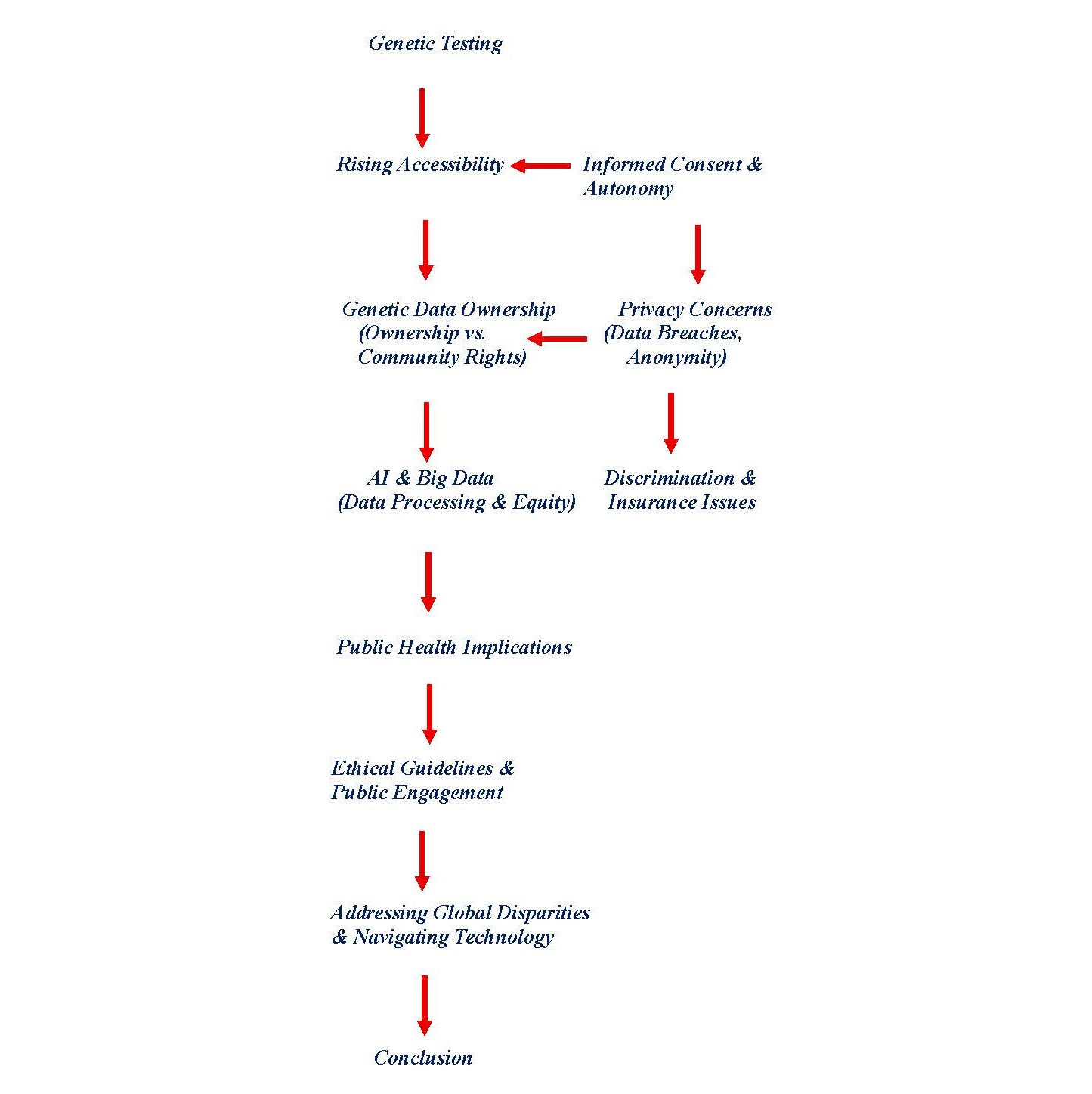
Figure 1. Flow graph of the project.
Conclusion
Genetic information and privacy ethics are a dynamic environment. As genetic testing continues to develop and healthcare begins to utilize the acquired data, the issue of ethics should be at the center of the debate. The problems of informed consent, ownership, privacy, discrimination, and new technologies need to be researched, debated, and acted upon.
In the future, we can see the necessity of collective strategies that would prioritize the rights of an individual but accept the possible advantage of genetic innovations to society in general. The ability to overcome challenges in the changing world of genetic information and privacy will require setting clear ethical standards, encouraging fair access, and encouraging community participation in the future. In a world where genetic information is increasingly becoming the order of the day, it is not only important but a form of requirement that moral concerns should be at the center of this conversation as it will help to protect human dignity, autonomy, and health.
Research Scope
The research primarily focuses on ethics, privacy, and ownership of genetic information in the context of recent advancements and societal implications. Essential findings indicate that while genetic testing can lead to significant health insights, the associated risks, especially concerning discrimination and data privacy, require rigorous ethical scrutiny.
Statements and Declarations
Funding
The authors declare that no funds, grants, or other support were received during the preparation of this manuscript.
Competing interests
The authors have no relevant financial or non-financial interests to disclose.
Author contributions
The work reported in this study has been carried out by the author, Prerna Mehta, who has also independently written this manuscript. This contains its development and planning, sample acquisition and testing, and writing and finalizing the paper for publication.
Compliance with ethical standards
In compliance with the standards of publishing the results of this research, the author, Prerna Mehta, hereby states that there is no conflict of interest to report. This work did not include human subjects and animals, hence, no informed consent, or animal welfare statements were required. Guidelines to ethical best practice have been followed in the preparation of this manuscript.
References
2. Oh B. Direct-to-consumer genetic testing: advantages and pitfalls. Genomics Inform. 2019 Sep;17(3):e33.
3. Mehta P. Recent discoveries in stem cell therapy: Charting new territories in regenerative medicine. Archives of Stem Cell and Therapy. 2025 Nov 29;6(1):1–2.
4. Seh AH, Zarour M, Alenezi M, Sarkar AK, Agrawal A, Kumar R, et al. Healthcare Data Breaches: Insights and Implications. Healthcare (Basel). 2020 May 13;8(2):133.
5. Mehta P. Wearable Technology Revolution: Improving Health Monitoring and Well-Being. Medinformatics. 2025 Nov 18.