

Abstract
Non-linear differential equations play a central role in modeling complex phenomena in physical, chemical, and biological sciences. Exact analytical solutions are rarely obtainable due to strong nonlinearities and complex boundary conditions. In this work, approximate analytical and semi-analytical methods are employed to construct accurate solutions for representative non-linear boundary value and reaction diffusion problems. The methodology is based on Homotopy-type approaches, decomposition techniques, and recently developed semi-analytical formulations. The effectiveness of the proposed framework is demonstrated through applications in physical boundary value problems, chemical reaction–diffusion systems, and biological biosensor models. The results show excellent agreement with numerical solutions reported in the literature, confirming the accuracy, convergence, and computational efficiency of the methods.
Keywords
Approximate analytical methods, Non-linear differential equations, Initial value problems, Boundary value problems, Reactiondiffusion equation, Magnetohydrodynamic (MHD)
Introduction
Non-linear differential equations constitute the mathematical foundation for modeling a wide range of phenomena in physical, chemical, and biological sciences. Problems arising in fluid mechanics, heat and mass transfer, chemical reaction engineering, enzyme kinetics, and biosensor technology are frequently governed by non-linear ordinary or partial differential equations subject to complex boundary or initial conditions. In most practical situations, these equations do not admit closed-form exact solutions due to strong nonlinearities, higher-order derivatives, coupled effects, and infinite or semi-infinite domains.
Traditionally, numerical methods [1] such as finite difference, finite element, and spectral techniques have been employed to approximate solutions of such problems. While numerical schemes are powerful and flexible, they often involve high computational cost, stability constraints, and limited physical interpretability. Moreover, numerical solutions provide discrete data rather than explicit functional expressions, making parametric analysis and qualitative understanding more difficult. These limitations have motivated the development of approximate analytical and semi-analytical methods, which aim to produce explicit or semi-explicit solutions with controllable accuracy.
Approximate analytical methods generate solutions in the form of convergent series or closed-form expressions without discretizing the governing equations. Semi-analytical methods further enhance this framework by combining analytical derivations with numerical evaluation of auxiliary parameters. Over the last two decades, methods such as the Homotopy Analysis Method (HAM) [2], Homotopy Perturbation Method (HPM) [3], Adomian Decomposition Method (ADM) [4], Akbari–Ganji Method (AGM) [5], Variational iteration method (VIM) [6] and modified Homotopy-based techniques [7] have emerged as effective tools for handling strongly non-linear systems.
In the context of physical sciences, non-linear boundary value problems frequently arise in flow and transport phenomena. Higher-order differential equations with boundary conditions specified at infinity pose particular challenges for conventional numerical and analytical methods. To address these difficulties, new semi-analytical approaches have been developed to handle infinite and semi-infinite domains effectively. The works of Ananthaswamy and collaborators introduced novel semi-analytical formulations capable of producing accurate solutions for third-order and higher-order non-linear boundary value problems, with excellent agreement to numerical results [8,9]. These methods offer rapid convergence and reduced computational complexity, making them attractive for physical modeling applications.
In chemical sciences, reaction–diffusion equations are central to modeling catalytic reactions, diffusion in porous media, and chemical reactors. Such models are inherently non-linear due to reaction kinetics and coupling between diffusion and reaction terms. Approximate analytical and semi-analytical methods have been successfully applied to these systems to obtain explicit concentration profiles and reaction rate expressions. In particular, the application of ADM and AGM to chemical reaction–diffusion models have enabled closed-form approximate solutions that capture essential chemical behavior while significantly reducing computational effort [10,11]. These analytical solutions facilitate deeper understanding of diffusion–reaction interactions and parameter sensitivity, which are crucial for reactor design and optimization.
In biological sciences, analytical and semi-analytical methods play a vital role in understanding complex non-linear systems arising from population interactions, disease transmission, and recovery mechanisms. Models such as SEIR and SIRS lead to coupled non-linear differential equations that are often difficult to solve exactly; however, decomposition-based analytical approaches provide explicit approximate solutions that preserve the inherent non-linearity of the system. Recent studies on Hepatitis B, Measles, COVID-19, and Typhoid disease models have shown that these methods yield rapidly convergent results with excellent agreement to numerical simulations, thereby offering an efficient and reliable framework for analyzing disease dynamics and assessing the impact of key epidemiological parameters [12,13].
Beyond individual applications, comparative studies have shown that approximate analytical and semi-analytical solutions exhibit strong agreement with numerical results across physical, chemical, and biological models. These methods offer several advantages, including reduced computational cost, ease of implementation, and enhanced interpretability of results. Furthermore, the availability of explicit analytical expressions enables systematic parametric studies that are often cumbersome in purely numerical approaches.
Motivated by these developments, the present research article focuses on the formulation and application of approximate analytical and semi-analytical methods for representative non-linear differential equations arising in physical, chemical, and biological sciences. Building upon established methodologies and previously reported applications, the study aims to demonstrate the accuracy, convergence, and practical relevance of these techniques in effectively solving complex non-linear problems.
Approximate Analytical Methods
Approximate analytical methods generate solutions in the form of convergent series or iterative expressions without linearization or discretization of the governing equations. Semi-analytical methods combine analytical procedures with numerical techniques to improve convergence and stability. Popular methods include the Homotopy Analysis Method (HAM), Adomian Decomposition Method (ADM), Variational Iteration Method (VIM), Taylor Series method, and Modified Homotopy Analysis Method (MHAM). A key advantage of these approaches is the presence of auxiliary or convergence-control parameters that allow adjustment of solution accuracy.
Method formulation of semi-analytical techniques
Homotopy Analysis Method (HAM)
HAM [14–17] constructs a continuous Homotopy between an initial guess and the exact solution using an embedding parameter and auxiliary convergence-control parameter. It provides rapidly convergent series solutions without requiring small or perturbation parameters.
Variational Iteration Method (VIM)
VIM [6] formulates correction functional using variational theory and optimally identified Lagrange multipliers to generate successive approximations. The method yields accurate analytical solutions with fast convergence and minimal computational effort.
Adomian Decomposition Method (ADM)
ADM [4] decomposes non-linear operators into Adomian polynomials and represents the solution as an infinite series. It avoids linearization and discretization while effectively handling strong nonlinearities.
Homotopy Perturbation Method (HPM)
HPM [3] combines classical perturbation techniques with Homotopy concepts to transform non-linear problems into a series of linear sub-problems. The method provides simple and rapidly convergent analytical approximations.
Modified Homotopy Analysis Method (MHAM)
MHAM [18] enhances the classical HAM by modifying auxiliary parameters and linear operators to improve convergence behavior. It is particularly effective for strongly non-linear boundary value problems.
New Homotopy Perturbation Method (NHPM)
NHPM [19,20] refines the standard HPM formulation by introducing improved perturbation structures for faster convergence. It simplifies computations while maintaining high accuracy for non-linear systems.
Modified q-Homotopy Analysis Method (M-q-HAM)
M-q-HAM [7] introduces an additional deformation parameter q to provide greater control over convergence. The method yields accurate solutions with fewer series terms for strongly coupled non-linear equations.
New Approximate Analytical Method (ASM)
The new approximate analytical method [21,22] constructs trial solution functions satisfying boundary conditions and minimizes the residual of governing equations. It produces compact analytical expressions with reduced computational complexity.
Applications of Semi-Analytical Methods
Semi-analytical methods serve as powerful tools for studying non-linear models in physical, chemical, and biological sciences by yielding accurate approximate solutions while preserving the inherent non-linearity of the systems. The following sections present a detailed discussion of their applications in physical, chemical, and biological sciences, respectively.
Applications in physical sciences
Non-Newtonian and MHD flow problems: Mathematical modeling of fluid flow and transport phenomena in physical sciences frequently leads to systems of non-linear ordinary and partial differential equations. Such models arise in magnetohydrodynamic (MHD) flows, non-Newtonian fluid dynamics, boundary layer theory, and stagnation-point flow problems. The presence of strong non-linearities, coupled momentum and energy equations, and complex boundary conditions makes the derivation of exact analytical solutions extremely difficult. Approximate analytical and semi-analytical methods therefore play a vital role in obtaining accurate and physically meaningful solutions.
Magnetohydrodynamic (MHD) flow models: MHD flow problems involve the interaction between electrically conducting fluids and magnetic fields and are governed by non-linear differential equations due to Lorentz forces and viscous effects. Ananthaswamy et al. and collaborators have employed Homotopy Analysis Method (HAM) and modified semi-analytical techniques to solve non-linear boundary value problems arising in MHD flow models. These approaches yield explicit series solutions for velocity and temperature profiles, allowing detailed analysis of magnetic parameter effects without resorting to numerical discretization [22,23].
The use of HAM in MHD problems is particularly advantageous because it does not rely on small perturbation parameters and provides convergence-control mechanisms. Comparative studies have shown excellent agreement between HAM-based solutions and numerical results, validating the effectiveness of this method for MHD boundary layer flows [4].
Casson fluid flow problems: Casson fluid models are widely used to describe non-Newtonian fluids such as blood, printing inks, and polymer suspensions. The governing equations are highly non-linear due to yield stress effects and viscosity variations. Casson nanofluid models are widely used to describe blood-based non-Newtonian fluids containing suspended nanoparticles, where yield stress effects, nanoparticle interactions, and coupled transport phenomena lead to strongly non-linear simultaneous differential equations. Semi-analytical techniques have been successfully employed to handle these non-linearities by constructing approximate analytical solutions that retain the essential physical characteristics of the flow. Such approaches provide explicit expressions for velocity, temperature, and concentration fields, enabling detailed analysis of Casson and nanoparticle parameters, with results showing good agreement with numerical solutions and demonstrating the reliability of semi-analytical methods for complex blood-based Casson nanofluid systems [8].
Maxwell and Williamson nanofluid flow problems: Maxwell and Williamson nanofluid models represent important classes of non-Newtonian fluids, where fluid relaxation effects and shear-thinning behavior introduce strong nonlinearities into the governing flow equations. Approximate analytical techniques have been effectively applied to these models to obtain convergent series solutions that retain the essential physical characteristics of the nanofluid flow. The resulting analytical expressions enable clear investigation of the effects of material parameters and flow conditions, while showing close agreement with numerical results, demonstrating the efficiency and accuracy of such methods for complex non-Newtonian nanofluid problems [24].
Stagnation-point flow problems: Stagnation-point flow problems arise in several engineering and industrial processes such as cooling of stretching surfaces, aerodynamic heating, and polymer extrusion, where the fluid motion near the stagnation region is governed by coupled and highly non-linear differential equations. When magnetic field effects are included, the complexity of the governing system further increases due to the interaction between fluid motion and electromagnetic forces. HAM-based approaches have been effectively employed to analyze MHD stagnation-point flow by treating the coupled momentum and energy equations in a systematic manner. These methods yield explicit approximate solutions for velocity and temperature distributions with good convergence and close agreement with numerical results, demonstrating their reliability and effectiveness in capturing the essential features of MHD stagnation-point flow problems [9].
Comparative methodological insights
Across MHD, Casson, Williamson, and stagnation-point flow problems, comparative studies reveal that approximate analytical and semi-analytical methods produce results that closely match numerical simulations. Each method offers specific advantages:
- HAM / MHAM: Strong convergence control and applicability to highly non-linear MHD and stagnation-point flows
- ADM: Effective handling of non-linear constitutive relations in Casson fluid models
- HPM: Computational simplicity and rapid convergence for Williamson fluid flows
- New semi-analytical methods: Efficient treatment of infinite and semi-infinite boundary conditions
- These methodological choices reflect the flexibility and adaptability of approximate analytical techniques in addressing diverse physical flow problems [21–25].
Significance in physical modeling
The studies conducted by Dr. V. Ananthaswamy demonstrate that approximate analytical and semi-analytical methods are not merely mathematical tools but powerful modeling techniques capable of providing deep physical insight. The availability of explicit analytical expressions enables systematic parametric analysis, optimization, and sensitivity studies, which are essential in engineering design and physical interpretation.
Applications in chemical sciences
Chemical science problems involving biosensors, catalytic reactions, and reaction–diffusion mechanisms are inherently non-linear due to coupled transport processes, reaction kinetics, and feedback effects. Such systems are commonly modeled using non-linear ordinary and partial differential equations defined on finite or semi-infinite domains, for which exact analytical solutions are rarely attainable. This has motivated the use of approximate analytical and semi-analytical methods, which have proven effective in chemical modeling by providing accurate solutions with clear physical interpretation.
Dual biosensor models: Dual biosensor systems involve interacting biochemical reactions coupled with diffusion processes, leading to strongly coupled non-linear differential equations with complex boundary conditions. Approximate analytical and semi-analytical methods such as homotopy-based approaches and newly developed analytical schemes have been effectively applied to these models to overcome analytical difficulties. These techniques yield explicit expressions for substrate concentration and sensor response, enabling efficient parametric studies and meaningful comparison between single and dual biosensor performance, with results showing close agreement with numerical simulations [26,33].
Autocatalytic and enzyme reaction systems: Autocatalytic reactions and enzyme kinetics models are characterized by non-linear rate laws, feedback mechanisms, and stiffness in the governing equations. Analytical treatment of such systems is challenging, motivating the use of decomposition-based and variational approaches. Methods such as the Adomian Decomposition Method and Variational Iteration Method allow systematic handling of non-linear reaction terms and provide rapidly convergent approximate solutions. The resulting analytical expressions offer valuable insight into reaction enhancement, enzyme inactivation effects, and sensitivity to kinetic parameters [10,30–32].
Chemical kinetics and electrochemical models: Non-linear chemical kinetics models arise frequently in electrochemical systems, biosensors, and catalytic processes, where coupled transport and reaction mechanisms dominate system behavior. Approximate analytical methods, including homotopy perturbation–based techniques and series expansion approaches, have been successfully employed to obtain explicit solutions for concentration profiles and current responses. These solutions facilitate direct analysis of reaction rate constants, diffusion coefficients, and geometric effects in planar and microelectrode systems [11,29,31].
Reaction–diffusion systems: Reaction–diffusion equations play a central role in modeling chemical transport in heterogeneous media such as biosensors, biofilms, and catalytic surfaces. The combination of diffusion terms with non-linear reaction kinetics makes exact solutions difficult to obtain. New approximate analytical methods, along with homotopy- and iteration-based techniques, have proven effective in reducing algebraic complexity while maintaining high accuracy. The analytical solutions obtained enable systematic investigation of diffusion–reaction coupling, boundary effects, and parameter influences in both finite and semi-infinite domains [27,28].
Comparative methodological insights
Across chemical science applications such as dual biosensors, enzyme kinetics, autocatalytic reactions, and reaction–diffusion systems, comparative studies show that approximate analytical and semi-analytical methods yield results in excellent agreement with numerical simulations. Each method offers distinct advantages:
- HAM / NHAM: Effective convergence control and robustness for strongly non-linear biosensor and reaction–diffusion models.
- ADM: Efficient treatment of non-linear reaction terms in autocatalytic and enzyme kinetics systems.
- VIM: Rapid convergence for non-linear kinetic and biofilm-related equations.
- New approximate analytical methods: Reduced algebraic complexity and efficient handling of finite and semi-infinite domains.
These methodological strengths highlight the flexibility and reliability of approximate analytical techniques in addressing a wide range of complex chemical and biochemical modeling problems [10,11,26–33].
Methodological significance
Across chemical science applications, approximate analytical and semi-analytical methods demonstrate strong reliability and versatility. Decomposition methods effectively handle non-linear source terms, Homotopy-based techniques offer convergence control, variational approaches ensure rapid convergence, and newly proposed analytical schemes reduce computational effort. Comparative studies consistently report excellent agreement between analytical approximations and numerical results, confirming the suitability of these methods for modeling complex chemical and biochemical systems [10,11,26–33].
Applications in biological science
Mathematical modeling has become an indispensable tool in understanding, predicting, and controlling the spread of infectious diseases. Many epidemic and endemic disease processes are governed by systems of non-linear ordinary differential equations representing interactions between susceptible, exposed, infected, recovered, vaccinated, and treated populations. The inherent non-linearity of transmission terms, coupled with intervention strategies such as vaccination, treatment, and isolation, makes analytical treatment challenging. Approximate analytical and semi-analytical methods provide a powerful framework for obtaining tractable solutions and qualitative insights into such epidemiological models.
In recent years, significant progress has been made in the mathematical analysis of infectious disease dynamics using approximate and semi-analytical approaches. These studies focus on deriving explicit or semi-explicit solutions to non-linear compartmental models, enabling detailed investigation of disease transmission mechanisms and evaluation of control strategies [26–28].
Lassa fever and viral hemorrhagic diseases: Lassa fever, a viral hemorrhagic disease endemic in parts of West Africa, is modeled using non-linear systems that incorporate both human-to-human and rodent-to-human transmission pathways. The complexity of these models arises from multiple transmission routes, incubation periods, and intervention measures. Semi-analytical methods allow explicit representation of infected and recovered populations, facilitating sensitivity analysis of transmission coefficients and control strategies, and helping identify dominant pathways for effective public health interventions [27].
COVID-19 pandemic models: The COVID-19 pandemic requires models capable of capturing rapid transmission, varying infection rates, and intervention measures such as lockdowns and vaccination. SEIR- and SIRS-type models describing COVID-19 dynamics involve strongly coupled non-linear equations with time-dependent parameters. Approximate analytical and semi-analytical techniques provide explicit or rapidly convergent series solutions, enabling efficient analysis of outbreak peaks, reproduction numbers, and long-term disease behavior. These methods complement numerical simulations by offering analytical clarity and reducing computational effort [28].
Hepatitis B models: Hepatitis B is modeled using non-linear compartmental systems that include vaccination effects, disease-induced mortality, and non-linear incidence rates. Semi-analytical solutions provide explicit expressions for infected and vaccinated populations, allowing assessment of vaccination efficacy, treatment strategies, and threshold conditions for disease eradication or persistence. These methods make it possible to extract insights that are difficult to obtain from purely numerical approaches [13].
Measles transmission and vaccination dynamics: Measles transmission is strongly influenced by vaccination coverage and herd immunity thresholds. Non-linear models incorporating treatment and vaccination strategies can be analyzed using semi-analytical techniques to produce closed-form or semi-closed-form solutions for population compartments. This enables clear evaluation of vaccination and treatment policies and their impact on disease control [26].
Typhoid disease models: Typhoid fever models involve non-linear differential equations capturing infection dynamics, environmental transmission, and recovery rates. Semi-analytical methods provide approximate solutions that reveal the influence of epidemiological parameters on disease spread, supporting efficient parametric studies and control strategy evaluation [12].
Comparative Methodological Insights
Across epidemiological applications such as Lassa fever, COVID-19, hepatitis B, measles, and typhoid disease models, comparative studies show that approximate analytical and semi-analytical methods produce results in strong agreement with numerical simulations. Each method offers specific advantages:
- HAM / NHAM: Effective convergence control and robustness for strongly non-linear compartmental and reaction–diffusion disease models.
- ADM: Efficient handling of non-linear transmission and reaction terms in infectious disease dynamics.
- VIM: Rapid convergence for non-linear epidemic and typhoid-related differential equations.
- New approximate analytical methods: Reduced algebraic complexity and efficient treatment of coupled compartments and time-dependent parameters.
These methodological strengths highlight the versatility and reliability of approximate analytical techniques in analyzing complex non-linear epidemiological models and supporting public health decision-making [12,13,26–28].
Significance of approximate analytical methods in epidemiology
Across these infectious disease models, including Lassa fever, COVID-19, hepatitis B, measles, and typhoid, approximate analytical and semi-analytical methods offer several advantages. They reduce dependence on extensive numerical simulations, provide explicit functional relationships between parameters and outcomes, and enable rapid sensitivity and parametric analysis. Comparative studies indicate strong agreement with numerical solutions, confirming their accuracy and reliability for epidemiological modeling. These methods serve as valuable tools for understanding disease dynamics, evaluating intervention strategies, and supporting evidence-based public health decision-making [12,13,26–28].
Advantages and Limitations
Approximate analytical and semi-analytical methods have proven to be powerful tools across physical, chemical, and biological sciences for solving strongly non-linear differential equations. Their advantages include:
- Analytical clarity: They provide explicit or semi-explicit expressions for key physical, chemical, or epidemiological quantities, enabling direct parametric analysis and deeper understanding of system behavior [5–28].
- Reduced computational effort: These methods reduce dependence on purely numerical simulations, offering rapidly convergent solutions with less computational cost [21–33].
- Flexibility and applicability: They are adaptable to a wide range of problems, including non-Newtonian fluid flows (Casson, Williamson, Maxwell), MHD stagnation-point flows, biosensor kinetics, autocatalytic reactions, and infectious disease dynamics [5–28].
- Parameter sensitivity and control: Approximate solutions allow systematic investigation of the influence of physical, chemical, or epidemiological parameters, supporting design, optimization, and intervention strategies [21–33].
Despite these advantages, there are limitations:
- Approximation errors: The solutions are approximate and may lose accuracy in extremely stiff, highly non-linear, or chaotic regimes if not carefully implemented.
- Method selection sensitivity: Different methods may perform differently depending on the problem type, boundary conditions, or non-linearity strength, requiring careful methodological choice [5–28].
- Limited global validity: Some methods may provide locally valid solutions but may not capture global behavior over very large domains or long time intervals.
- Algebraic complexity: For strongly coupled systems with multiple variables, the decomposition or homotopy expansions can become algebraically intensive, requiring additional simplifications [27,28].
Overall, the advantages of approximate analytical and semi-analytical methods often outweigh their limitations, making them reliable and insightful tools for modeling complex physical, chemical, and biological systems.
Publication Distribution and Method Usage
The body of research from 2000 to 2025 demonstrates extensive application of approximate and semi-analytical methods across physical, chemical, and biological sciences. To illustrate the distribution and methodological trends, two visual summaries have been constructed based on published works.
Discipline-wise distribution
Figure 1 shows the distribution of publications across three major scientific domains. Physical Sciences constitute the largest share (~45%), covering studies on magnetohydrodynamic (MHD) flows, non-Newtonian fluids such as Casson, Williamson, and Maxwell models, and stagnation-point flow problems. Chemical Sciences account for approximately 40%, including reaction–diffusion systems, chemical kinetics, autocatalytic reactions, dual biosensors, and catalytic processes. Biological Sciences represent around 15%, primarily focusing on biosensor modeling, enzyme transport, and mathematical modeling of infectious diseases such as COVID-19, Hepatitis B, Measles, Lassa fever, and Typhoid. This distribution highlights the interdisciplinary nature of the research, integrating rigorous analytical techniques with diverse scientific applications [5–28].
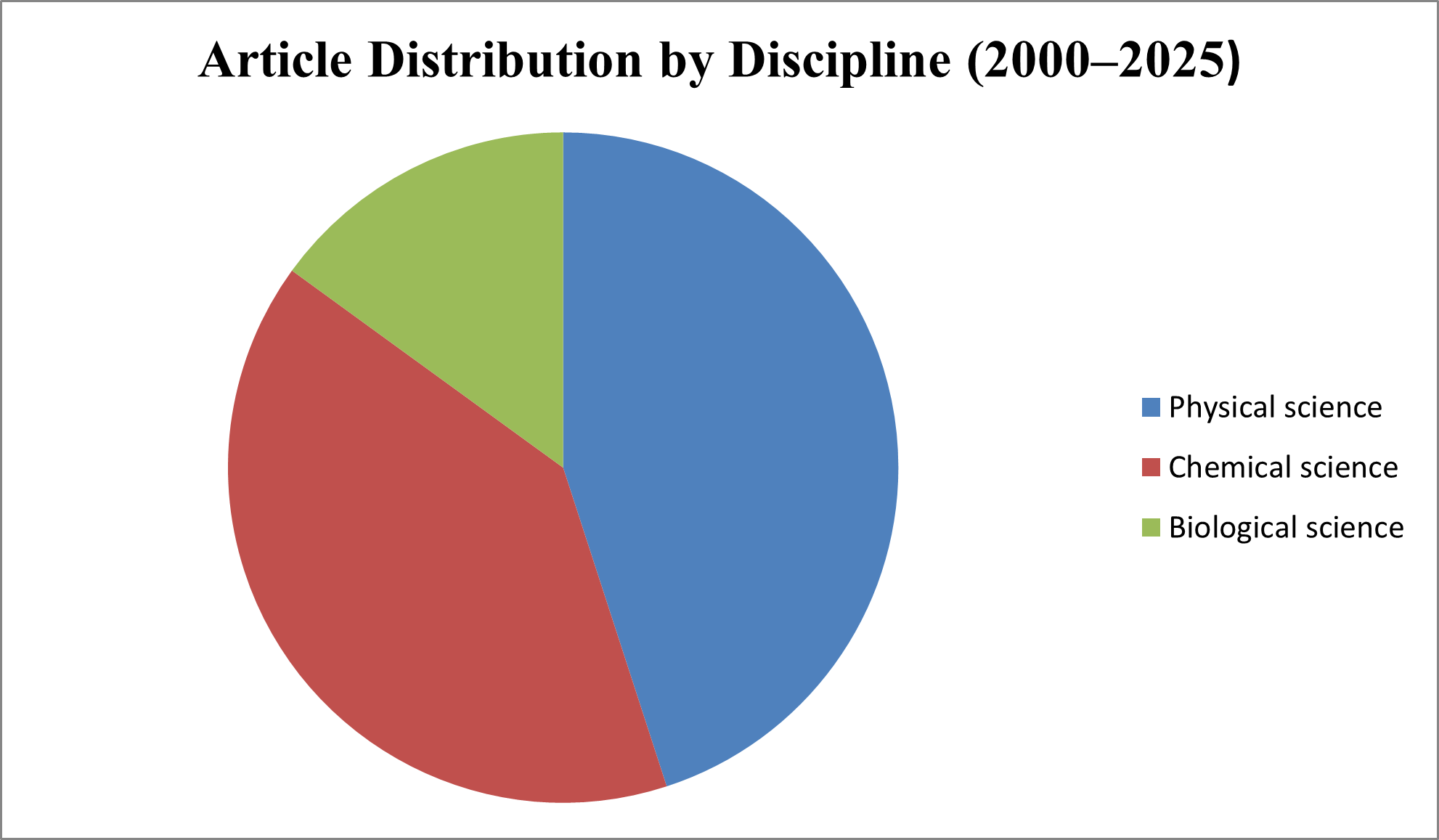
Figure 1. Distribution of research articles (2000–2026) by major discipline: Physical Sciences (MHD, non-Newtonian flows, stagnation-point flows), Chemical Sciences (reaction–diffusion, chemical kinetics, biosensors, catalysis), and Biological Sciences (disease and transport modeling).
Method-wise distribution
Figure 2 illustrates the relative usage of approximate and semi-analytical methods across the publications. The Homotopy Analysis Method (HAM) is most frequently applied (~20%), followed by Adomian Decomposition Method (ADM) and Modified Homotopy Analysis Method (MHAM) (~15% each). Other methods, including New Homotopy Analysis Method (NHAM), Modified q-HAM (M-q-HAM), Homotopy Perturbation Method (HPM), Variational Iteration Method (VIM), and newly developed approximate analytical techniques, contribute between 10–15% each. This distribution reflects the methodological diversity and the strategic selection of techniques based on problem type and non-linearity, highlighting the versatility and innovation in applying classical and modified Homotopy and decomposition-based approaches [21–28].
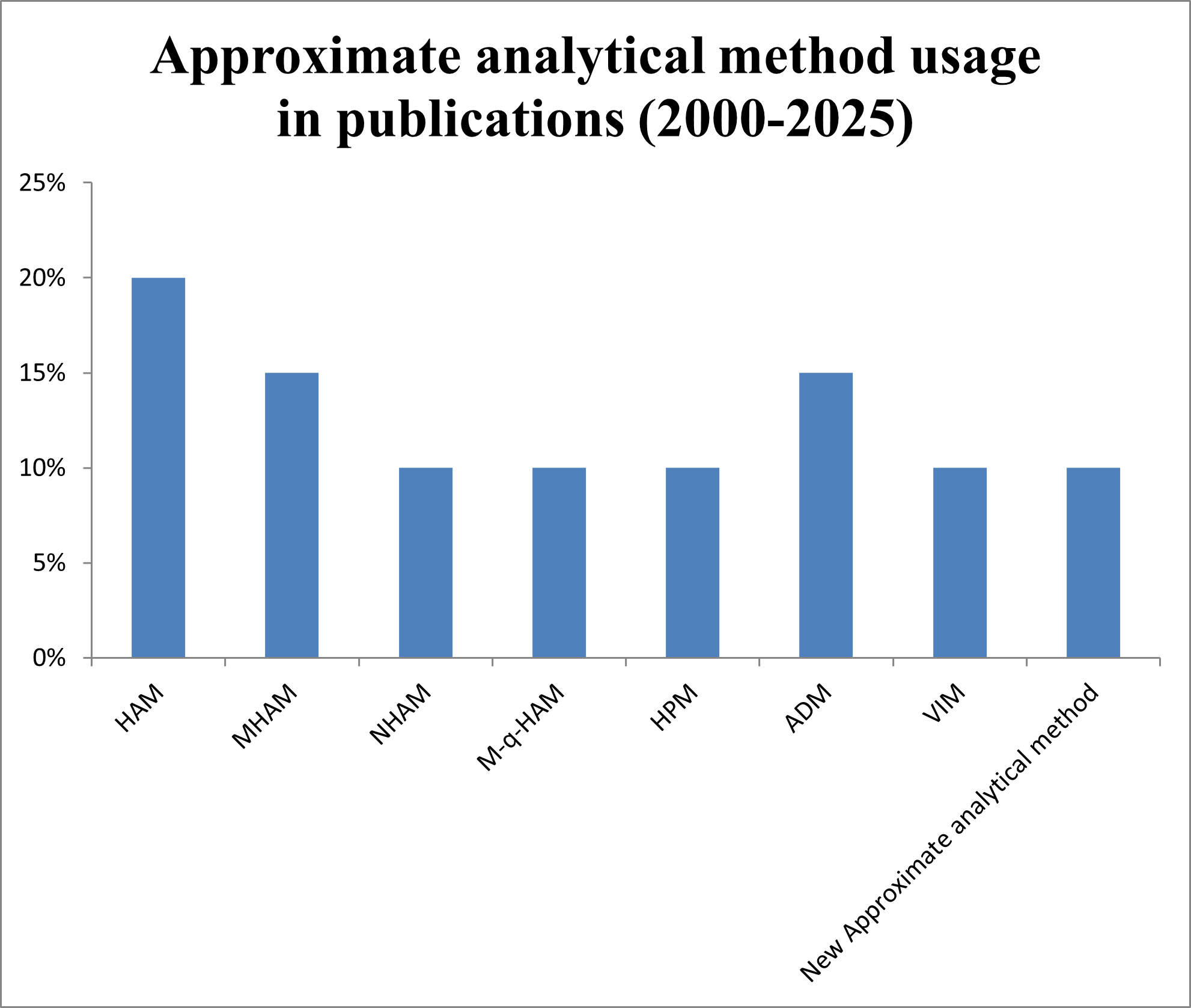
Figure 2. Relative usage of approximate and semi-analytical methods in publications (2000–2026): HAM: Homotopy Analysis Method; MHAM: Modified HAM; NHAM: New HAM; M-q-HAM: Modified q-HAM; HPM: Homotopy Perturbation Method; ADM: Adomian Decomposition Method; VIM: Variational Iteration Method; New Approximate: Analytical Method.
Interpretation and significance
Figure 1 underscores the breadth of research, with substantial contributions in fluid dynamics, chemical processes, and epidemiological and biological modeling. Figure 2 emphasizes methodological versatility, showing a balanced application of HAM, MHAM, NHAM, M-q-HAM, HPM, ADM, VIM, and other new approximate techniques. Together, these visuals provide a quantitative overview of publication trends, illustrating both interdisciplinary scope and the development and application of semi-analytical methods over more than two decades.
These summaries highlight not only research productivity but also the evolution and impact of semi-analytical methods in addressing non-linear differential equations across physical, chemical, and biological sciences. They offer insight into the practical relevance and adaptability of these techniques for multi-disciplinary scientific modeling.
Conclusion
The survey of approximate analytical and semi-analytical methods highlights their crucial role in solving non-linear differential equations across physical, chemical, and biological sciences. Techniques such as HAM, MHAM, NHAM, M-q-HAM, HPM, ADM, VIM, and newly developed analytical methods provide explicit or semi-explicit solutions with high accuracy, rapid convergence, and reduced computational effort, offering clear advantages over purely numerical approaches. In physical sciences, these methods effectively address MHD flows, non-Newtonian fluids including Casson, Williamson, and Maxwell models, and stagnation-point flow problems. In chemical sciences, they are successfully applied to dual biosensors, autocatalytic reactions, chemical kinetics, and reaction–diffusion systems, enabling detailed parametric and sensitivity analyses. In biological applications, semi-analytical methods have been employed for epidemic and infectious disease models such as COVID-19, Lassa fever, hepatitis B, measles, and typhoid, providing explicit insight into disease transmission dynamics and the effectiveness of intervention strategies. Comparative assessments indicate that homotopy-based methods are most widely used, with decomposition and variational iteration methods complementing specific problem types. Overall, the literature confirms that approximate and semi-analytical methods form a robust, versatile, and interdisciplinary framework, effectively bridging theoretical analysis and practical modeling of complex non-linear systems.
References
2. Liao S, Campo A. Analytic solutions of the temperature distribution in Blasius viscous flow problems. Journal of Fluid Mechanics. 2002 Feb;453:411–25.
3. He JH. Homotopy perturbation method: a new nonlinear analytical technique. Applied Mathematics and computation. 2003 Feb 15;135(1):73–9.
4. Wazwaz AM. A reliable modification of Adomian decomposition method. Applied mathematics and computation. 1999 Jul 1;102(1):77–86.
5. Akbari M, Ahmadi A, Ganji DD. Nonlinear dynamic in engineering by Akbari-Ganji’s method. Xlibris Corporation; 2015 Nov 10.
6. He JH. Variational iteration method–a kind of non-linear analytical technique: some examples. International journal of Non-linear mechanics. 1999 Jul 1;34(4):699–708.
7. Huseen SN, Grace SR. Approximate Solutions of Nonlinear Partial Differential Equations by Modified q‐Homotopy Analysis Method. Journal of Applied Mathematics. 2013;2013(1):569674.
8. Lakshmi CG, Ananthaswamy V, Sivasankari S, Subha M. A Mathematical Study on Non-linear Simultaneous Differential Equations of Blood-Based Casson Nanofluid. Discontinuity, Nonlinearity, and Complexity. 2025 Dec 1;14(04):719–30.
9. Kalaivani M, Sivasankari S, Ananthaswamy V, Santhi VK, Sivasundaram S. A semi-analytical investigation on the system of non-linear differential equations in MHD stagnation-point flow. Nonlinear Studies. 2025 Nov 28;32(4):1293–308.
10. Muthukaruppan S, Eswari A, Rajendran L. Mathematical modelling of a biofilm: The Adomian decomposition method. Natural Science. 2013 Apr 17;5(4):456–62.
11. Manimegalai B, Lyons ME, Rajendran L. A kinetic model for amperometric immobilized enzymes at planar, cylindrical and spherical electrodes: The Akbari-Ganji method. Journal of Electroanalytical Chemistry. 2021 Jan 1;880:114921.
12. Shruthi M, Ananthaswamy V, Sivasundaram S. A mathematical study on the typhoid disease model. Mathematics in Engineering, Science & Aerospace (MESA). 2024 Dec 1;15(4).
13. Meenakshi S, Ananthaswamy V, Jothi JA, Sivasundaram S, Santhi VK. A semi-analytical study of the SEIR model for hepatitis b disease in Ambon city. MESA. 2025 Nov 28;16(4):1161–77.
14. Liao SJ. A uniformly valid analytic solution of two-dimensional viscous flow over a semi-infinite flat plate. Journal of Fluid Mechanics. 1999 Apr;385:101–28.
15. Liao SJ. An approximate solution technique not depending on small parameters: a special example. International Journal of Non-Linear Mechanics. 1995 May 1;30(3):371–80.
16. Liao SJ. An explicit totally analytic approximation of Blasius viscous flow problems.
17. Liao SJ. The proposed homotopy analysis technique for the solution of nonlinear problems (Doctoral dissertation, Ph. D. Thesis, Shanghai Jiao Tong University).
18. Lone SA, Anwar S, Raizah Z, Kumam P, Seangwattana T, Saeed A. Analysis of the Time-Dependent magnetohydrodynamic Newtonian fluid flow over a rotating sphere with thermal radiation and chemical reaction. Heliyon. 2023 Jul 4;9(7):e17751.
19. Rabbani M. New homotopy perturbation method to solve non-linear problems. J. Math. Comput. Sci. 2013;7(1):272–5.
20. Biazar J, Eslami M. A new homotopy perturbation method for solving systems of partial differential equations. Computers & Mathematics with Applications. 2011 Jul 1;62(1):225–34.
21. Ananthaswamy V, Sivasankari S, Sivasundaram S. A semi-analytical expression of heat transfer equation using a new approximate analytical approach. Nonlinear Studies. 2024 Jul 1;31(3): 779–94.
22. Sivasankari S, Ananthaswamy V. A mathematical study on non-linear ordinary differential equation for Magnetohydrodynamic flow of the Darcy-Forchheimer nanofluid. Computational Methods for Differential Equations. 2023 Jul 1;11(4):696–715.
23. Petchiammal G, Ananthaswamy V. A semi analytical study on non-linear boundary value problem for MHD fluid flow with chemical effect. Journal of Heat and Mass Transfer Research. 2024 Nov 1;11(2):237–54.
24. Ananthaswamy V, Kalaivani M, Sivasankari S. Approximate analytical study on Maxwell and Williamson nanofluid flow. Computational Methods for Differential Equations. 2025 Nov 7.
25. Lakshmi CG, Ananthaswamy V, Sivasankari S, Sivasundaram S. A semi-analytical method for solving the non-linear differential equation of a completely wet trapezoidal fin. Mathematics in Engineering, Science & Aerospace (MESA). 2025 Mar 1;16(1):131–45.
26. Meenakshi S, Ananthaswamy V, Subha M, Shruthi M, Sivasundaram S. A semi-analytical study of a non-linear initial value problem for the measles disease model. Mathematics in Engineering, Science & Aerospace (MESA). 2025;16(3)899–911.
27. Meenakshi S, Ananthaswamy V, Jothi JA, Sivasundaram S. Mathematical analysis of COVID-19 disease in Malaysia using SIRS model. Nonlinear Studies. 2025 Apr 1;32(2).
28. Meenakshi S, Ananthaswamy V, Jothi JA, Sivasundaram S. Mathematical analysis of COVID-19 disease in Malaysia using SIRS model. Nonlinear Studies. 2025 Apr 1;32(2).
29. Ananthaswamy V, Anantha Jothi J, Subha M. A mathematical study on reaction-diffusion process in amperometric biosensor. Journal of Applied Nonlinear Dynamics. 2025;15(3):615–27.
30. Vijayalakshmi V, Ananthaswamy V, Anantha Jothi J. Semi-analytical study on non-isothermal steady R-D equation in a spherical catalyst and biocatalyst. CFD Letters. 2023;15(12):60–76.
31. Chitra J, Ananthaswamy V, Gajendran P, Anantha Jothi J. Semi-analytical expressions of non-linear R-D equations in mixed quadratic-cubic autocatalytic reactions. CFD Letters. 2023;15(11):131–50.
32. Ananthaswamy V, Vijayalakshmi V, Anantha Jothi J, Sivasundaram S. A mathematical analysis of transport and kinetics in electrocatalytic thin film biosensors with non-Michaelis-Menten kinetics. Mathematics in Engineering, Science and Aerospace. 2023;14(2):1–16.
33. Anantha Jothi J, Ananthaswamy V, Sivasundaram S. A mathematical study on non-linear differential equations in dual biosensor. Mathematics in Engineering, Science and Aerospace. 2025;16(3):709–31.