Loading


Journal of Muscle Biology
ISSN: 3144-6868
Archive
2026
Recommended Articles
Muscle Biology and the Pathogenesis of AIS: Insights from Electrophysiology, Imaging, Histology, and Molecular Genetics
Studies have indicated that patients with idiopathic scoliosis (IS) commonly present with an imbalance of the paraspinal muscles regarding the orientation, length, thickness, volume, cross sectional area, and fiber type composition. However, whether paraspinal muscle imbalance is the cause or the consequence of spinal deformities in IS, remains unclear.
Sarcopenia: An Upcoming Challenge for Elderly Health
Ageing is known to be a natural process but is associated with significant decline in neuromuscular function and performance. Sarcopenia is an age related disease described by progressive loss of skeletal muscle mass and function. In addition, sarcopenia is a major clinical problem in public health of older people; with some adverse outcomes such as disability, poor quality of life, and increased risk of death.
The Wugeng China Initiative: A Muscle-centric Microcirculation Paradigm for Eliminating Lethal Stroke, Dementia, and Heart Attack – Operationalizing "Treating Pre-disease" Through the 4s Muscle Maintenance Model
"Wugeng" (??)—literally meaning "free of obstruction/infarction for stroke and dementia" represents a transformative national health goal for China: the annual elimination or near-zero incidence of lethal stroke, dementia, and heart attack through systematic preservation of the muscle-vascular-brain axis.
Trends in Muscle Biology: To the Science of Plasticity and Regeneration
This manuscript reviews key advancements in muscle biology, focusing on molecular mechanisms underlying muscle plasticity and regeneration. We explore the roles of myokines, particularly interleukin-6 (IL-6), and the mechanistic target of rapamycin (mTOR) signaling pathway in muscle adaptation and repair.
Biochemistry of Myopathies and Biochemical Remediation
Myopathies constitute a heterogeneous group of disorders defined by impaired skeletal muscle functions that originate from structural, metabolic, genetic, or inflammatory abnormalities. At the biochemical level, these conditions are characterized by significant disruptions in essential processes, including energy metabolism, calcium homeostasis, and redox balance.
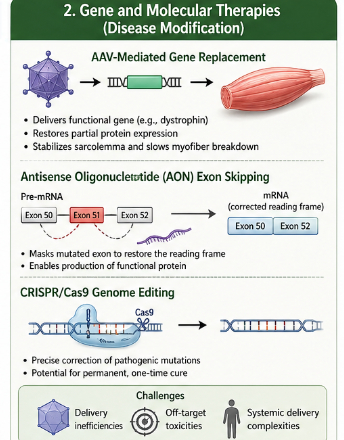
Current Advances and Future Directions in AAV Gene Therapy for Duchenne Muscular Dystrophy
Duchenne muscular dystrophy (DMD) is a serious genetic disease that affects muscles, caused by loss-of-function mutations in the DMD gene, which encodes the structural protein dystrophin. The absence of dystrophin leads to destabilization of the dystrophin-associated glycoprotein complex (DAPC), compromises sarcolemmal integrity and trigger progressive muscle fiber degeneration.