

Abstract
Transgender women (TW) experience high rates of anal cancer, yet linkage to high-resolution anoscopy (HRA) following abnormal anal cancer screening (AACS) remains low. This study identifies stakeholder-informed interventions to improve linkage to HRA among TW.
We interviewed eight stakeholders: 4 healthcare professionals involved in ACS in the Mid-Atlantic US and 4 TW community leaders in Washington DC. Interviews elicited recommendations for intervention strategies targeting previously identified barriers and facilitators to HRA among TW. Transcripts were analyzed using rapid qualitative methods.
Stakeholders identified three key intervention targets: 1) educational sessions for TW with AACS, 2) provider education, and 3) integration of HRA into gender-affirming care clinics. Educational sessions to TW should be led by trusted sources such as TW peers, case managers, or clinicians, and use accessible language. Provider education should focus on screening guidelines, communication skills, and trust-building. Integration of HRA into gender-affirming care clinics may enhance comfort and continuity of care, though feasibility is limited by a shortage of trained HRA providers.
Stakeholder perspectives highlight the need to incorporate peer support, provider training, and structural integration of services to improve linkage to HRA among TW and close the gap in anal cancer prevention. Such interventions would require piloting to test their acceptability and feasibility in real-world settings.
Keywords
Sexual and gender minorities, HPV, Cancer prevention and control, Sexual health, Qualitative evaluation, Behavior change, HIV co-infections
Introduction
Anal cancer disproportionately affects transgender women (TW) with rates 5.5 times higher than those in cisgender individuals [1]. This is due to a high prevalence of anal Human Papilloma Virus (HPV) infection – the main cause of anal cancer – and HIV, which potentiates the risk of anal cancer [2]. Current anal cancer screening (ACS) guidelines from the Center for Diseases Control and the International Anal Neoplasia Society recommend initiating screening at age 35 for TW with HIV, and at age 45 for those without HIV [3]. Screening modalities include a combination of anal cytology (anal pap) and/or high-risk HPV testing. Those with abnormal ACS (AACS) are referred for high-resolution anoscopy (HRA), a procedure that allows the histological identification of anal dysplasia, and its treatment using ablative techniques, reducing the risk of cancer by 60% [3]. Further, these medical societies recommend vaccination against HPV in populations at risk including TW up to age 45 [3].
The implementation of these ACS guidelines has faced some real-life challenges. Vaccination rates against HPV in the United States (US) are low [4] and so are rates of ACS among eligible patients [5]. Healthcare providers often lack knowledge regarding appropriate ACS practices [6]. Further, access to HRA is restricted due to a shortage of trained clinicians [7,8].
While rates of ACS are generally suboptimal, TW have disproportionately low rates of primary and secondary anal cancer prevention [9]. In a cohort of 75 TW with and without HIV in Washington DC, we have previously described low rates of HPV vaccination (24%) [2]. Such low rates are thought to be due to gendered language around HPV vaccination and low knowledge regarding this vaccine [10]. Further, of 36 TW with AACS, only 42% completed HRA highlighting missed opportunities for cancer prevention [9]. In that same cohort, we conducted a mixed-methods study to explore facilitators and barriers to HRA in TW. We found that HIV suppression, gender affirmation, and preserving anal sexual health were main facilitators to HRA completion [9]. In qualitative interviews with TW who were referred to HRA, low knowledge regarding ACS and negative patient-provider dynamics were considered barriers to HRA completion. However, evidence on effective interventions to address barriers noted in the existing literature and our own cohort to improve linkage to HRA and optimize ACS in TW remains scarce.
As such, we conducted a qualitative sub-study with community stakeholders to identify intervention elements that address the barriers identified in our previous research. Furthermore, we explored the potential use of health promotion intervention for addressing ACS. In this analysis, we aim to bridge this critical gap by presenting findings from key stakeholder interviews aimed at identifying interventions targeting these barriers, emphasizing these facilitators, and improving linkage to HRA among TW.
Methods
Conceptual frameworks
This study was guided by the Information, Motivation, and Behavioral Skills (IMB) Model [11] and Experimental Medicine Approach to Behavior Change (EMABC) to inform the conceptualization of potential intervention targets from our prior mixed-methods data into potential behavioral interventions which were evaluated by stakeholders in the study. The IMB model asserts that individual behavior change requires knowledge about the behavior being changed, motivation to change the behavior, and the necessary behavioral skills to modify the behavior [11]. The IMB model theorizes that information is both objective and subjective; motivations are based on perceptions, attitudes, intentions, and social norms; and behavioral skills require self-efficacy and planning. Complementary to the IMB model, we used the EMABC to evaluate the potential success of the proposed intervention targets. This framework was developed by the National Institutes of Health and evaluates intervention development based on identifying a target mechanism, measuring it reliably, and testing the mechanism through an experience [12]. Furthermore, the framework identifies specific classes of intervention targets which modify behavior; self-regulation, stress resilience and stress reactivity, and interpersonal and social processes. Moreover, this framework suggests that all targets should be evaluated based on malleability, testability, practicality, feasibility, and relationship to the outcome [13].
Approach
For this qualitative sub-study, we used a deductive qualitative approach [14], which is appropriate when the researchers apply an existing theory, frameworks, or set of concepts to analyze text, interviews, or observations [15]. Since this sub-study builds off the findings from our mixed-methods study that identified facilitators and barriers to HRA and potential intervention targets, a deductive approach was utilized.
Study sample
For the sub-study, we used a purposive sampling method to recruit 4 TW community leaders that either have experience working with TW or serve in community organizations that serve the transgender community in Baltimore, Maryland and Washington DC. Further we recruited 4 healthcare professionals who are involved in ACS in the Mid-Atlantic US, including referring providers who perform ACS, clinicians who perform HRA, and other healthcare personnel who coordinate the referral process. Based on the eligibility criteria for the study, a list of potential participants was created by the investigative team with feedback from TW and community partners involved in the larger study. Then, potential participants were sent an email inviting them to participate in the study. TW leaders were not asked specifically about their previous experience with ACS as this was already addressed in the mixed-methods study. Given the specific topic of the study, 8 participants were sufficient to reach saturation among the sample.
Data collection
We conducted semi-structured interviews with stakeholders using an interview guide based on existing literature on linkage to HRA and the themes which emerged from previously described mixed-methods research of TW with AACS [9]. We converted each theme from the mixed-method study into a potential intervention target based on the conceptual framework and existing literature (e.g., lack of knowledge about HPV/HRA was converted into an intervention that increases knowledge). These targets were then evaluated using the conceptual framework for viability and those deemed viable were included in the final interview guide. In the interviews, we introduced stakeholders to the steps associated with the ACS cascade and summarized findings from the mixed-methods study. Participants in the study were asked their perspective on each potential intervention for TW related to ACS and HRA. The interviews were conducted using Zoom©. The interviews took approximately 45 minutes each to complete. A third-party transcription service was used to transcribe interview audio verbatim. The study was approved by the IRB at the University of Maryland Baltimore.
Data analysis
We used rapid qualitative data analysis to identify potential interventions to address linkage to HRA. Rapid qualitative approaches are a set of qualitative and mixed-method approaches which are useful in implementation research [16]. In addition, we used a constant comparative approach to ensure saturation was achieved in the data. In our study we used a team-based, matrix-based analysis method [16]. We developed a matrix organized by the IMB model constructs and the EMABC [17]. All 5 team members reviewed and coded all the transcripts using the matrix to create a summary template for each transcript. To establish rigor and validity, each transcript and its summary template was reviewed by the study team to elaborate or expand it, as warranted. Potential interventions were organized into matrices based on agreement from the research team. We evaluated the potential interventions identified by stakeholders based on criteria of malleability, testability, practicality, feasibility, and relationship to the outcome of linkage to HRA, as outlined by the EMABC. To increase trustworthiness, the data and results were reviewed by members of the community who were not participants in the study. To reduce potential bias, the interviews were conducted by investigators who did not have affiliation with participants. Further, to increase credibility and reduce bias, the investigators used a similar reflective practice as in the mixed-method study, whereby we engaged in both reflection and discussions of bias when coding the data and bracketing of our own experiences, values, and beliefs, to enhance trustworthiness of the findings.
Results
Stakeholder characteristics
Briefly, of the 4 healthcare professionals, 2 were from federally qualified health centers, and 2 performed HRA. Of the 4 TW community leaders, 2 were members of community-based organizations (Table 1).
|
Category of Stakeholder |
Organization Type |
Relationship to ACS or HRA |
|
Healthcare Professionals |
Academic center |
Nurse who coordinates HRA referrals |
|
Academic center |
Provider who performs HRA |
|
|
Federally qualified health center |
Provider who performs ACS and refers to HRA |
|
|
Federally qualified health center |
Provider who performs HRA |
|
|
TW Leaders |
Community-based organization that serves the transgender community |
No direct relation |
|
Leader in the transgender community |
||
|
Leader in community organizing among LGBTQ populations |
||
|
Online community organizer among TW |
||
|
HRA: High-Resolution Anoscopy; LGBTQ: Lesbian, Gay, Bisexual, Transgender, and Queer; TW: Transgender Women |
||
Stakeholders recommended intervention targets that are tailored to both TW with AACS and healthcare professionals (Table 2).
|
Target audience |
Intervention |
Persons involved |
Evaluation criteria considerations |
Quotes from the stakeholders |
|
Transgender women with AACS |
Educational sessions (in-person or via video) |
Healthcare personnel (clinicians, nurses, case managers) and TW with lived experience with ACS |
|
“I would like to hear more information from a doctor's perspective, but it is also always extremely important to have a lived experienced person to kind of give them a relatable-- so that they can relate to it.” (TW community leader) |
|
Healthcare Providers |
Educational sessions |
Healthcare personnel and health systems |
|
“So educational campaign like that, educational campaign among providers to really educate them to how to deliver this information in a very patient-centered and a general format rather than very high scientific way where people will listen to you, but they probably don't know what's going on, and they'll probably forget after.” (Healthcare Worker) |
|
Embedding HRA into gender-affirming care clinics |
Healthcare personnel, and health systems |
|
“So I would say through transgender hormone replacement clinics. I think that that is somewhere that we know the trans population is going to attend.” (TW community leader) |
|
|
HRA: High-Resolution Anoscopy; TW: Transgender Women; AACS: Abnormal Anal Cancer Screening |
||||
Educational sessions targeting TW with AACS
Most healthcare professionals and community leaders recommended in-person and multimedia educational sessions targeting TW with AACS to improve linkage to HRA. The in-person sessions were recommended to be given, in the clinic, before ACS, and after discussing the results of the screening. Several stakeholders recommended that healthcare professionals delivering this information include clinicians, nurses, case managers, and/or social workers. Some stakeholders from both categories stated that case managers and social workers, especially in HIV clinics, may have a very strong rapport with TW and may represent a trusted resource for relaying information related to ACS. One TW community leader mentioned: “I would say maybe a case manager, a person who's not a doctor, a person who's a little bit more empathetic and know a little bit more about how the person feels.”
Both healthcare and community leader stakeholders suggested that TW peers, with lived experience with ACS, provide these educational sessions. A TW community leader reported: “I would like to hear more information from a doctor's perspective, but it is also always extremely important to have a lived experienced person to kind of give them a relatable-- so that they can relate to it.” Similarly, a healthcare professional who performs HRA stated: “I don't think it's necessarily doctors because we tend to talk over everyone's education level pretty significantly. So if there were such a role, and some clinics do have clinical educators that are very good at delivering this information, would be, I think, more useful.”
However, some healthcare stakeholders highlighted the importance of robust scientific training of these peers to ensure gaining trust from patients. One healthcare provider discussed: “I was alluding to the fact that peer navigators to be scientifically informed for them to deliver the information in a manner which is comprehensible to the person listening to them.”
Regarding multimedia educational tools, most community leaders and healthcare stakeholders recommended sharing videos with TW with AACS. These videos would explain the importance of ACS, the different aspects of the HRA procedure, and the recommended follow-up steps. Like in-person sessions, stakeholders recommended that either healthcare professionals and/or TW with lived experience with ACS relay this information in these videos. These interventions aim to target information and motivation of the IMB Model (Figure 1).
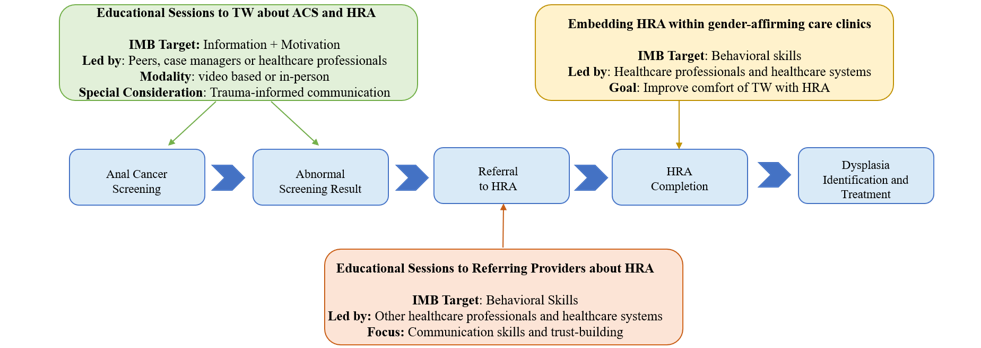
Figure 1. Conceptual model of interventions targeting different stages of the Anal Cancer Screening (ACS) continuum, from ACS to High-Resolution Anoscopy (HRA), among Transgender Women (TW), and their relationship to the Information-Motivation-Behavioral Skills (IMB) Model constructs.
The acceptability and feasibility of both interventions would depend on human and financial resources available to health systems looking to implement these interventions. To make these interventions more accessible, stakeholders recommended using language that accommodates low health literacy, keeping videos short, and adopting trauma-informed communication practices. They also advised avoiding the word “cancer” when explaining screening results via multimedia tools. One healthcare provider who was conducting ACS and referring patients to HRA shared that a TW experienced trauma after reading the word “cancer” when receiving her cancer screening recommendations by text message: “Some of my patients came to me crying in the visit, said, "I got a text from [redacted]. I am scared that I have cancer." [..] but it's the intention how we deliver. So, when we use things like cancer, like those very hardcore words in messaging, it may not deliver.”
Educational sessions targeting healthcare workers
All healthcare professional stakeholders recommended offering educational sessions targeting other healthcare professionals on the benefits of ACS, culturally competent and trauma-informed communication regarding ACS, and what patients should expect when undergoing an HRA. One provider who conducts ACS in their clinic mentioned: “So educational campaign like that, educational campaign among providers to really educate them to how to deliver this information in a very patient-centered and a general format rather than very high scientific way where people will listen to you, but they probably don't know what's going on, and they'll probably forget after.” Another healthcare professional involved in referrals to HRA stated: “I would start that conversation before the Pap is collected, before the patient fully consents to the Pap. I think that the conversation really does have to start with, "This is something that I think could benefit you because you matter and I care about you. And then if it is positive, these would be the next steps. And this is what that looks like. This is what an anoscopy is. It can be just a sentence about what an anoscopy is. " That way, the patient is kind of prepared as to what are the next steps.”
These sessions should be planned by healthcare systems and given by educators with expertise in ACS. Stakeholders highlighted that the feasibility and acceptability of these sessions would depend on clinician availability and their time constraints, the availability of ACS champions in the healthcare facility, and the prioritization of ACS by the healthcare systems that serve populations at risk, notably TW and people with HIV.
Embedding HRA into gender-affirming care clinics
Both community leaders and healthcare stakeholders highlighted that the incorporation of ACS and HRA in gender-affirming care clinics could help improve linkage to HRA in this population. One community leader mentioned: “So I would say through transgender hormone replacement clinics. I think that that is somewhere that we know the trans population is going to attend”. A healthcare provider who performs HRA at a federally qualified center stated: “I think it's already integrated really well into what we're doing. It is all under the umbrella of primary care, and it's not an external referral. So they're coming here for either their gender-affirming care or their HIV care or both. If they're eligible for an anal Pap, they get it from the PCP, and the PCP refers them to me or one of two other providers to do endoscopy.”
This intervention was thought to improve TW’s comfort with HRA by having the procedure completed in a familiar space, and potentially by their own gender-affirming care clinician. However, the acceptability and feasibility of this intervention would depend on the financial resources available to purchase HRA equipment and on the limited number of clinicians who are skilled in HRA.
Discussion
Though TW are known to have high rates of anal cancer and suboptimal rates of ACS, effective interventions to enhance linkage to HRA for cancer prevention remain unknown. To address this critical gap, we engaged stakeholders to identify interventions targeting previously described facilitators and barriers to HRA linkage. Educating both TW and healthcare systems that serve them about ACS and integrating HRA practices into gender-affirming care clinics were recommended as potential strategies.
Educational sessions targeting TW with AACS are essential to ensure linkage to HRA and target both information and motivation components of the IMB Model. Improving health literacy among TW has been a key component of successful interventions for HIV treatment and prevention, suggesting that similar strategies may be effective in the context of ACS [18]. The timing of delivery and the person delivering these sessions are likely to influence their impact. TW with lived experience with ACS can build trust with other TW, improving their linkage to HRA – a strategy that has shown success in engaging TW in HIV care [18]. Delivering these sessions prior to ACS may help prepare individuals for the screening process and increase the likelihood of HRA follow-up. The role of case managers may be most valuable after referral of TW with AACS to HRA, helping patients navigate logistical and psychosocial barriers. In HIV clinics, case managers are already integral to addressing social determinants of health that can impede access to care among TW [19]. Given that low socioeconomic status is a known barrier to HRA completion, leveraging the existing infrastructure of interprofessional HIV care teams may be a practical and effective strategy to improve linkage to HRA [9].
Equally important is the need to enhance provider knowledge and competence in ACS. A lack of provider recommendation remains a major barrier to screening uptake, particularly among cisgender men who have sex with men, and likely extends to TW [6]. Educational efforts should focus on when and how to screen, how to interpret results, and how to communicate the purpose and process of HRA in a clear and affirming manner. In fact, evidence suggests that in cisgender men who have sex with men with AACS, linkage to HRA was highly influenced by the referring provider’s ability to establish trust and convey information in a supportive, culturally competent way [20]. The qualitative interviews that we conducted with TW who were referred to HRA revealed the same findings. Such training should balance trauma-informed communication that minimizes fear-based messaging while ensuring that patients receive accurate information and clear expectations regarding screening procedures and outcomes [21]. Further, incorporating cultural competency into provider education on ACS is essential to ensure a trans-affirming approach when reporting ACS results to TW. This training is critically important since most providers receive little to no formal training in transgender health [22].
Integrating HRA practice into gender affirming care was highlighted as a promising structural intervention to improve linkage to HRA among TW with AACS. The co-location of HIV treatment with gender-affirming care is a framework that is thought to improve linkage to care among TW with HIV and could be extrapolated to ACS [23]. However, the limited number of clinicians trained in HRA, and the need to train the workforce in gender-affirming care clinics in the practice of HRA, remains a significant obstacle to scaling this model [7]. Additionally, the restrictive policy landscape surrounding gender-affirming care in many states in the US may further impede the implementation of HRA programs within gender-affirming care settings, where an already strained workforce reports increased burnout associated with legislative restrictions [24]. An alternative solution would be to ensure that HRA clinics provide a welcoming environment to TW. Integrating gender-affirming cultural competency training into HRA training programs could help reach this goal. Such training would be particularly crucial in the current sociopolitical climate, where transgender individuals face increasing discrimination in healthcare and fear seeking preventative healthcare [23].
Our study has several limitations. TW with AACS who informed us of facilitators and barriers to linkage to HRA, were not themselves included as stakeholders, as they had already provided us with insight into ACS. As with many qualitative studies, the use of purposive sampling may have introduced selection bias [25], and the experiences represented in our sample may not reflect the full range of perspectives within the broader population. Additionally, although there are no standard guidelines for sample size for qualitative research [26], the small purposive sample is not representative, and the results may not be generalizable to other geographic locations. Further, the referral processes and healthcare environments described by our stakeholders may reflect specific institutional or regional contexts which could limit the generalizability of our findings to other settings, especially non-US settings. Future research should examine the acceptability and feasibility of different ACS interventions specific for TW.
Conclusion
Improving linkage to HRA among TW with AACS requires a multifaceted approach that addresses both patient and provider level barriers. Stakeholder insights underscore the importance of educational interventions targeting TW and healthcare providers, the use of peer-led support, and integration of HRA into gender-affirming care settings. Equipping healthcare professionals with the knowledge and communication skills necessary for effective screening and referral are essential steps toward reducing anal cancer disparities in this underserved population. Integrating peer support, targeted education, and gender-affirming approaches into routine care of TW can strengthen providers’ ability to screen, counsel, and link TW to timely HRA services. Policies that expand access to gender-affirming, culturally competent anal cancer prevention services and support workforce training in HRA can help reduce barriers to anal cancer prevention among TW. Future studies should focus on piloting these interventions among TW.
Acknowledgments and Declaration of Interest Statement
The authors thank the stakeholders for their time. The authors have no conflicts of interest to disclose. We acknowledge the support of the University of Maryland, Baltimore, Institute for Clinical & Translational Research (ICTR) and the National Center for Advancing Translational Sciences (NCATS) Clinical Translational Science Award (CTSA), UM1TR004926.
References
2. Harfouch O, Lisco A, Omari H, Eyasu R, Davis A, Zoltick M, et al. High Rates of High-risk HPV Anal Infection and Abnormal Cytology in a Cohort of Transgender People Assigned Male at Birth. Open Forum Infect Dis. 2024 Nov 12;11(12):ofae662.
3. Stier EA, Clarke MA, Deshmukh AA, Wentzensen N, Liu Y, Poynten IM, et al. International Anal Neoplasia Society's consensus guidelines for anal cancer screening. Int J Cancer. 2024 May 15;154(10):1694–702.
4. Amantea C, Foschi N, Gavi F, Borrelli I, Rossi MF, Spuntarelli V, et al. HPV Vaccination Adherence in Working-Age Men: A Systematic Review and Meta-Analysis. Vaccines (Basel). 2023 Feb 15;11(2):443.
5. Nyitray AG, Walsh JL, Deshmukh AA, Chiao EY, Brzezinski B, Ridolfi TJ, et al. Anal Cancer Screening Prevalence in U.S. Cities and Factors Associated With Screening. Am J Prev Med. 2026 Sep;71(3):108373.
6. Koskan AM, LeBlanc N, Rosa-Cunha I. Exploring the Perceptions of Anal Cancer Screening and Behaviors Among Gay and Bisexual Men Infected With HIV. Cancer Control. 2016 Jan;23(1):52–8.
7. Palefsky JM. Prevention of Anal Cancer in High-Risk Individuals. JAMA. 2024 Nov 19;332(19):1663–4.
8. Barnell GM, Schechter MS. Anal Cancer Screening and Prevention-A New Era, Limited by Access to High-Resolution Anoscopy. JAMA Netw Open. 2024 Mar 4;7(3):e240019.
9. Harfouch O, Whitfield D, Mammadli T, Eyasu R, Volpi C, Mansfield M, et al. A Sequential Mixed-Methods Study of Factors Associated with Low High-Resolution Anoscopy Completion in Transgender Women with Abnormal Anal Cytology. AIDS Patient Care STDS. 2025 Feb;39(2):36–43.
10. Domínguez-Riscart J, Ariza-Jimenez AB, Baez-Castillo C, Mateo-Gavira I. Factors associated with knowledge and vaccination intention for human papillomavirus on trans girls by their main caregiver: A cross-sectional study. Front Immunol. 2023 Mar 30;14:1097449.
11. Fisher JD, Fisher WA, Misovich SJ, Kimble DL, Malloy TE. Changing AIDS risk behavior: effects of an intervention emphasizing AIDS risk reduction information, motivation, and behavioral skills in a college student population. Health Psychol. 1996 Mar;15(2):114–23.
12. Sumner JA, Beauchaine TP, Nielsen L. A mechanism-focused approach to the science of behavior change: An introduction to the special issue. Behav Res Ther. 2018 Feb;101:1–2.
13. Nielsen L, Riddle M, King JW, et al. The NIH Science of Behavior Change Program: Transforming the science through a focus on mechanisms of change. Behaviour Research and Therapy 2018; 101:3–11.
14. Fife ST, Gossner JD. Deductive qualitative analysis: Evaluating, expanding, and refining theory. International journal of qualitative methods. 2024 Mar 25;23:16094069241244856.
15. Robinson OC, Bailey-Rodriguez D. Deductive qualitative research: an integrative approach to designing studies. Qualitative research in psychology. 2026 Apr 3;23(2):369–84.
16. Vindrola-Padros C, Chisnall G, Cooper S, Dowrick A, Djellouli N, Symmons SM, et al. Carrying Out Rapid Qualitative Research During a Pandemic: Emerging Lessons From COVID-19. Qual Health Res. 2020 Dec;30(14):2192–204.
17. Sheeran P, Klein WMP, Rothman AJ. Health Behavior Change: Moving from Observation to Intervention. Annu Rev Psychol 2017; 68:573–600.
18. Crepaz N, Peters O, Higa DH, Mullins MM, Collins CB. Identifying Effective Strategies for Improving Engagement in HIV Prevention and Care Among Transgender Persons in the United States: A Systematic Review. AIDS Behav. 2025 Jan;29(1):377–99.
19. Bouabida K, Chaves BG, Anane E. Challenges and barriers to HIV care engagement and care cascade: viewpoint. Front Reprod Health. 2023 Jul 20;5:1201087.
20. Apaydin KZ, Nguyen A, Panther L, Shtasel DL, Dale SK, Borba CPC, et al. Facilitators of and barriers to high-resolution anoscopy adherence among men who have sex with men: a qualitative study. Sex Health. 2018 Nov;15(5):431–40.
21. Marshall DC, Carney LM, Hsieh K, Dickstein DR, Downes M, Chaudhari A, et al. Effects of trauma history on cancer-related screening, diagnosis, and treatment. Lancet Oncol. 2023 Nov;24(11):e426–e437.
22. Yu H, Flores DD, Bonett S, Bauermeister JA. LGBTQ + cultural competency training for health professionals: a systematic review. BMC Med Educ. 2023 Aug 9;23(1):558.
23. Berrian K, Exsted MD, Lampe NM, Pease SL, Akré EL. Barriers to quality healthcare among transgender and gender nonconforming adults. Health Serv Res. 2025 Feb;60(1):e14362.
24. Scheffert AH, Timbers VL. The impact of restrictive legislation on gender-affirming care providers in the United States: A national survey. Sexuality Research and Social Policy. 2025 Oct 2:1–1.
25. Ahmad M, Wilkins S. Purposive sampling in qualitative research: A framework for the entire journey. Quality & quantity. 2025 Apr;59(2):1461–79.
26. Boddy CR. Sample size for qualitative research. Qualitative market research: An international journal. 2016 Sep 12;19(4):426–32.