

Keywords
Follicular lymphoma, Immunotherapy, Radiotherapy, Chemotherapy, Tumour immune microenvironment, Clinical trial, Positron emission tomography, Survival
Introduction
Follicular lymphoma (FL) is a complex immunological disease with a heterogenous clinical trajectory. It originates in the germinal centers of lymph node follicles, from malignant B-cell lymphocytes that usually harbor the t(14;18) chromosomal translocation, leading to an overexpression of the B-cell lymphoma 2 (Bcl-2) protein [1]. However, BCL2 overexpression alone is insufficient to drive disease development, and FL cells remain highly reliant on interactions with surrounding lymphoma microenvironment (LME) for survival, proliferation, and immune evasion [2–4]. Consequently, the onset and progression of FL are exquisitely dependent on interactions with the LME.
The unique biology of FL contributes to its marked radiosensitivity and its response to anti-CD20 directed therapy, such as rituximab, which directly targets malignant B cells and further disrupts the LME [5]. Furthermore, accumulating evidence suggests bispecific antibodies (BsAbs), such as mosunetuzumab and epcoritamab that target CD3xCD20 antigens, may overcome microenvironment mediated immune suppression, activating cytotoxic T cells and providing an effective treatment in relapsed or refractory disease [6–8]. Early-stage FL (ESFL) has a gene expression signature that differs significantly from advanced stage FL and typically has more CD8+ T cells, fewer CD68+/CD163+ macrophages and a lower rate of BCL2 translocation [9,10]. ESFL may respond more favorably compared to advanced-stage disease when treated with immunotherapy.
The updated secondary analyses from the TROG 99.03/ALLGLow5 randomized controlled trial provide a rich dataset that invites consideration beyond the headline finding of TROG 99.03: namely a 40% improvement in >10-year progression-free survival among patients with ESFL treated with rituximab, compared with those treated without rituximab (involved field radiotherapy (IFRT) plus cyclophosphamide, vincristine, prednisolone (CVP) or IFRT alone) [11,12]. The absence of any observed histological high-grade transformation among patients who received rituximab, the absence of any increased second malignancy signal within previously irradiated volumes, and the similar toxicity burden of CVP versus R-CVP, have implications that extend well into the current therapeutic era.
Here, we revisit the recently published TROG 99.03 secondary analyses, within the broader context of the published literature, to consider what they reveal about the beneficial immunological effects of rituximab and the key questions that remain in the management of ESFL. To date, TROG 99.03 remains the only randomized controlled trial examining the addition of systemic therapy to radiotherapy in ESFL. The trial randomized 75 patients to IFRT alone versus 75 to IFRT followed by systemic therapy, with approximately half of those randomized to systemic therapy receiving CVP and half — following a protocol amendment — receiving R-CVP.
Rituximab as the Active Immunological Agent: What the Transformation Data Tell Us
One of the most striking findings in the TROG 99.03 dataset is that in the subset randomized to systemic therapy, all five histological transformations to high-grade lymphoma occurred in patients who received IFRT plus CVP, while no transformations were observed in the 32 patients who received IFRT plus R-CVP [12]. The rate of transformation was similar in patients who received RT alone versus RT plus CVP without rituximab. Given the small number of events, this observation is limited and should therefore be considered hypothesis-generating rather than statistically meaningful. However, it suggests that rituximab, rather than cytotoxic chemotherapy CVP, played the most important role in suppressing the risk of histological transformation. This finding and hypothesis are supported by the population-based Aristotle study, which analyzed more than 8,000 patients with follicular lymphoma and found that exposure to rituximab as part of first-line therapy was associated with a significantly lower risk of histological transformation, irrespective of disease stage or chemotherapy backbone [13].
There are several mechanisms by which rituximab may prevent transformation. Direct anti-CD20 antibody-mediated cellular cytotoxicity (ADCC), complement-dependent cytotoxicity (CDC), and induction of apoptosis in malignant B-cells are well established [5,14]. Potentially more important in the context of transformation prevention, however, is rituximab's likely capacity to disrupt several key tumor-microenvironment interactions that occur in FL [3,4]. By depleting CD20-positive B-cells from the tumor niche, rituximab may disrupt the crosstalk between malignant B-cells and the follicular T-helper cells, macrophages and follicular dendritic cells that ordinarily sustain tumor growth and immune evasion [2–4,15]. This disruption could reduce selective pressure for the acquisition of genetic alterations deregulating cell-cycle progression and DNA damage responses (such as inactivation of CDKN2A/B, MYC rearrangements, and TP53 mutations), leading to transformed FL [16].
The updated primary analysis of TROG 99.03 (2024), identified elevated intratumoral CD8a expression on diagnostic biopsy as an independent favorable prognostic factor alongside rituximab in multivariate analysis [17]. Among patients receiving systemic therapy, those with high baseline CD8a expression who received rituximab-containing treatment had markedly superior median PFS (11.5 years) compared with either CVP alone (6.58 years) or rituximab-containing therapy in patients with low baseline CD8a expression (5.67 years), suggesting that the pre-treatment immunological context of the tumor microenvironment substantially modifies the efficacy of anti-CD20 therapy. A possible mechanistic explanation is provided by recent evidence that rituximab-mediated ADCC, which is executed by natural killer cells, is augmented by T-cell help within the tumor microenvironment; interestingly, this effect has been linked to CD4+ rather than CD8+ T cells [18], suggesting the relationship between CD8a expression and rituximab efficacy may reflect a broader immunologically "hot" microenvironment rather than a direct CD8-dependent mechanism. Conversely, tumors with low CD8a infiltration may reflect a more immunologically "cold" microenvironment and therefore be less responsive to rituximab therapy.
That CD8+ T-cell infiltration appears to be more prevalent in early-stage than advanced-stage FL lends particular relevance to these findings in the ESFL setting [10], and is consistent with earlier observations from a Nordic cohort suggesting a favorable prognostic role for CD8+ infiltration in rituximab-treated patients [19]. Whether CD8a expression constitutes a truly predictive biomarker capable of identifying patients most likely to benefit from rituximab, or reflects a more broadly favorable immune phenotype, warrants prospective evaluation. However, it raises an important prospect of immune phenotyping the FL tumor microenvironment as a future tool for treatment selection in ESFL.
Reconsidering Chemotherapy: The Case for De-escalation in Selected Patients
The TROG 99.03 secondary analyses confirm that R-CVP carries significant but manageable acute toxicity. Whilst 99% of patients receiving systemic therapy experienced some kind of adverse event (AE), 70% of these AEs were CTCAE Grade 1 or 2 [12]. Toxicity with R-CVP was generally transient, though in some cases even G1–G2 peripheral neuropathy could have been associated with a meaningful reduction in quality of life. A comprehensive account of treatment-related toxicity outcomes in TROG 99.03 is provided in the original secondary outcomes publication [12].
The observation that global toxicity burden scores were very similar between CVP and R-CVP patients, combined with the finding that transformation only occurred in the non-rituximab group, naturally prompts the question: is the chemotherapy backbone of cyclophosphamide and vincristine adding any meaningful benefit, or is it simply adding toxicity? This possibility must, however, be treated cautiously. TROG 99.03 was neither designed nor powered to formally evaluate chemotherapy omission, and no treatment arm directly compared rituximab alone with R-CVP. The question is therefore raised by indirect evidence (transformation events and toxicity burden) rather than answered by a direct randomized comparison. Can systemic therapy be de-escalated, and chemotherapy removed altogether?
Published observational and phase II evidence suggests that rituximab monotherapy combined with radiotherapy is a well-tolerated regimen that may achieve equivalent or near-equivalent long-term disease control to chemoimmunotherapy in ESFL. A multicenter Italian observational study (n=94) demonstrated that the addition of rituximab to IFRT prolonged 10 year PFS compared to IFRT alone (64.6% vs 50.7% respectively) [20]. Subsequently, the phase II MIR study (n=85) examined the use of rituximab plus involved-field RT in early-stage nodular FL and concluded that the PFS at 5 years of 78% was similar to that of TROG 99.03 (86% at 5y with IFRT + R-CVP) but without the accompanying toxicity [21]. These two studies form the foundation for the MD Anderson trial, NCI-2012-00734, which is randomizing patients with ESFL to IFRT versus IFRT plus concurrent and maintenance rituximab [22]. Recruitment is complete, and its results will provide the first randomized, prospective test of whether chemotherapy can be safely omitted from frontline systemic therapy in ESFL.
Radiotherapy as an Immune Partner
Radiotherapy's role in FL extends beyond local tumor control. It can induce a significant immune response, even producing regression outside the irradiated volume (the abscopal effect) [23]. Radiotherapy's resulting shift in the LME may enhance the activity of subsequent immunotherapy, raising the question of whether radiotherapy and anti-CD20 therapy also interact more directly at the cellular level. Preclinical evidence supports the existence of such direct radiosensitizing effects of rituximab on lymphoma cells, providing a mechanistic rationale for the combination of anti-CD20 therapy with external beam radiotherapy beyond their simply additive, independent activities. Skvortsova and colleagues demonstrated that simultaneous exposure of NHL cell lines to ionizing radiation and rituximab markedly enhanced apoptosis and cell growth delay compared with either modality alone, mediated through downregulation of c-myc and bcl-XL expression alongside modulation of cell cycle regulatory proteins including p53, p21/WAF1, and p27/KIP1 [24].
A subsequent study by the same group extended these findings, showing that rituximab abrogated the radioresistance of B-lymphoma RL and Raji cells in-vitro, and enhanced radiation-triggered apoptosis via both caspase-dependent and caspase-independent mechanisms [25]. However, the relationship between rituximab and radiation is not straightforwardly synergistic at all dose levels.
One in-vitro study found that whilst rituximab radiosensitized lymphoma cells at lower radiation doses, it paradoxically conferred relative radioprotection at higher doses, possibly through cell cycle arrest in the radioresistant G0/G1 phase, a finding that warrants consideration in the design of combined modality regimens [26]. These preclinical observations collectively suggest that the sequencing and dose of radiotherapy relative to rituximab administration may influence the magnitude of any radiosensitizing effect. Whether this translates into a clinically meaningful enhancement of tumor cell kill within the irradiated volume in ESFL, over and above what would be achieved by IFRT or rituximab alone, has not been formally tested, but it provides an additional biological rationale for combining low-dose radiotherapy with anti-CD20 antibody therapy in the de-escalation strategies now under investigation.
How Low Can We Go with Radiotherapy?
The rationale for de-escalation of radiotherapy partly comes from the FORT trial which established that 4 Gy radiotherapy was effective at providing good local control for indolent lymphoma with minimal toxicity, with 81% of patients responding to treatment [27,28]. However, 4 Gy was inferior to 24 Gy in achieving complete response (CR): 68% of sites irradiated after 24 Gy achieved CR whereas only 49% achieved it after 4 Gy [27]. CR rate at a single early timepoint may nonetheless underestimate true long-term local disease control — in the TROG 99.03 study, fewer than 5% of patients had isolated in-field relapses after 30 Gy.
When combined with immunotherapy, the primary role of low-dose RT (LDRT) need not be permanent local disease eradication per se, but rather to exert an immunomodulatory effect on the tumor microenvironment and amplify the anti-tumor immune response induced by anti-CD20 antibody therapy [29]. This potential synergy between LDRT and anti-CD20 antibodies is now being tested prospectively, with complete metabolic response (CMR) as the key outcome measure — a marker already established as prognostic for progression-free survival in FL by the landmark GALLIUM trial using baseline and end-of-induction PET/CT scans [30].
The GAZAI trial (NCT03341520) is a single arm phase II study investigating the synergistic effect of combination LDRT (4 Gy) and anti-CD20 antibody obinutuzumab in patients with early-stage nodular follicular lymphoma with the aim of reducing the RT dose whilst maintaining adequate CMR. It reported its promising interim results in 2023: 46/53 patients (87%) achieved a CMR at 18 weeks (Deauville score <3) [31].
Following this, the FORTplus trial (NCT05045664) is now investigating this further in a randomized phase III study, setting out to prove the non-inferiority of LDRT (4 Gy) in a combined approach with an anti-CD20-antibody, and the possible superiority of the obinutuzumab + LDRT vs rituximab and standard dose radiotherapy [32]. The results of this are eagerly awaited.
Low Rate of Treatment-Related Second Malignancies
The TROG 99.03 secondary analyses provide unique long-term data on second malignancy risk, with 29 new malignancies diagnosed in 28 patients over a median follow-up of 11.3 years [12]. The observation that the large majority (26/29, 90%) occurred distant from the previously irradiated volume is reassuring and consistent with emerging evidence from other NHL cohorts that modern IFRT, with smaller fields and more conformal techniques, contributes minimally to second cancer risk [33].
Interestingly, the cumulative incidence of second malignancies at 10 years was lowest in the R-CVP group (3%) compared to IFRT alone (15%) or IFRT plus CVP (17%), although the R-CVP-treated patients had shorter median follow-up. This is consistent with prior literature suggesting that rituximab exposure does not appreciably increase second malignancy risk beyond that conferred by chemotherapy or the underlying disease itself [34–37]. Several explanations may underlie this finding. First, in TROG 99.03 R-CVP patients experienced substantially lower rates of relapse and therefore received fewer cumulative lines of subsequent chemotherapy, reducing their exposure to chemotherapeutic agents with mutagenic potential [11]. This is consistent with the trial's observation that the single case of myelodysplasia/acute myeloid leukemia arose after multiple courses of chemotherapy for relapsed disease, rather than a likely direct consequence of frontline therapy. Secondly, rituximab's mechanism of action does not directly involve DNA damage or hematopoietic stem cell exposure, unlike alkylating agents such as cyclophosphamide. A third, more speculative possibility is that rituximab-mediated disruption of the immunosuppressive FL microenvironment may help preserve broader immune surveillance, which could plausibly reduce susceptibility to second malignancies, given that FL patients carry up to a 42% excess risk of second cancers compared with the general population, an excess thought to be partly attributable to chronic immune dysfunction [35,38,39]. The sample sizes in TROG 99.03 are insufficient to distinguish between these explanations but are hypothesis-generating; evaluation in larger cohorts with mature follow up would help clarify whether the apparent advantage with rituximab reflects reduced cumulative chemotherapy exposure, preserved immune surveillance, or both. Table 1 summarizes the trials discussed above, alongside their treatment strategies, radiotherapy doses, sample sizes, key outcomes, and major limitations.
|
Trial |
Design |
Treatment strategy |
RT dose |
Sample size |
Key outcome |
Major limitations |
|
TROG 99.03 / ALLG NHL05 (MacManus et al. 2018) [11]
TROG 99.03/ ALLG NHL05 Secondary analyses (Johnstone et al. 2026) [12] |
Randomized controlled trial |
IFRT alone vs IFRT + systemic therapy (CVP, later amended to R-CVP) |
IFRT (standard dose) |
n=150 |
>10-year PFS improved 40% with rituximab-containing arm; all 5 histological transformations occurred in the non-rituximab arm; similar toxicity with CVP vs R-CVP |
Small number of transformation events (5) thus no formal statistical inference possible; predates FDG-PET staging and obinutuzumab/bispecific antibodies |
|
Italian multicentre observational study (Ruella et al. 2016) [20] |
Retrospective observational |
IFRT ± rituximab |
IFRT |
n=94 |
10-year PFS 64.6% (+rituximab) vs 50.7% (IFRT alone) |
Observational, retrospective data, non-randomized |
|
MIR study (Herfarth et al. 2018) [21] |
Phase II, single-arm |
Rituximab + IFRT |
IFRT |
n=85 |
5-year PFS 78%, similar to TROG 99.03 R-CVP arm (86%) but without added toxicity |
No randomized comparator; single-arm phase II design |
|
MD Anderson trial (NCI-2012-00734. Current) [22] |
Randomized controlled trial |
IFRT vs IFRT + concurrent/maintenance rituximab |
IFRT |
Recruitment complete; not yet reported |
Pending — first randomized, prospective test of chemotherapy omission in ESFL |
Results not yet available |
|
FoRT trial (Hoskin et al. 2014; long-term follow-up 2021) [27,28] |
Randomized controlled trial, phase 3 non-inferiority |
RT dose comparison alone |
4 Gy vs 24 Gy |
n=548 |
4 Gy inferior to 24 Gy for local control (5-year LPFS 70.4% vs 89.9%) and complete response (49% vs 68%) |
Includes follicular and marginal zone lymphoma across all stages and both radical/palliative intent, not ESFL-specific |
|
FORTplus trial (NCT05045664. Current) [32] |
Randomized controlled trial, phase III |
Low-dose RT (4 Gy) + obinutuzumab vs standard-dose RT + rituximab |
4 Gy vs standard dose |
Ongoing |
Pending — testing non-inferiority of low-dose RT + obinutuzumab |
Results not yet available |
|
GAZAI (NCT03341520; Herfarth et al. 2023) [31] |
Phase II, single-arm |
Low-dose RT (4 Gy) + obinutuzumab |
4 Gy |
n=53 |
Interim (2023): 46/53 (87%) achieved complete metabolic response at 18 weeks (Deauville <3) |
Interim results only; single-arm, no randomized comparator; small sample |
|
PFS: Progression-Free Survival; IFRT: Involved-Field Radiotherapy; RT: Radiotherapy; LPFS: Local Progression-Free Survival; CVP: Cyclophosphamide, Vincristine, Prednisolone; R-CVP: Rituximab plus CVP. |
||||||
Where This Leaves Us: Initial Treatment Selection for Early-Stage Fl in the 2026 Landscape
The trajectory of these findings points toward a future ESFL treatment paradigm built on immunological rather than purely anatomical or histological criteria. TROG 99.03 remains the only randomized controlled trial to compare RT alone with RT plus adjuvant systemic therapy, and therefore constitutes the only level 1 evidence to date. Notably, the trial was designed and conducted in an era predating both incorporation of FDG-PET into staging and the development of more effective anti-CD-20 antibodies, such as obinutuzumab. Despite these limitations, its findings make clear that the initial treatment strategy in ESFL warrants careful consideration where long term PFS and freedom from transformed disease are important to the patient and secondary analyses provide a coherent rationale for testing immunotherapeutic agents earlier in the disease course.
Radiotherapy alone can therefore no longer serve as the benchmark against which future strategies aimed at improving long-term disease free survival are compared. Instead, the combination of local radiation therapy and rituximab offers a low-toxicity and cost-effective [40] benchmark against which newer and more expensive therapies — such as obinutuzumab or bispecific agents - should be evaluated. Obinutuzumab's enhanced direct cytotoxicity and ADCC relative to rituximab [41,42] is already being exploited in GAZAI and FORTplus trials as a means of potentially compensating for reduced radiotherapy dose [31,32]. Whether this translates into durable disease control, and whether it further reduces risk of high grade transformation beyond what moderate-dose radiotherapy and rituximab can achieve, remains to be established.
The newer CD3xCD20 bispecific antibodies, such as mosunetuzumab and epcoritamab, offer a mechanistically distinct approach to engaging T-cell immunity against CD20-positive tumor cells. Unlike rituximab, whose efficacy may depend in part on the local microenvironment already containing sufficient effector or helper T cells to support NK-cell-mediated ADCC, bispecific antibodies act by directly cross-linking CD3 on any circulating or tissue-resident T cell to CD20 on the tumor cell, triggering T-cell activation and direct cytotoxicity independent of pre-existing tumor-infiltrating lymphocyte density, NK-cell function, or complement fixation [6,7,43]. This mechanism does not require a tumor already populated by an adequate T-cell infiltrate; rather, it recruits and activates T cells at the tumor site regardless of the baseline immune landscape. As such, CD3xCD20 bispecific antibodies may represent a particularly valuable strategy in tumors with a CD8-poor, immunologically "cold" microenvironment, where insufficient tumor T-cell infiltration could limit the effectiveness of antibody therapies that depend on it.
Combining low-dose radiotherapy — which induces immunogenic cell death and recruits effector T-cells into the tumor microenvironment [44] — with a bispecific antibody capable of engaging those recruited T-cells against residual disease is an attractive hypothesis that has yet to be tested in ESFL. This raises the prospect of an immunologically rational treatment algorithm in which patients with CD8-enriched tumors might be managed with radiotherapy plus rituximab or obinutuzumab, while those with CD8-poor disease are directed toward radiotherapy plus CD3xCD20 bispecific antibody. Figure 1 demonstrates an example schematic diagram to this effect.
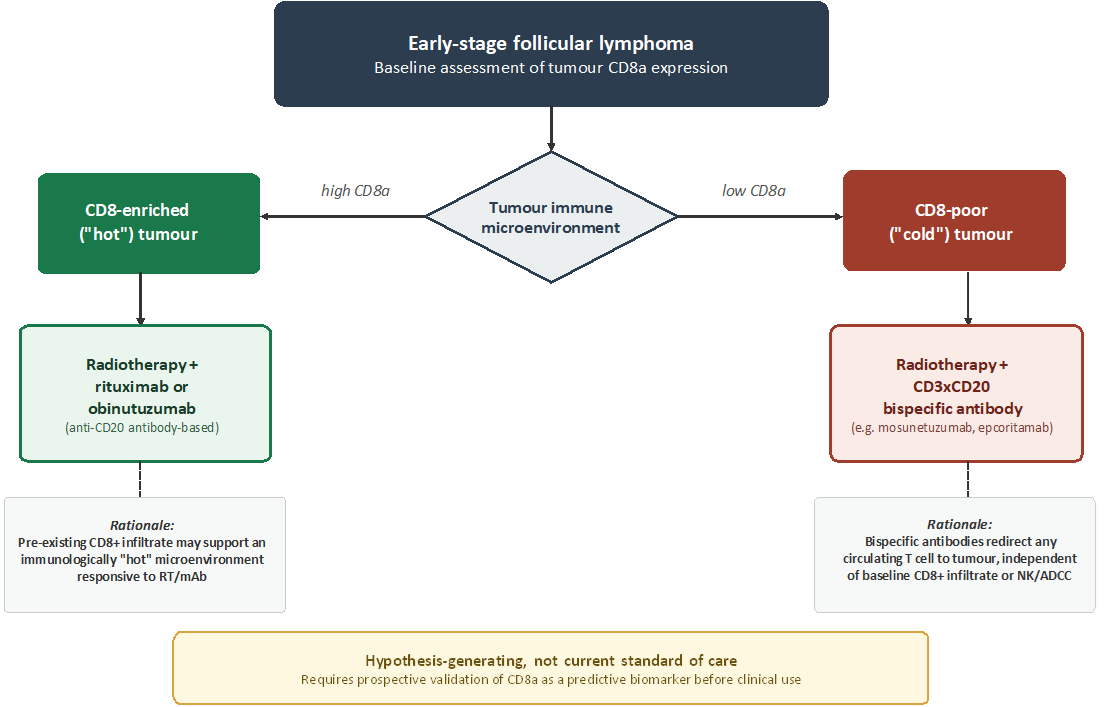
Figure 1. Proposed biomarker-guided treatment algorithm for early-stage follicular lymphoma (ESFL). Tumors with high baseline CD8a expression (an immunologically "hot" microenvironment) may be preferentially managed with radiotherapy plus an anti-CD20 antibody (rituximab or obinutuzumab), which depend in part on pre-existing CD8+ effector cells and NK-cell-mediated ADCC. Tumors with low CD8a expression ("cold" microenvironment) may instead be directed toward radiotherapy plus a CD3xCD20 bispecific antibody (e.g. mosunetuzumab, epcoritamab), which redirects circulating T cells to the tumor independent of baseline immune infiltrate. This algorithm is hypothesis-generating and has not been prospectively validated; CD8a is not currently a validated predictive biomarker and should not yet guide treatment selection outside a research setting.
It is worth noting, however, that bispecific agents are currently expensive and can carry significant toxicity [45]. Their widespread adoption in ESFL would only be justifiable if they proved cost-effective and could match the PFS achieved with radiotherapy plus R-CVP in the TROG 99.03 study. Replacing radiotherapy — an inexpensive, effective, and low-toxicity backbone of combination therapy in ESFL — in favor of a more costly and potentially more toxic alternative would require high-level evidence of superior efficacy.
Chimeric antigen receptor (CAR) T-cell therapy represents a further, mechanistically distinct approach to engaging T-cell immunity against B-cell lymphoma and is already established in the relapsed/refractory setting [46–48]. Axicabtagene ciloleucel, an autologous anti-CD19 CAR T-cell product, achieved an overall response rate of 94% (79% CR) in the pivotal ZUMA-5 trial in the FL subgroup of relapsed/refractory indolent non-Hodgkin lymphoma [49]. Tisagenlecleucel, a second CD19-directed CAR T-cell product, produced a CR rate of 69.1% and an overall response rate of 86.2% in the ELARA trial, with a manageable toxicity profile (grade ≥3 cytokine release syndrome in 0% and grade ≥3 neurotoxicity in 3% of patients) [50]. Both products are now FDA approved for relapsed/refractory FL. However, this evidence base is confined to heavily pretreated, relapsed/refractory disease, where tumor burden, prior immunosuppression, and host immune fitness differ substantially from the first-line ESFL setting. Extrapolating a role for CAR T-cell therapy to first-line ESFL is currently not supported by any existing trial data.
Realizing any of these biologically guided strategies, such as a CD8a-directed treatment algorithm, low-dose radiotherapy combined with anti-CD20 or bispecific antibodies, or cellular therapies, will require long-term prospective trial data. For approaches guided by immune phenotype, this will also require routine, standardized assessment of the tumor immune microenvironment at diagnosis, a practice not currently employed in most FL staging pathways. The TROG 99.03 CD8a findings illustrate what such a biomarker might look like, though, as discussed below, several limitations temper how far these findings can currently be extended.
Limitations
Several limitations warrant consideration. TROG 99.03 remains the only randomized controlled trial directly testing the addition of systemic therapy to radiotherapy in ESFL, thus much of the surrounding discussion draws on observational, phase II, and biomarker data [17,19–21]. The trial predates the routine use of FDG-PET in staging, raising the possibility of occult under-staging in some patients; its findings should therefore be interpreted with caution when applied to a contemporary, PET-staged population. The prognostic value of CD8a expression, while biologically plausible [17,18], has not been prospectively validated and should not yet guide treatment selection. At present, proposed future strategies remain supported only by indirect or preclinical evidence.
Conclusion
The secondary analyses of TROG 99.03, along with other published literature, suggest that rituximab, not the cytotoxic chemotherapy backbone, is the agent most plausibly responsible for the prevention of histological transformation and the favorable long-term outcomes observed with combined modality therapy in ESFL. Taken together with the broader shift toward immunologically guided therapy in FL, this reframes the central clinical question from "should systemic therapy be added to radiotherapy" to "which systemic therapy, with what dose of radiotherapy, and for which patients." The emerging evidence around radiotherapy dose de-escalation, the immunological synergy between low-dose radiotherapy and anti-CD20 antibody therapy, and the apparent absence of added second malignancy risk with rituximab collectively support a shift away from chemotherapy-based combinations and toward immunological, biomarker-informed treatment strategies. The results of FORTplus and the MD Anderson trial will be important steps in testing these hypotheses prospectively; in the interim, TROG 99.03 is a reminder of how a robust, mature study continues to generate questions and discussion long after having been reported.
Conflicts of Interest
None.
Funding
None.
Author Contributions
Both authors contributed to the conceptualization, writing and editing of this article.
References
2. Dobaño-López C, Araujo-Ayala F, Serrat N, Valero JG, Pérez-Galán P. Follicular Lymphoma Microenvironment: An Intricate Network Ready for Therapeutic Intervention. Cancers (Basel). 2021 Feb 5;13(4):641.
3. Laurent C, Dietrich S, Tarte K. Cell cross talk within the lymphoma tumor microenvironment: follicular lymphoma as a paradigm. Blood. 2024 Mar 21;143(12):1080–90.
4. Radtke AJ, Roschewski M. The follicular lymphoma tumor microenvironment at single-cell and spatial resolution. Blood. 2024 Mar 21;143(12):1069–79.
5. Feugier P. A review of rituximab, the first anti-CD20 monoclonal antibody used in the treatment of B non-Hodgkin's lymphomas. Future Oncol. 2015;11(9):1327–42.
6. Linton KM, Vitolo U, Jurczak W, Lugtenburg PJ, Gyan E, Sureda A, et al. Epcoritamab monotherapy in patients with relapsed or refractory follicular lymphoma (EPCORE NHL-1): a phase 2 cohort of a single-arm, multicentre study. Lancet Haematol. 2024 Aug;11(8):e593–e605.
7. Budde LE, Sehn LH, Matasar M, Schuster SJ, Assouline S, Giri P, et al. Safety and efficacy of mosunetuzumab, a bispecific antibody, in patients with relapsed or refractory follicular lymphoma: a single-arm, multicentre, phase 2 study. Lancet Oncol. 2022 Aug;23(8):1055–65.
8. Budde LE, Assouline S, Sehn LH, Schuster SJ, Yoon SS, Yoon DH, et al. Durable Responses With Mosunetuzumab in Relapsed/Refractory Indolent and Aggressive B-Cell Non-Hodgkin Lymphomas: Extended Follow-Up of a Phase I/II Study. J Clin Oncol. 2024 Jul 1;42(19):2250–56.
9. Staiger AM, Hoster E, Jurinovic V, Winter S, Leich E, Kalla C, et al. Localized- and advanced-stage follicular lymphomas differ in their gene expression profiles. Blood. 2020 Jan 16;135(3):181–90.
10. Los-de Vries GT, Stevens WBC, van Dijk E, Langois-Jacques C, Clear AJ, Stathi P, et al. Genomic and microenvironmental landscape of stage I follicular lymphoma, compared with stage III/IV. Blood Adv. 2022 Sep 27;6(18):5482–93.
11. MacManus M, Fisher R, Roos D, O'Brien P, Macann A, Davis S, et al. Randomized Trial of Systemic Therapy After Involved-Field Radiotherapy in Patients With Early-Stage Follicular Lymphoma: TROG 99.03. J Clin Oncol. 2018 Oct 10;36(29):2918–25.
12. Johnstone P, Bressel M, Seymour JF, Juneja S, Ahmad H, MacManus M. Secondary outcomes of the TROG 99.03 randomized trial of systemic therapy after involved-field radiotherapy in early-stage follicular lymphoma, including toxicity, relapse and second malignancy data. Radiother Oncol. 2026 Apr;217:111388.
13. Federico M, Caballero Barrigón MD, Marcheselli L, Tarantino V, Manni M, Sarkozy C, et al. Rituximab and the risk of transformation of follicular lymphoma: a retrospective pooled analysis. Lancet Haematol. 2018 Aug;5(8):e359–e367.
14. Weiner GJ. Rituximab: mechanism of action. Semin Hematol. 2010 Apr;47(2):115–23.
15. Pangault C, Amé-Thomas P, Ruminy P, Rossille D, Caron G, Baia M, et al. Follicular lymphoma cell niche: identification of a preeminent IL-4-dependent T(FH)-B cell axis. Leukemia. 2010 Dec;24(12):2080–9.
16. Pasqualucci L, Khiabanian H, Fangazio M, Vasishtha M, Messina M, Holmes AB, et al. Genetics of follicular lymphoma transformation. Cell Rep. 2014 Jan 16;6(1):130–40.
17. MacManus MP, Seymour JF, Tsang H, Fisher R, Keane C, Sabdia MB, et al. Adjuvant rituximab and elevated intratumoural CD8 expression are associated with sustained disease control after radiotherapy in a randomised trial of systemic therapy in early-stage follicular lymphoma. EBioMedicine. 2024 Dec;110:105468.
18. Arora J, Ayyappan S, Yin C, et al. T-cell help in the tumor microenvironment enhances rituximab-mediated NK-cell ADCC. Blood. 2024;143(18):1816–24.
19. Wahlin BE, Sundström C, Holte H, Hagberg H, Erlanson M, Nilsson-Ehle H, et al. T cells in tumors and blood predict outcome in follicular lymphoma treated with rituximab. Clin Cancer Res. 2011 Jun 15;17(12):4136–44.
20. Ruella M, Filippi AR, Bruna R, Di Russo A, Magni M, Caracciolo D, et al. Addition of Rituximab to Involved-Field Radiation Therapy Prolongs Progression-free Survival in Stage I-II Follicular Lymphoma: Results of a Multicenter Study. Int J Radiat Oncol Biol Phys. 2016 Mar 15;94(4):783–91.
21. Herfarth K, Borchmann P, Schnaidt S, Hohloch K, Budach V, Engelhard M, et al. Rituximab With Involved Field Irradiation for Early-stage Nodal Follicular Lymphoma: Results of the MIR Study. Hemasphere. 2018 Nov 30;2(6):e160.
22. M. D. Anderson Cancer Center. Radiation Therapy and Rituximab in Treating Patients With Stage I-II Grade 1 or Grade 2 Follicular Lymphoma [Internet]. [cited 2026 June 15]; Available from: https://clinicaltrials.gov/study/NCT01473628
23. MacManus MP, Hofman MS, Hicks RJ, Campbell BA, Wirth A, Seymour JF, et al. Abscopal Regressions of Lymphoma After Involved-Site Radiation Therapy Confirmed by Positron Emission Tomography. Int J Radiat Oncol Biol Phys. 2020 Sep 1;108(1):204–11.
24. Skvortsova I, Popper BA, Skvortsov S, Saurer M, Auer T, Moser R, et al. Pretreatment with rituximab enhances radiosensitivity of non-Hodgkin's lymphoma cells. J Radiat Res. 2005 Jun;46(2):241–8.
25. Skvortsova I, Skvortsov S, Popper BA, Haidenberger A, Saurer M, Gunkel AR, et al. Rituximab enhances radiation-triggered apoptosis in non-Hodgkin's lymphoma cells via caspase-dependent and - independent mechanisms. J Radiat Res. 2006 Jun;47(2):183–96.
26. Kapadia NS, Engles JM, Wahl RL. In vitro evaluation of radioprotective and radiosensitizing effects of rituximab. J Nucl Med. 2008 Apr;49(4):674–8.
27. Hoskin PJ, Kirkwood AA, Popova B, Smith P, Robinson M, Gallop-Evans E, et al. 4 Gy versus 24 Gy radiotherapy for patients with indolent lymphoma (FORT): a randomised phase 3 non-inferiority trial. Lancet Oncol. 2014 Apr;15(4):457–63.
28. Hoskin P, Popova B, Schofield O, Brammer C, Robinson M, Brunt AM, et al. 4 Gy versus 24 Gy radiotherapy for follicular and marginal zone lymphoma (FoRT): long-term follow-up of a multicentre, randomised, phase 3, non-inferiority trial. Lancet Oncol. 2021 Mar;22(3):332–40.
29. Zhou L, Liu Y, Wu Y, Yang X, Spring Kong FM, Lu Y, et al. Low-dose radiation therapy mobilizes antitumor immunity: New findings and future perspectives. Int J Cancer. 2024 Apr 1;154(7):1143–57.
30. Trotman J, Barrington SF, Belada D, Meignan M, MacEwan R, Owen C, et al. Prognostic value of end-of-induction PET response after first-line immunochemotherapy for follicular lymphoma (GALLIUM): secondary analysis of a randomised, phase 3 trial. Lancet Oncol. 2018 Nov;19(11):1530–42.
31. Herfarth K, Scholz C.W, Hübel K, Wirths S, Buske C, Dürig J, et al. High rate of metabolic complete response after low dose radiotherapy and obinutuzumab in early stage follicular lymphoma: initial results of the gazai study (GLA 2018-3). Hematological Oncology, 41: 218–20.
32. Heidelberg University. Early Stage Follicular LymphOma and RadioTherapy PLUS Anti-CD20 Antibody (FORTplus) [Internet]. [cited 2026 June 15]; Available from: https://clinicaltrials.gov/study/NCT05045664?tab=researcher#recruitment-information
33. Parsons MW, Rock C, Chipman JJ, Shah HR, Hu B, Stephens DM, et al. Secondary malignancies in non-Hodgkin lymphoma survivors: 40 years of follow-up assessed by treatment modality. Cancer Med. 2023 Feb;12(3):2624–36.
34. Fleury I, Chevret S, Pfreundschuh M, Salles G, Coiffier B, van Oers MH, et al. Rituximab and risk of second primary malignancies in patients with non-Hodgkin lymphoma: a systematic review and meta-analysis. Ann Oncol. 2016 Mar;27(3):390–7.
35. Prusila REI, Sorigue M, Jauhiainen J, Mercadal S, Postila A, Salmi P, et al. Risk of secondary haematological malignancies in patients with follicular lymphoma: an analysis of 1028 patients treated in the rituximab era. Br J Haematol. 2019 Nov;187(3):364–71.
36. Northend M, Wilson W, Ediriwickrema K, Clifton-Hadley L, Qian W, Rana Z, et al. Early rituximab monotherapy versus watchful waiting for advanced stage, asymptomatic, low tumour burden follicular lymphoma: long-term results of a randomised, phase 3 trial. Lancet Haematol. 2025 May;12(5):e335–e345.
37. Moccia AA, Taverna C, Schär S, Vanazzi A, Rondeau S, Hitz F, et al. Prolonged rituximab maintenance in follicular lymphoma patients: long-term results of the SAKK 35/03 randomized trial. Blood Adv. 2020 Dec 8;4(23):5951–57.
38. Dinnessen MAW, Visser O, Tonino SH, Posthuma EFM, Blijlevens NMA, Kersten MJ, et al. Risk of second primary malignancies in patients with follicular lymphoma: a population-based study in the Netherlands, 1989-2018. Blood Cancer J. 2021 Nov 13;11(11):179.
39. Giri S, Bhatt VR, Verma V, Pathak R, Bociek RG, Vose JM, et al. Risk of Second Primary Malignancies in Patients With Follicular Lymphoma: A United States Population-based Study. Clin Lymphoma Myeloma Leuk. 2017 Sep;17(9):569–74.
40. Erku D, Tobin JWD, Seymour JF, MacManus M, Scuffham P, Hapgood G. An Economic Evaluation of the TROG 99.03 Trial: Systemic Therapy After Radiotherapy in Early-Stage Follicular Lymphoma. EJHaem. 2025 Feb 12;6(1):e70002.
41. Marcus R, Davies A, Ando K, Klapper W, Opat S, Owen C, et al. Obinutuzumab for the First-Line Treatment of Follicular Lymphoma. N Engl J Med. 2017 Oct 5;377(14):1331–44.
42. Townsend W, Hiddemann W, Buske C, Cartron G, Cunningham D, Dyer MJS, et al. Obinutuzumab Versus Rituximab Immunochemotherapy in Previously Untreated iNHL: Final Results From the GALLIUM Study. Hemasphere. 2023 Jun 30;7(7):e919.
43. Falchi L, Nijland M, Huang H, Linton KM, Seymour JF, Tao R, et al. Epcoritamab, lenalidomide, and rituximab versus lenalidomide and rituximab for relapsed or refractory follicular lymphoma (EPCORE FL-1): a global, open-label, randomised, phase 3 trial. Lancet. 2026 Jan 10;407(10524):161–73.
44. Guo S, Yao Y, Tang Y, Xin Z, Wu D, Ni C, et al. Radiation-induced tumor immune microenvironments and potential targets for combination therapy. Signal Transduct Target Ther. 2023 May 19;8(1):205.
45. Li X, Liang H, Leng P, Cao Z. Safety assessment of obinutuzumab: Real-world adverse event analysis based on the FAERS and JADER databases from 2013 to 2025. PLoS One. 2025 Oct 10;20(10):e0334317.
46. Chavez JC, Hoffmann MS, Popplewell LL. Evaluating the Role of CAR-T Cell Therapy in the Context of Current Therapy Options for Patients With Relapsed or Refractory Follicular Lymphoma. Transplant Cell Ther. 2025 Sep;31(9):639–54.
47. Iacoboni G, Morschhauser F. Building the future management of follicular lymphoma with T-cell-redirecting strategies. Blood. 2025 Jan 9;145(2):170–75.
48. Marchetti M, Corradini P, Arcaini L, Bramanti S, Di Rocco A, Ladetto M, et al. A SWOT-Consensus for CAR-T in Follicular Lymphoma: Fine Tuning of Patient Journey and Selection. Hematol Oncol. 2025 Sep;43(5):e70125.
49. Jacobson CA, Chavez JC, Sehgal AR, William BM, Munoz J, Salles G, et al. Axicabtagene ciloleucel in relapsed or refractory indolent non-Hodgkin lymphoma (ZUMA-5): a single-arm, multicentre, phase 2 trial. Lancet Oncol. 2022 Jan;23(1):91–103.
50. Fowler NH, Dickinson M, Dreyling M, Martinez-Lopez J, Kolstad A, Butler J, et al. Tisagenlecleucel in adult relapsed or refractory follicular lymphoma: the phase 2 ELARA trial. Nat Med. 2022 Feb;28(2):325–32.