

Abstract
Background: Lower limb injuries in athletes frequently arise from poor movement mechanics and neuromuscular control, underscoring the importance of early identification of biomechanical deficiencies to prevent injury. The Landing Error Scoring System (LESS) and the Modified Tuck Jump Assessment (MTJA) are established screening tools: LESS assesses landing mechanics, while MTJA evaluates neuromuscular control during repeated jumps.
Objectives: This study analyzes the most frequent biomechanical errors in university athletes using LESS and MTJA and explores their correlation and level of agreement to determine whether they should be used interchangeably or as complementary tools.
Method: A Cross-sectional study which includes 42 athletes (Age = 21.16 ± 2.21 years, Height = 173.99 ± 10.50 cm, Weight = 67.05 ± 13.24 kg, BMI = 22.07 ± 3.42 kg/m2) involved in lower limb dominant sports like volleyball and handball were analyzed using MTJA and LESS.
Results: Pearson correlation analysis demonstrated no statistically significant correlation between MTJA and LESS scores (r = 0.179, p = 0.257). The most frequent biomechanical errors observed were Overall Impression errors (98.8%), Trunk Flexion at Maximum Knee Flexion (70.9%), Joint Displacement (68.6%), Foot Position – Toe Out (65.1%), and Knee Valgus Displacement (62.7%). Bland–Altman analysis demonstrated poor agreement between the two assessment tools.
Conclusion: The findings suggest that MTJA and LESS assess different aspects of lower limb biomechanics and neuromuscular control and therefore should not be considered interchangeable assessment tools. Combining both assessments may provide a broader evaluation of injury risk factors and movement deficiencies in athletes.
Keywords
Movement screening, Biomechanical errors, Neuromuscular control, Landing mechanics
Abbreviations
MTJA: Modified Tuck Jump Assessment; LESS: Landing Error Scoring System; BMI: Body Mass Index; ACL: Anterior Cruciate Ligament; GRF: Ground Reaction Force
Introduction
Clinical evaluation instruments are widely utilized in sports medicine settings to measure muscle imbalances, movement dysfunctions, and balance. Certain clinical screening methods aim to offer a quick and simple way to find musculoskeletal issues that could cause a sports injury. These instruments offer healthcare professionals a productive way to recognize people who might be injured. There are a number of evaluation instruments available to determine an athlete's risk of injury. Among these, the Landing Error Scoring System (LESS) and the Modified Tuck Jump Assessment (MTJA) are two well-known and well-recognized instruments. MTJA, given by Fort-Vanmeerhaeghe et al. [4], is used to analyze an athlete's neuromuscular control, landing technique, and general quality of movement when performing tuck jumps. This tool offers a simple solution that requires little equipment, can be administered in a matter of minutes, and may be able to identify changes in high-risk movement patterns due to injury, fatigue, or growth disturbances, as well as decreases in high-risk movement patterns brought on by neuromuscular training.
Another well-known instrument that analyzes landing mechanics is the LESS. It was introduced by Padua et al. [15,16], and evaluates a person's jump-landing style based on “errors” found when they execute a bilateral drop vertical jump challenge. Athletes must execute the drop vertical leap task from a height of 30 cm. The objective for them is to leap as high as they can and land at a spot half the player's height away. Fox et al. [5] systematically reviewed such field-based screening methods and supported the validity of LESS in identifying anterior cruciate ligament (ACL) injury risk.
A critical need arises to perform a thorough comparative analysis of the MTJA and LESS, as they are popular and useful in assessing the risk of lower limb injuries. Addressing this need can have a significant impact on athletes' injury prevention plans, which will ultimately improve their long-term performance and well-being.
Therefore, this study aims to identify which movement errors are most frequent among athletes. By recognizing common biomechanical faults, coaches and physiotherapists can design more effective training programs to reduce injury risk and enhance performance. Another objective of this study is to determine the level of agreement between the two assessment tools in identifying athletes at higher risk of lower limb injuries and exploring potential correlations between the scores obtained from MTJA and LESS. Based on previous research [4,5,15,16], we hypothesize that there will be a statistically significant correlation between scores obtained on MTJA and LESS.
Materials and Methods
Design
A cross-sectional observational design was used to analyze the correlation between the scores obtained on MTJA and LESS and frequency of biomechanical errors in athletes.
Participants
A total of 42 athletes from the Directorate of Sports, Guru Nanak Dev University campus, were recruited using convenience sampling according to the inclusion and exclusion criteria. Coaches and team physiotherapists were contacted, and eligible athletes were invited to voluntarily participate in the study.
Professional/National/State/University-level male and female athletes within the age group of 18–24 years involved in lower limb dominant sports such as handball, volleyball, football, hockey, basketball, and similar sports were included in the study. Participants were required to be free from any recent injury (within the previous 6 months), musculoskeletal pain, neurological impairment, cognitive impairment, or any musculoskeletal disorder affecting lower limb function.
The study protocol was approved by the Institutional Ethics Committee of Guru Nanak Dev University, Amritsar (Approval No: 2707). Written informed consent was obtained from all participants prior to participation in the study.
Procedure
Demographic data such as name, age, gender, height, weight, and body mass Index (BMI) was documented and the players were evaluated as per LESS and MTJA.
MTJA
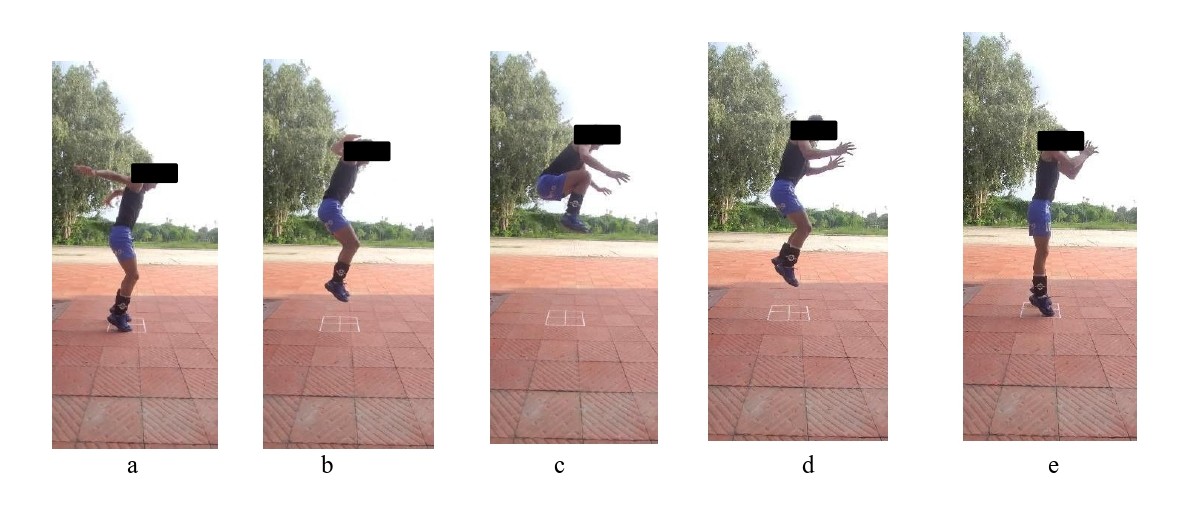
The MTJA consists of continuous maximal height tuck jumps performed for ten seconds mentioned in Figure 1. Participants were instructed to place their feet in the middle of a rectangle marked on the floor, which consisted of four smaller rectangles. Basic instructions were provided on how to carry out the test, including lifting the knees to hip height and attempting to land on the same footprint with their feet shoulder-width apart, as outlined by Myer et al. [12,13]. Participants were then allowed to ask questions to clarify their understanding of the test requirements and were provided with three practice trials to ensure accurate interpretation of the tuck jump. The performance of each test session was observed in both the frontal and sagittal planes.
LESS
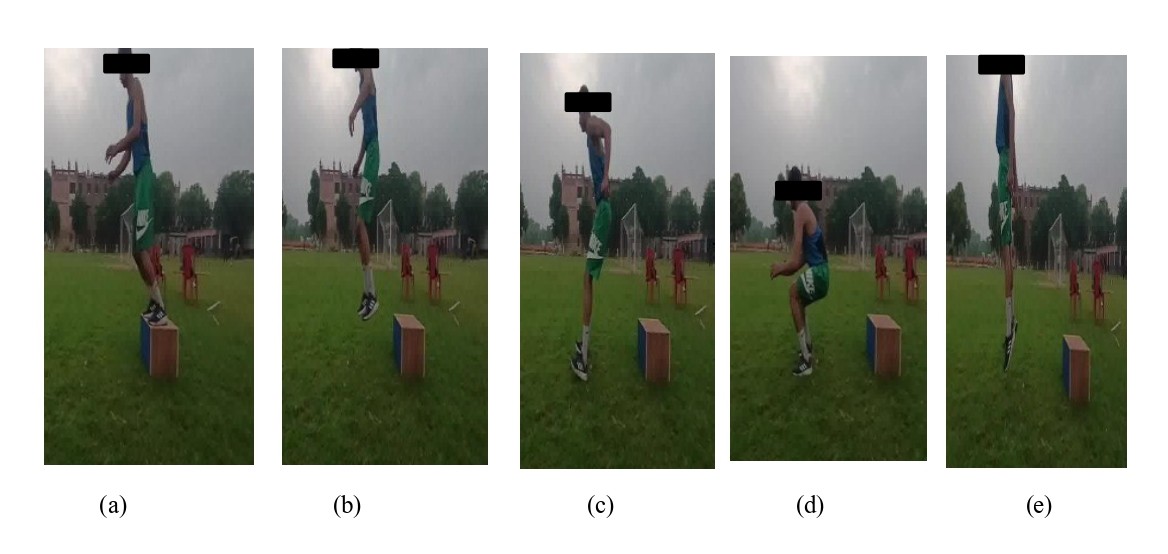
The player stood on a 12-inch (30 cm) box. A target line was drawn on the floor at a distance of half the player’s height. The player was instructed to jump forward from the box and land just ahead of the marked line with both feet landing simultaneously and immediately rebound by jumping for maximum vertical height. The player was instructed not to take a pause between landing on the ground and initiating the vertical jump. The player was shown a demonstration performed by the therapist and then he was allowed to practice 2–3 times. The therapist did not provide the athlete any advice on how to land properly and the performance of each trial was observed in Frontal Plane and Sagittal Plane using video analysis as the participant completed four trials mentioned in Figure 2. Video analysis was used to capture the movement and assign scores based on the presence or absence of these errors. Summing up each domain on the LESS scoring sheet produced the final score.
Kinematic analysis
A two-dimensional video camera (Nikon Coolpix) was used to capture the tests and the player’s landing technique was assessed through freely available software (Kinovea version 0.9.5, USA)
Statistical analysis
The distribution of raw data sets was checked using the Shapiro-wilk test and demonstrated that all data had a normal distribution; hence Pearson Correlation test was used. Descriptive statistics including means, standard deviations (SDs), frequencies, and percentages were calculated for all variables and biomechanical errors. Data were presented as ranked frequencies of common movement deficiencies. Bland–Altman analysis was performed using the total MTJA and LESS scores to assess agreement and interchangeability between the two assessment tools. All statistical analyses were conducted using IBM SPSS Statistics version 27.0, with the level of significance set at p < 0.05.
Results
Table 1 depicts the mean and standard deviation of age, height, weight, and BMI of the included participants.
|
Demographic Variables |
Mean ± SD |
|
Age (years) |
21.16 ± 2.21 |
|
Height (Cm) |
173.99 ± 10.50 |
|
Weight (Kg) |
67.05 ± 13.24 |
|
BMI (Kg/m²) |
22.07 ± 3.42 |
|
Male |
34 (81%) |
|
Female |
8 (19%) |
|
Abbreviations: BMI: Body Mass Index; Cm: Centimeters; Kg: Kilograms |
|
Table 2 compares knee movement errors in MTJA and LESS, focusing on knee flexion, knee valgus at initial contact, and knee valgus displacement. Athletes often land with improper knee bend, reducing shock absorption and increasing ACL injury risk. Knee valgus is more frequent in MTJA, especially under fatigue. Valgus displacement, higher in MTJA, indicates weak hip abductors and poor neuromuscular control, further elevating injury susceptibility during dynamic movements.
|
Error Type |
LESS Frequency |
MTJA Frequency |
Why it happens |
Implications |
|
Knee Flexion at Initial Contact |
25/42 (59.5%) |
21/42 (50%) |
Athletes land with either too much or too little knee bend. |
Poor shock absorption increases ACL risk. |
|
Knee Valgus at Initial Contact |
13/42 (31%) |
17/42 (40.5%) |
Knees collapse inward, more frequent in MTJA. |
Higher risk of ACL injuries, especially in fatigue. |
|
Knee Valgus Displacement |
4/42 (9.5%) |
17/42 (40.5%) |
Worse in MTJA due to rapid movement and repeated jumps. |
Indicates weak hip abductors and poor neuromuscular control. |
Table 3 compares stance width, foot position, and symmetric foot contact errors in MTJA and LESS, highlighting their frequencies, causes, and implications. Narrow stance increases ankle sprain risk, while a wide stance affects balance. Toe-out positioning in LESS indicates poor alignment, leading to improper force distribution. Symmetric foot contact issues in both tests elevate stress on one leg.
|
Error Type |
LESS Frequency |
MTJA Frequency |
Why it happens |
Implications |
|
Narrow Stance Width |
25/42 (59.5%) |
21/42 (50%) |
Athletes land with feet too close together. |
Decreases stability, increases risk of lateral ankle sprains. |
|
Wide Stance Width |
17/42 (40.5%) |
4/42 (9.5%) |
Less common but still present. |
Can affect force absorption and balance. |
|
Foot Position - Toe Out |
21/42 (50%) |
4/42 (9.5%) |
More frequent in LESS, meaning poor foot alignment on landing. |
Can cause overpronation and improper force distribution. |
|
Symmetric Foot Contact |
17/42 (40.5%) |
17/42 (40.5%) |
Equal occurrence in both. |
Indicates uneven landings, increasing stress on one leg. |
Table 4 compares trunk movement errors in MTJA and LESS, analyzing trunk flexion at maximum knee flexion and lateral trunk flexion. It highlights their frequencies, causes, and implications, emphasizing increased knee stress, asymmetric landings, and uneven force distribution, which can impact movement stability and elevate injury risk during dynamic activities.
|
Error Type
|
LESS Frequency |
MTJA Frequency |
Why it happens |
Implications |
|
Trunk Flexion at Max Knee Flexion
|
13/42 (31%)
|
21/42 (50%)
|
Worse in MTJA because of the added movement demands. |
Increases knee stress by shifting weight forward. |
|
Lateral Trunk Flexion |
8/42 (19%) |
NA |
Only observed in LESS, not in MTJA. |
Can cause asymmetric landings, leading to uneven force distribution. |
Table 5 compares joint displacement and overall movement errors in MTJA and LESS, highlighting frequencies, causes, and implications. LESS shows higher joint displacement due to single-jump demands, while both tests reveal movement inefficiencies, confirming their effectiveness in identifying postural control and joint stability deficits in athletes.
|
Error Type
|
LESS Frequency |
MTJA Frequency |
Why it happens |
Implications |
|
Joint Displacement
|
21/42 (50%)
|
13/42 (31%)
|
Worse in LESS because single jumps require more control. |
Indicates poor postural control & joint stability. |
|
Overall Impression (Errors Present) |
42/42 (100%) |
42/42 (100%) |
Every athlete had at least one noticeable issue. |
Confirms that both assessments detect movement inefficiencies. |
Pearson correlation analysis demonstrated no statistically significant correlation between MTJA and LESS scores (r = 0.179, p = 0.257).
The most commonly observed biomechanical errors across both assessment tools were Overall Impression errors (98.8%), Trunk Flexion at Maximum Knee Flexion (70.9%), Joint Displacement (68.6%), Foot Position – Toe Out (65.1%), and Knee Valgus Displacement (62.7%).
The Bland–Altman analysis demonstrated wide limits of agreement and considerable variability between MTJA and LESS scores, indicating poor agreement and lack of interchangeability between the two assessment tools.
Discussion
This study explored the relationship between two widely used assessment tools, the MTJA and the LESS, to identify athletes at an increased risk of lower limb injuries. Our findings demonstrated no statistically significant correlation between MTJA and LESS scores (r = 0.179, p = 0.257), suggesting that the two assessments evaluate different aspects of movement quality and injury risk.
The absence of a statistically significant correlation suggests that MTJA and LESS should not be considered interchangeable tools for lower limb injury risk assessment.
A notable distinction between LESS and MTJA is the rate of knee valgus displacement, a critical risk factor for anterior cruciate ligament (ACL) injuries. LESS identified knee valgus in only 10% of trials, whereas MTJA detected valgus in 40% of athletes. This suggests that repetitive jumping in the MTJA induces neuromuscular fatigue, leading to medial knee collapse and compromised control. This observation aligns with studies indicating that fatigue diminishes lower limb proprioception, increasing valgus angles and ACL strain during repeated jumping tasks [7,8].
Fort-Vanmeerhaeghe et al. [4] demonstrated that the MTJA is a reliable tool for assessing such deficits, with excellent inter-rater reliability (ICC = 0.94) and intra-rater reliability (ICC = 0.94–0.96) among experienced raters. Additionally, inadequate knee flexion angles were observed in both assessments (LESS: 60%, MTJA: 50%), suggesting that athletes struggle with proper knee bending upon landing. Limited knee flexion reduces shock absorption capacity, leading to higher impact forces at the knee joint, thereby increasing the risk of ACL injuries, patellofemoral pain syndrome, and meniscal damage [5,7,8,12,15]. Errors related to stance width and foot positioning were prevalent in both assessments, indicating deficiencies in lower limb stability and force absorption mechanics. Narrow stance width occurred in 60% of LESS trials and 50% of MTJA trials, suggesting an inherent tendency toward instability upon landing.
A narrow stance reduces the base of support, increasing lateral ankle instability, knee valgus, and hip misalignment [3,5,11]. Interestingly, toe-out foot positioning was significantly higher in LESS (50%) compared to MTJA (10%), indicating that athletes struggle more with foot alignment in single landing tasks than in repeated jumps. Poor foot positioning disrupts ground reaction force (GRF) distribution, increasing stress on the medial knee and ankle structures, which is particularly relevant in sports involving rapid deceleration and pivoting movements, such as basketball and soccer [2,3,10].
Trunk stability is crucial for lower limb biomechanics, and this analysis shows that MTJA induces greater trunk flexion errors (50%) than LESS (30%). Excessive trunk flexion suggests fatigue-related core instability, which increases anterior knee loading and disrupts movement efficiency [4,7,13]. Additionally, lateral trunk flexion (20%) was noted in LESS but was absent in MTJA, implying that single landings require more lateral postural control than repeated jumps. Poor lateral control may indicate asymmetric lower limb loading, leading to hip instability and unilateral injury risks [5,9,17].
While both tools aim to assess lower limb injury risks, they approach the problem differently. The MTJA is more dynamic, focusing on how athletes perform during repetitive jumping tasks. It highlights functional deficits, such as poor movement control and fatigue-related decline in technique [4,18,21]. Conversely, the LESS provides a detailed breakdown of landing biomechanics, identifying specific joint angles, asymmetries, and misalignments that could lead to injuries [14–16].
Joint displacement errors were higher in LESS (50%) than MTJA (30%), indicating that single-leg landing requires greater neuromuscular control than continuous jumps [3,12,14]. This aligns with studies showing that athletes struggle more with unilateral loading tasks, making LESS a crucial tool for identifying deficits in landing control and force absorption [10,15].
Interestingly, both assessments identified common risk factors, such as lower extremity valgus, a key predictor of ACL injuries [5,7,18]. However, LESS offered more detailed insights into why these errors occur, such as insufficient knee flexion or poor trunk alignment [6,9,11]. This suggests that MTJA is valuable for capturing real-world movement errors, while LESS provides a deeper biomechanical understanding [3,13].
The MTJA evaluates an athlete's neuromuscular control and general movement quality during tuck jumps, focusing on knee height, landing stability, and foot alignment [4,18]. It captures explosive jumping mechanics and assesses consistency of movement within a set time. In contrast, the LESS focuses more on jump-landing mechanics, analyzing joint alignment and technique to detect biomechanical errors during a drop jump [8,14]. The differences in focus — MTJA on neuromuscular control during continuous jumping and LESS on landing mechanics from a single drop jump — may contribute to the low correlation observed, as they assess movement in different contexts and likely capture different elements of injury risk [12,19].
LESS is superior for assessing single-landing stability, joint control, and foot positioning errors, whereas MTJA is better at identifying fatigue-induced knee valgus and trunk instability [5,17].
The findings from this study suggest that using both MTJA and LESS together may provide a more thorough evaluation of an athlete's injury risk profile. Since MTJA and LESS highlight different aspects of lower limb movement and neuromuscular control, combining the two tools might identify a broader range of at-risk movement patterns [2,6]. For example, an athlete who scores poorly on MTJA may have suboptimal neuromuscular control during repetitive movements, while a low score on LESS may indicate specific landing mechanics issues that could contribute to injury risk [10,16]. This supports the idea that using both assessments can capture a more nuanced picture of injury risk factors, which is valuable for creating individualized training and intervention programs [7,13]. Our findings are consistent with earlier studies suggesting the utility of MTJA and LESS as separate but complementary tools in identifying risk factors for lower limb injuries. Fort-Vanmeerhaeghe et al. (2017) highlighted the MTJA's effectiveness in screening for poor neuromuscular control, particularly in athletes who perform repeated jumping actions, such as in volleyball and basketball [4]. Similarly, Padua et al. (2009) and Fox et al. (2016) reported that the LESS is beneficial for identifying landing mechanics errors that may lead to injuries in sports requiring high-impact landings, such as gymnastics and soccer [8,9]. However, neither study identified a significant correlation between the tests, supporting our findings that MTJA and LESS evaluate different risk components [10,19]. The Bland–Altman analysis further confirmed the lack of interchangeability between MTJA and LESS, as it showed no significant agreement in the scores between the two tools [12]. This finding reinforces the idea that clinicians and coaches should not rely on one test alone when assessing an athlete’s injury risk.
Given that both MTJA and LESS are quick to administer and require minimal equipment, they are practical for inclusion in pre-season screenings or ongoing assessments [3,17]. A dual approach may provide insights that could lead to targeted interventions addressing both neuromuscular control and landing mechanics [6,15].
This study has some limitations. The relatively small sample size may have reduced the statistical power of the study and limited the ability to detect statistically significant associations between MTJA and LESS scores. Therefore, the study may be considered underpowered. Future studies with larger sample sizes and multicenter recruitment are recommended.
Additionally, while both male and female athletes were included, no gender-specific analysis was conducted, which may affect the interpretation of results due to potential differences in movement patterns between genders [1,5]. The study focused on a specific population of athletes from Guru Nanak Dev University, further limiting the applicability of findings to other athlete groups. The use of a single 2D video camera setup restricts the ability to the ability to capture full movement dynamics, which may impact the accuracy of the assessments [10,14]. Furthermore, the cross-sectional design provides only a snapshot in time, offering no insight into performance changes over time or the effects of training interventions. Lastly, the study relied on self-reported health and injury history, which could introduce recall bias or inaccuracies [2,18]. Together, these limitations suggest areas for improvement in future research to enhance the study's applicability and precision [19].
Conclusion
The findings of this study suggest that MTJA and LESS assess different components of lower limb biomechanics and neuromuscular control. No statistically significant correlation was observed between the two assessment tools, indicating that they should not be considered interchangeable. However, combining both assessments may provide a broader and more comprehensive evaluation of lower limb injury risk factors in athletes.
The study also identified common biomechanical deficiencies related to landing control, knee stability, and neuromuscular endurance, emphasizing the importance of targeted injury prevention strategies and movement retraining programs in athletes.
Acknowledgements
We would like to sincerely thank Guru Nanak Dev University's Directorate of Sports for their excellent assistance and collaboration in making this study possible. We sincerely thank the athletes who took part in the study; their commitment and readiness to give off their time and energy were essential to the project's success.
Ethical Approval Statement
The study was conducted in accordance with the ethical standards of the institutional research committee. Ethical approval was obtained from the Institutional Ethics Committee of Guru Nanak Dev University. All participants provided informed consent before participation in the study.
Funding Statement
This research did not receive any specific grant from funding agencies in the public, commercial, or not-for-profit sectors.
Data Availability Statement
The datasets generated and analyzed during the current study are available from the corresponding author on reasonable request.
Source of Support
MYAS-GNDU Department of Sports Sciences and Medicine provides funding for conducting this study.
Authors’ Contribution
All authors contributed to the fulfilment of the study.
Conflict of Interest
The author declares that there is no conflict of interest regarding the publication of this manuscript.
References
2. Cochrane JL, Lloyd DG, Buttfield A, Seward H, McGivern J. Characteristics of anterior cruciate ligament injuries in Australian football. J Sci Med Sport. 2007 Apr;10(2):96–104.
3. Fong DT, Hong Y, Chan LK, Yung PS, Chan KM. A systematic review on ankle injury and ankle sprain in sports. Sports Med. 2007;37(1):73–94.
4. Fort-Vanmeerhaeghe A, Montalvo AM, Lloyd RS, Read P, Myer GD. Intra- and Inter-Rater Reliability of the Modified Tuck Jump Assessment. J Sports Sci Med. 2017 Mar 1;16(1):117–124.
5. Fox AS, Bonacci J, McLean SG, Spittle M, Saunders N. A Systematic Evaluation of Field-Based Screening Methods for the Assessment of Anterior Cruciate Ligament (ACL) Injury Risk. Sports Med. 2016 May;46(5):715–35.
6. Heidt RS Jr, Sweeterman LM, Carlonas RL, Traub JA, Tekulve FX. Avoidance of soccer injuries with preseason conditioning. Am J Sports Med. 2000 Sep-Oct;28(5):659–62.
7. Hewett TE, Myer GD, Ford KR. Reducing knee and anterior cruciate ligament injuries among female athletes: a systematic review of neuromuscular training interventions. J Knee Surg. 2005 Jan;18(1):82–8.
8. Hewett TE, Stroupe AL, Nance TA, Noyes FR. Plyometric training in female athletes. Decreased impact forces and increased hamstring torques. Am J Sports Med. 1996 Nov-Dec;24(6):765–73.
9. Hewett TE, Ford KR, Myer GD, Wanstrath K, Scheper M. Gender differences in hip adduction motion and torque during a single-leg agility maneuver. J Orthop Res. 2006 Mar;24(3):416–21.
10. Willems T, De Ridder R, Roosen P. Is consumer behaviour towards footwear predisposing for lower extremity injuries in runners and walkers? : a prospective study. JOURNAL OF FOOT AND ANKLE RESEARCH. 2019;12(1):8625228.
11. Krosshaug T, Nakamae A, Boden BP, Engebretsen L, Smith G, Slauterbeck JR, Hewett TE, Bahr R. Mechanisms of anterior cruciate ligament injury in basketball: video analysis of 39 cases. Am J Sports Med. 2007 Mar;35(3):359-67.
12. Lloyd RS, Oliver JL, Myer GD, De Ste Croix MB, Wass J, Read PJ. Comparison of Drop Jump and Tuck Jump Knee Joint Kinematics in Elite Male Youth Soccer Players: Implications for Injury Risk Screening. J Sport Rehabil. 2019 Oct 18;29(6):760–5.
13. Myer GD, Ford KR, Hewett TE. Tuck Jump Assessment for Reducing Anterior Cruciate Ligament Injury Risk. Athl Ther Today. 2008 Sep 1;13(5):39–44.
14. Myer GD, Brent JL, Ford KR, Hewett TE. Real-time assessment and neuromuscular training feedback techniques to prevent ACL injury in female athletes. Strength Cond J. 2011 Jun 1;33(3):21–35.
15. Padua DA, Boling MC, Distefano LJ, Onate JA, Beutler AI, Marshall SW. Reliability of the landing error scoring system-real time, a clinical assessment tool of jump-landing biomechanics. J Sport Rehabil. 2011 May;20(2):145–56.
16. Padua DA, Marshall SW, Boling MC, Thigpen CA, Garrett WE Jr, Beutler AI. The Landing Error Scoring System (LESS) Is a valid and reliable clinical assessment tool of jump-landing biomechanics: The JUMP-ACL study. Am J Sports Med. 2009 Oct;37(10):1996–2002.
17. Pollard CD, Sigward SM, Powers CM. Gender differences in hip joint kinematics and kinetics during side-step cutting maneuver. Clin J Sport Med. 2007 Jan;17(1):38–42.
18. Read PJ, Oliver JL, de Ste Croix MB, Myer GD, Lloyd RS. Reliability of the Tuck Jump Injury Risk Screening Assessment in Elite Male Youth Soccer Players. J Strength Cond Res. 2016 Jun;30(6):1510–6.
19. Robles-Palazón FJ, Ruiz-Pérez I, Oliver JL, Ayala F, Sainz de Baranda P. Reliability, validity, and maturation-related differences of frontal and sagittal plane landing kinematic measures during drop jump and tuck jump screening tests in male youth soccer players. Phys Ther Sport. 2021 Jul; 50:206–16.
20. Trost SG, McIver KL, Pate RR. Conducting accelerometer-based activity assessments in field-based research. Med Sci Sports Exerc. 2005 Nov;37(11 Suppl): S531–43.
21. Walbright PD, Walbright N, Ojha H, Davenport T. Validity of functional screening tests to predict lost-time lower quarter injury in a cohort of female collegiate athletes. Int J Sports Phys Ther. 2017 Nov;12(6):948–59.