

Abstract
Human Papilloma Virus (HPV)-related cervical cancer (CC) still drives cancer-related mortality in low-to-middle income countries (LMICs), exacerbated by disparities in HPV screening, HPV vaccination status, specialist availability, and treatment costs compared to higher-income countries. This study describes how botanical nutraceuticals may provide a viable, low-cost strategy to target molecular hallmarks of HPV-related CC that would specifically benefit regions with limited access to specialized oncologists or radiotherapy infrastructure. Additionally, this study discusses recent studies that indicate how these botanical agents may double as radio-sensitizing agents, which may decrease the frequency of radiation therapy. We also discuss how topical use could potentially overcome the primary issue of bioavailability, and modern innovations in utilizing chitosan-based hydrogels and mucoadhesive wafers that enhance localized concentrations of nutraceuticals. Botanical therapeutics represent a scalable, economically feasible adjuvant to standard care in CC in LMICs. By leveraging widely available natural products, we can work towards ensuring that no woman is left without a treatment option.
Keywords
Cervical cancer, Nutraceuticals, Plant extracts, Health disparities, Low-to-middle income countries
Introduction
Cervical cancer (CC) remains a significant global health challenge that has, in recent years, become defined by disparities between high and low-to-middle-income countries (LMICs). While high-income countries continue to reduce the diagnoses of CC due to HPV vaccinations, sexual hygiene, and molecular screening programs, lower-income countries continue to suffer from high rates of CC diagnoses. CC is the leading cause of cancer-related deaths in 37 countries, associated with high risk HPV strains (HPV-16 and HPV-18) identified as class I carcinogens. These countries are mainly in sub-Saharan Africa, as well as South America and Southeastern Asia. The rates of diagnoses are also ten times lower in these countries when compared to North America [1].
Following a diagnosis of CC, there are additional barriers to treatment that lower-income countries tend to face compared to higher income ones. For example, the cost of cancer treatment in LMIC results in 58.42% of patients having catastrophic healthcare expenditure, defined as costs exceeding 10% of the total household expenditure [2]. While the effects on treatment abandonment are not well documented, one study notes that in Kenya, 40% of women with stage II-IV CC are lost to follow-up [3]. While this may be caused by multiple factors, affordability should be considered a major barrier to access and continuation of treatment.
Perhaps the largest barrier to care is the lack of oncologists qualified to care for CC patients in LMICs. According to reports presented at the ESMO Congress 2025, 92.2% of oncologists in the world work in high and higher-middle-income countries. This leaves about one oncologist per 7,160 new cancer cases in LMICs, this is compared to the 1:256 ratio found in higher-income countries [4]. Shockingly, countries like Rwanda operated with fewer than 10 oncology specialists, and other countries, including South Sudan, Lesotho, Benin, Gambia, and Sierra Leone have no oncologists [5,6]. This increases wait times to get into the oncologist and increases the distance patients may have to travel for care, which negatively impacts patient outcomes. A depiction of these barriers can be seen in Figure 1.
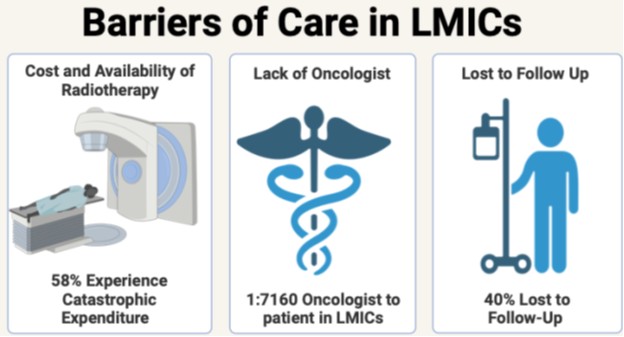
Figure 1. The barriers to care are depicted here. First are the cost and availability of radiotherapy, 58% face catastrophic financial expenses because of radiotherapy. Second is the lack of oncologists available in LMIC, with multiple countries having zero oncologists in total. Finally, these struggles all contribute to large losses in follow-up amongst citizens.
To address these concerns, there is a strong necessity for low-cost and widely available therapeutics for HPV-related CC. While there are certain options that overcome the barriers discussed, such as Metformin or oral metronomic chemotherapies, we posit that more attention should focus on “nutraceuticals” that target CC cells to increase the availability and affordability of treatment.
HPV Oncogenesis and Immune Evasion in Cervical Cancer
HPV, a double stranded DNA virus, is implicated in multiple human cancers, most notably CC. HPV enters host basal keratinocytes through cervical micro-trauma sustained during sexual intercourse [7]. Inside the cell, HPV oncoproteins E6 and E7 create an environment suitable for HPV virion replication by stimulation differentiated keratinocytes of the cervix to transition into the S-phase of the cell cycle; E7 most notably accomplishes this by inactivating RB, preventing retinoblastoma protein (pRb) from binding to and inhibiting E2F transcription factors. The resulting activation of E2F drives transcription of cyclins, which mediate cell cycle progression by bypassing cellular checkpoints. Simultaneously, oncoprotein E6 is implicated in the degradation of p53, disabling DNA-damage checkpoints and preventing the virally infected keratinocytes from undergoing apoptosis [8]. HPV oncoproteins, therefore, turns off DNA synthesis regulatory mechanisms, resulting in genomic instability and the production of cells with mutant DNA, ultimately leading to cervical dysplasia.
Although infection with lower risk HPV types are usually cleared by the immune system, high risk strains, such as HPV-16 and HPV-18, are more likely to lead to chronic infection and drive carcinogenesis. High risk HPV infections may persist and lead to CC by altering the tumor immune microenvironment (TIME) through oncoproteins E6 and E7. The degradation of p53 by E6 decreases type I interferon production, preventing neighboring cells from activating viral defense mechanisms [9]. E7-induced inactivation of retinoblastoma protein results in reduced transcription of antiviral genes, which impairs dendritic cell maturation and inhibits phagocytosis of HPV infected cervical keratinocytes. E7 also aids in immune evasion by upregulating PD-L1, an inhibitory T cell immunomodulator, and immunosuppressive cytokines, such as IL-10. Through these mechanisms, HPV creates an immunosuppressed TIME, preventing an effective immune response and allowing the virus to persist within cervical keratinocytes and induce carcinogenesis [9].
Nutraceuticals that Target CC
Proliferative arrest via cyclin-CDK inhibition
As the molecular landscape of HPV-driven CC is defined by the disruption of the Rb/E2F pathway and unregulated S-phase entry, re-establishing cell cycle control is therefore a goal of therapy [7]. Cyclins, cell cycle progression regulatory proteins, are a potential therapeutic target. Previous studies from our laboratory have demonstrated that extracts from spinach and mangosteen effectively downregulate cyclin B and D [10,11]. Additionally, mangosteen also downregulates cyclin E [11]. These cyclins function at the G1/S and G2/M transitions; their depletion effectively starves the tumor of the machinery required for replication (Figure 2) [12].
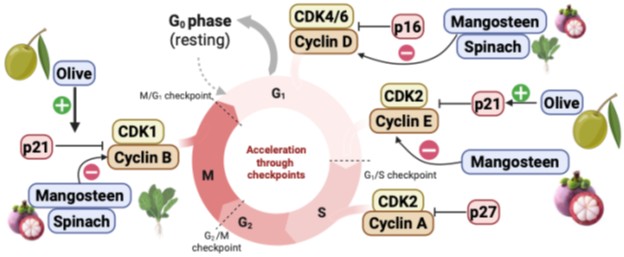
Figure 2. The botanical extracts that contribute to decreased cell proliferation in CC cells are depicted here. Olive upregulates p21, which inhibits progression in the cell cycle. Spinach downregulates cyclin D and B, inhibiting progression at the M/G2 and G1/S checkpoints. Similarly, mangosteen downregulates cyclin B, D, and E, thereby inhibiting cell cycle progression at the G1/S and G2/M checkpoints.
Furthermore, a study on olive extract demonstrated its ability to inhibit proliferation via the potent upregulation of p21, a p53-induced CDK inhibitor, indicating that combination with CDK downregulation therapies could increase treatment efficacy [13]. As an inhibitor of CDKs, p21 functions as a cellular brake on the cell cycle; therefore, the combination of CDK downregulation, combined with the upregulation of p21, may suggest a potential synergistic strategy for fighting CC proliferation and progression [14]. These botanical agents are available globally at low cost, and in vitro studies show they are effective against CC. Further in vivo studies should be considered to confirm this effect.
Reinstating apoptosis and rescuing p53 regulation
The survival of CC cells depends on evasion of apoptosis, often mediated by the HPV E6 oncoprotein’s ability to target the tumor suppressor p53 for proteasomal degradation [15]. Previously, studies have shown that raspberry extract can rescue this apoptotic program by upregulating p53 and the death receptor Fas [16]. Additionally, sesamin from sesame seeds have demonstrated the ability to upregulate p53 and attenuate p53/PTEN apoptosis [17]. In preclinical trials, sesamin has been shown to inhibit HeLa cell proliferation through the upregulation of p53 and PTEN, inducing apoptosis [17]. These results indicate that widely available extracts and even viral-derived peptides can bypass the E6-mediated inhibition to trigger intrinsic and extrinsic apoptosis pathways.
Additionally, both the Raspberry extract and the SARS-CoV-2 Spike protein affect anti-apoptotic proteins, which prevent CC cells from evading apoptosis [16,18]. Both mangosteen and spinach extract have been shown to significantly downregulate FLIP and survivin [10,11]. Both molecules are frequently overexpressed in advanced CC to evade apoptosis and may also be associated with more aggressive pathology [19,20]. Making the cell vulnerable to apoptosis may also sensitize the cells to the patient’s own immune clearance [21]. This is a helpful consideration in LMIC, where specialized immunotherapies may be limited.
The radio sensitization frontier
As discussed previously, radiotherapy is often limited in LMIC, with only 160 total centers in Africa, and 60% of these centers are located in Egypt and South Africa [22]. Additionally, radiotherapy can have unpleasant side effects, including neurological, gastrointestinal, dermatological, and genitourinary symptoms [23]. Therefore, the need to reduce the frequency and amount of radiotherapy would be useful to address these barriers in LMICs. Radiosensitizers are molecules that allow less radiation to be used and potentially may require less radiation.
Our lab’s work with Blueberry extract highlights its potential as a radio-sensitizer. It does so via the downregulation of cyclin D and E and the upregulation of TRAIL. Additionally, other works in the field have shown that alpha-mangostin similarly enhances radiosensitivity in HeLa cells by enhancing G2/M arrest [24]. There is a result that supports our previous discussion on mangosteen downregulating cyclin B, D, and E.
More recent research has suggested other nutraceuticals may be active against CC cells, including Azadirachta indica and Celosia argentea, which promote the G2/M phase arrest of CC cells [25]. Further studies should investigate their use as a radiosensitizer because cells are particularly vulnerable during the G2/M transition. Therefore, these extracts may lock the cell in a radio-sensitive state. There is also research supporting the use of Artemisia kopetdaghensis, resveratrol, plumbagin, and ferulic acid as radiosensitizers in CC cells [26–29]. All these extracts are from relatively common plants and can be obtained easily and with minimal cost. Additionally, studies should explore other extracts to allow for a broader base of papers that can be used to compare these extracts amongst each other.
Safety and Bioavailability of Phytochemicals
Lutein and β-carotene in spinach extract are generally considered safe, but high doses of carotene have been shown to interact with fat-soluble vitamin absorption; consequently, due to the interaction of carotenoids with lipids, lipid-based formulations can enhance the absorption of therapeutic carotenoids [30]. Oral preparations of spinach components have a low bioavailability, so a topical route of administration would be best for enhancing therapeutic effects.
Resveratrol is also considered a safe therapeutic phytochemical in the treatment of cervical cancer. However, the bioavailability of resveratrol is a limiting factor in its use. As resveratrol undergoes metabolism into glucuronic acid and sulfates, oral administration is less efficacious than topical. High doses are required to achieve therapeutic effects, which may cause adverse effects and CYP3A4 inhibition, but data have shown that the therapeutic dose of resveratrol will likely be well below the dose at which toxic side effects occur [31].
Raspberry and blueberry extracts are generally safe for therapeutic use but have low oral bioavailability. Polyphenols, active compounds in blueberry extract, are absorbed from the small intestine and are hydrolyzed by intestinal enzymes or colonic bacteria, reducing the oral bioavailability [32]. Bioavailability of active compounds in raspberry extract is also affected by intestinal absorption and metabolism, reducing oral bioavailability and increasing need for targeted, topical administration to cancer cells. Active compounds in raspberry extract have also been determined to be safe, with minimal interactions with medications [33].
Ferulic acid undergoes moderate oral absorption but is rapidly metabolized and conjugated to glucuronide and sulfates, decreasing systemic levels of compounds active against cancer cells. Ferulic acid is generally safe, with low toxicity, and little evidence of significant drug interactions has been observed. However, this phytochemical action as an antioxidant should be considered when in combination with ROS-dependent chemotherapy and radiotherapy [34].
Mangosteen and α-mangostin are usually well tolerated, but certain studies have demonstrated that high oral doses have led to hepatotoxicity and GI upset in animal models; effects of continuous high doses of mangosteen in humans has not been well studied. Similar to other phytochemicals, mangosteen undergoes extensive first-pass metabolism by CYP 1A2 and conjugation to glucuronide/sulfates, decreasing the oral bioavailability [35]. Similarly, sesamin is rapidly absorbed and rapidly metabolized. However, sesamin metabolism in the liver produces a catechol metabolite that is a more potent antioxidant. Although nutritional doses are safe, the safety of therapeutic doses of sesamin in humans is not well defined. Sesamin has also demonstrated concern for the potential of specific drug interactions and should be considered in therapeutical use [36].
Plumbagin, Artemisia kopetdaghensis, Celosia, and Azadiratcha indica have limited studies on their bioavailability in human patients. In animal models, plumbagin is a potent ROS generator that demonstrates rapid absorption and dose-dependent hepatoxicity and nephrotoxicity [37]. The safety profiles of Celosia and Artemisia kopetdaghensis are not well studied in human models. Adverse effects, dosing, and drug interactions for Plumbagin, Artemisia, Celosia, and Azadiratcha should be further investigated.
Overcoming the bioavailability barrier
Although phytochemicals show mechanistic efficacy in CC therapy, most undergo extensive first-pass metabolism and exhibit low oral bioavailability, limiting their ability to reach therapeutic concentrations systemically. For example, the oral bioavailability of lutein and β-carotene, two major molecules within spinach extract, were 21% and 6.8%, respectively [38]. While there have been multiple formulations that have been developed to enhance the bioavailability of hydrophilic or hydrophobic molecules, to our knowledge, there is no study that has demonstrated the ability to preserve all contents within spinach extracts [39]. To bypass these challenges, topical delivery systems might be able to increase localized concentrations to have an effect against CC.
According to recent papers, advances in polymeric nanoscience have allowed the development of chitosan-based hydrogels or mucoadhesive wafers that can extend the localized concentrations of anti-cancer drugs, growth factors, and bioactive chemicals for increased amounts of time [40,41]. These localized delivery methods offer a significant clinical advantage in LMICs because they can be self-administered or applied by community health workers. Topical chemotherapies are already being explored in Africa for self-application; a preliminary study revealed that patients enjoyed being able to self-administer treatment more than going to the doctor. Additionally, many cited this as being more comfortable and private [42]. Self-administered topicals would directly address the workforce shortages in LMICs and potentially reduce the necessity of frequent appointments with oncology.
Standardization
The transition to nutraceuticals from in vitro models to clinical medicine will require significant work to standardize the process. A significant barrier in the current literature is the phytochemical variability of plant extracts, and the preparation of these extracts varies between companies. For example, the choice of extraction method has been demonstrated to determine the chemical composition and bioactivity of natural product mixtures [43]. Traditional extraction methods, including maceration, Soxhlet extraction, and hydro-distillation, are often used because they are low-cost. However, these methods also suffer from potential degradation of flavonoids and polyphenols, which would decrease the amount of desired therapeutic compounds [44,45]. To illustrate this point, literature reveals a significant lack of consensus regarding the primary active constituents of spinach; while some analyses identify common aglycons such as apigenin present in moderate amounts (0.017% fresh weight), other studies have revealed significantly higher concentrations (0.3% dry weight) [46,47]. To address these variations, future clinical and pre-clinical studies must utilize high-performance liquid chromatography with mass spectrometry to establish phytochemical fingerprints to ensure consistency from study to study.
High-performance liquid chromatography (HPLC) and mass spectroscopy, tools used to detect and quantify a specific compound in a sample, should be used to determine standardization across batches. For some phytochemicals, like Resveratrol, higher-than-therapeutic doses can cause adverse effects and CYP inhibition, altering drug metabolism in patients. Alternatively, HPLC may also be used to ensure that the minimum therapeutic dose is maintained in manufactured products. To avoid adverse effects that could result from excessive or insufficient concentrations of active phytochemical compounds in formulations, tools such as HPLC should be a standard of manufacturing [48]. Prior to widespread use of nutraceuticals and phytochemicals therapeutically, more studies should be conducted to investigate the most efficacious method to standardize therapeutic doses across all manufacturers.
In conjunction with standardizing doses across formulations, adequate evaluation of dosage safety and efficacy need to be studied. Currently, many of the clinical trials studying phytochemicals are conducted with animal models. However, for some phytochemicals, such as plumbagin, Artemisia kopetdaghensis, Celosia, and Azadirachta, minimal clinical trials have been conducted to study their safety [37]. More clinical trials are necessary to determine safe dosing and to determine potential adverse effects with long-term phytochemical use before phytochemicals become standard of care.
Phytochemicals have demonstrated great promise in treatment of CC by impacting apoptotic pathways, cell cycle progression, and radiosensitivity; however, the transition to using phytochemicals in CC therapy requires the standardization of phytochemical doses across all manufactured formulations, determination of safe and toxic doses, as well as effects of chronic use. HPLC, mass spectroscopy, and an increasing number of clinical trials are vital steps in this direction.
|
Phytochemical |
Immune Mechanism Evidence |
Model Type |
Therapeutic Dose |
Endpoint Relevance |
|
Spinach extract [10] |
↓FLIP ↓ survivin ↓ Cyclin B ↓ Cyclin D |
HeLa Cell line |
50 µg/mL Topical |
Apoptosis, cell cycle arrest |
|
Mangosteen [11] |
↓ Cyclin B ↓ Cyclin D ↓ FLIP ↓ survivin |
SiHa Cell line |
50 µg/mL Topical |
Apoptosis, cell cycle arrest |
|
Olive extract [13] |
↑ p21 |
HeLa Cell line |
50 µg/mL Topical |
P21 upregulation, proliferation inhibition |
|
Raspberry extract [16] |
↑ p53 ↑ Fas |
HeLa Cell line |
50 µg/mL Topical |
P53 activation, apoptosis, Fas upregulation |
|
Sesamin [17] |
↑ p53 |
PTEN Cell line |
75-100 µM Topical |
P53/PTEN signaling, apoptosis |
|
Blueberry extract [49] |
↓ Cyclin D ↓ Cyclin E ↑ TRAIL |
SiHa Cell line |
50 µg/mL Topical + 4 Gy radiation |
Radiosensitivity, TRAIL expression, cell cycle progression |
|
Azadirachta indica [25] |
↑ G2/M arrest |
HeLa Cell line |
125 mg GAE/g Topical |
Cell cycle arrest, ↓ proliferation, radiosensitivity |
|
Celosia argentea [25] |
↑ G2/M arrest |
HeLa Cell line |
95 mg GAE/g Topical |
Cell cycle arrest, ↓ proliferation, radiosensitivity |
|
Artemisia kopetdaghensis [26] |
↑Radiosensitivity |
HeLa Cell line |
25-250 µg/mL Topical + 2 Gy Radiation |
Radiosensitivity, apoptosis |
|
Plumbagin [28] |
↑ Radiosensitivity ↑ ROS generation |
HeLa, SiHa, C33A Cell Lines |
0.75-2.5 µM Topical + 2-10 Gy Radiation |
Radiosensitivity, apoptosis |
|
Ferulic acid [29] |
↑ Radiosensitivity ↑ ROS geration |
HeLa and Me-180 Cell lines |
10 µg/mL Topical + 6-12 Gy radiation |
Radiosensitivity, apoptosis |
Conclusion
The disparity in CC survival is an economic and logical problem, as much as it is a biological one. While high-income countries move closer toward eliminating CC through excellent screening and the HPV vaccination, much work is necessary in LMICs to reduce the CC burden and mortality. We believe that widely available and cheap plant-derived agents can be leveraged to attack CC molecular pathways at multiple points in the disease process. These pharmaceuticals do not seek to replace chemotherapy or radiotherapy but rather work alongside them to ensure that women have increased access to care, regardless of geographic or socioeconomic status. We believe that these botanical agents can address the major difficulties, including a lack of specialists, the cost of care, and side effects from radiation and chemotherapy.
Acknowledgement
This study was supported by a grant from Des Moines University for Dr. Yujiang Fang (IOER 112-3140).
Disclosure of Interest
The authors report no conflict of interest.
Author Disclosure Statement
The authors have no disclosures or conflicts.
Author Contribution
Yujiang Fang initiated the idea and supervised the process. Jacob M. Parker and Sidney R. Kritzmire wrote the draft. Yujiang Fang and Mark R. Wakefield made critical revisions to the draft.
References
2. Kaso AW, Regesu AH, Haftu HK, Agero G, Jima GH, Kaso T, et al. Magnitude of catastrophic health expenditure and its determinants among cancer patients in low and middle-income countries: a systematic review and meta-analysis. BMC Health Serv Res. 2025 Nov 26;25(1):1533.
3. Shaffi AF, Odongo EB, Itsura PM, Tonui PK, Mburu AW, Hassan AR, et al. Cervical cancer management in a low resource setting: A 10-year review in a tertiary care hospital in Kenya. Gynecol Oncol Rep. 2024 Feb 1;51:101331.
4. Benjamin DJ, Jenei K, Lythgoe MP. 2275O The global medical oncology workforce, 2025: Disparities in access to care. Ann Oncol. 2025 Sep 1;36:S1169–70.
5. Omotoso O, Teibo JO, Atiba FA, Oladimeji T, Paimo OK, Ataya FS, et al. Addressing cancer care inequities in sub-Saharan Africa: current challenges and proposed solutions. Int J Equity Health. 2023 Sep 11;22(1):189.
6. Rubagumya F, Costas-Chavarri A, Manirakiza A, Murenzi G, Uwinkindi F, Ntizimira C, et al. State of Cancer Control in Rwanda: Past, Present, and Future Opportunities. JCO Glob Oncol. 2020 Jul;6:1171–7.
7. Banerjee NS, Wang HK, Broker TR, Chow LT. Human papillomavirus (HPV) E7 induces prolonged G2 following S phase reentry in differentiated human keratinocytes. J Biol Chem. 2011 Apr 29;286(17):15473–82.
8. Dyson NJ. RB1: a prototype tumor suppressor and an enigma. Genes Dev. 2016 Jul 1;30(13):1492–502.
9. Zhou X, An R, Li X. Cervical cancer immune microenvironment: Mechanisms of HPV-mediated immune evasion and advances in immunotherapy (Review). Oncol Lett. 2025 Nov 5;31(1):22.
10. Parker JM, Williams LR, Haines NA, Mayberry TG, Cowan BC, Maher AJ, et al. Unveiling the Molecular Blueprint of Spinach Induced Anti-proliferation and Pro-apoptosis in Cervical Cancer. Anticancer Res. 2026 Apr 1;46(4):1833–41.
11. Givens NT, Zhao L, Zhu Z, Lequio M, Xiao H, Johnson BD, et al. Mangosteen Inhibits Growth and Survival of Cervical Cancer Cells. Anticancer Res. 2022 Jun;42(6):2903–9.
12. Casimiro MC, Crosariol M, Loro E, Li Z, Pestell RG. Cyclins and cell cycle control in cancer and disease. Genes Cancer. 2012 Nov;3(11-12):649–57.
13. Patel L, Deng Z, Zhu Z, Lequio M, Hough J, Xiao H, et al. Olive: A Potential Suppressor for Cervical Cancer by Upregulation of P21. Cureus. 2023 May 8;15(5):e38719.
14. Karimian A, Ahmadi Y, Yousefi B. Multiple functions of p21 in cell cycle, apoptosis and transcriptional regulation after DNA damage. DNA Repair (Amst). 2016 Jun;42:63–71.
15. Thomas M, Pim D, Banks L. The role of the E6-p53 interaction in the molecular pathogenesis of HPV. Oncogene. 1999 Dec 13;18(53):7690-700.
16. Sham N, Qin C, Zhu Z, Redington CG, Xiao H, Bai Q, et al. Raspberry Extract With Potential Antitumor Activity Against Cervical Cancer. Anticancer Res. 2021 Jul;41(7):3343–48.
17. Kuo TN, Lin CS, Li GD, Kuo CY, Kao SH. Sesamin inhibits cervical cancer cell proliferation by promoting p53/PTEN-mediated apoptosis. Int J Med Sci. 2020 Aug 25;17(15):2292–8.
18. Willson CM, Lequio M, Zhu Z, Wakefield MR, Bai Q, Fajardo E, et al. The Role of SARS-CoV-2 Spike Protein in the Growth of Cervical Cancer Cells. Anticancer Res. 2024 May;44(5):1807–15.
19. Cheng KY, Wang ZL, Gu QY, Hao M. Survivin Overexpression Is Associated with Aggressive Clinicopathological Features in Cervical Carcinoma: A Meta-Analysis. PLoS One. 2016 Oct 20;11(10):e0165117.
20. Wang W, Wang S, Song X, Sima N, Xu X, Luo A, et al. The relationship between c-FLIP expression and human papillomavirus E2 gene disruption in cervical carcinogenesis. Gynecol Oncol. 2007 Jun;105(3):571–7.
21. Tuomela K, Ambrose AR, Davis DM. Escaping Death: How Cancer Cells and Infected Cells Resist Cell-Mediated Cytotoxicity. Front Immunol. 2022 Mar 23;13:867098.
22. Grover S, Xu MJ, Yeager A, Rosman L, Groen RS, Chackungal S, et al. A systematic review of radiotherapy capacity in low- and middle-income countries. Front Oncol. 2015 Jan 22;4:380.
23. Palagudi M, Para S, Golla N, Meduri KC, Duvvuri SP, Vityala Y, et al. Adverse Effects of Cancer Treatment in Patients With Cervical Cancer. Cureus. 2024 Feb 13;16(2):e54106.
24. Aissara P, Prapan A, Suwannasing C. Alpha-Mangostin Enhances Radiosensitivity in HeLa Cervical Cancer Cells. Sci Pharm. 2025 Oct 23;93(4):54.
25. Ezzeldien M, Alafer F, Said AH. In vitro multi-target therapeutic potential of Azadirachta indica and Celosia argentea in cervical cancer: integrated antioxidant, anti-inflammatory, antidiabetic, and radiosensitization evaluation. Chem Pap. 2026 Mar 23;80:5465–86.
26. Fanipakdel A, Hosseini A, Afshar ST, Nourbakhsh M, Mousavi SH. Cytotoxic effects and radiosensitizing potential of Artemisia kopetdaghensis extract in human cervical cancel HeLa cells. Electron Physician. 2019 Jul 1;11(3):7585.
27. Zoberi I, Bradbury CM, Curry HA, Bisht KS, Goswami PC, Roti Roti JL, et al. Radiosensitizing and anti-proliferative effects of resveratrol in two human cervical tumor cell lines. Cancer Lett. 2002 Jan 25;175(2):165–73.
28. Nair S, Nair RR, Srinivas P, Srinivas G, Pillai MR. Radiosensitizing effects of plumbagin in cervical cancer cells is through modulation of apoptotic pathway. Mol Carcinog. 2008 Jan;47(1):22–33.
29. Karthikeyan S, Kanimozhi G, Prasad NR, Mahalakshmi R. Radiosensitizing effect of ferulic acid on human cervical carcinoma cells in vitro. Toxicol In Vitro. 2011 Oct;25(7):1366–75.
30. Abourashed EA. Bioavailability of plant-derived antioxidants. Antioxidants. 2013 Nov 5;2(4):309–25.
31. Kemper C, Benham D, Brothers S, Wahlestedt C, Volmar CH, Bennett D, et al. Safety and pharmacokinetics of a highly bioavailable resveratrol preparation (JOTROLTM). AAPS Open. 2022;8(1):11.
32. Scalbert A, Williamson G. Dietary intake and bioavailability of polyphenols. J Nutr. 2000 Aug;130(8S Suppl):2073S–85S.
33. Eskra JN, Schlicht MJ, Bosland MC. Effects of Black Raspberries and Their Ellagic Acid and Anthocyanin Constituents on Taxane Chemotherapy of Castration-Resistant Prostate Cancer Cells. Sci Rep. 2019 Mar 13;9(1):4367.
34. Li D, Rui YX, Guo SD, Luan F, Liu R, Zeng N. Ferulic acid: A review of its pharmacology, pharmacokinetics and derivatives. Life Sci. 2021 Nov 1;284:119921.
35. John OD, Mushunje AT, Surugau N, Guad RM. The metabolic and molecular mechanisms of α‑mangostin in cardiometabolic disorders (Review). Int J Mol Med. 2022 Sep;50(3):120.
36. Kiso Y. Antioxidative roles of sesamin, a functional lignan in sesame seed, and it's effect on lipid- and alcohol-metabolism in the liver: a DNA microarray study. Biofactors. 2004;21(1-4):191–6.
37. Sumsakul W, Plengsuriyakarn T, Na-Bangchang K. Pharmacokinetics, toxicity, and cytochrome P450 modulatory activity of plumbagin. BMC Pharmacol Toxicol. 2016 Nov 14;17(1):50.
38. Yuan X , Liu X , McClements DJ , Cao Y , Xiao H . Enhancement of phytochemical bioaccessibility from plant-based foods using excipient emulsions: impact of lipid type on carotenoid solubilization from spinach. Food Funct. 2018 Aug 15;9(8):4352–65.
39. Manzoor MF, Waseem M, Javed MR, Saleem M, Khalil AA, Althawab SA, et al. Unlocking Spinach Polyphenols: Novel Extraction, Impact of Processing, Value-Addition and Therapeutic Potentials. Food Rev Int. 2026 Mar 31;42(4):2721–58.
40. Salamat Q, Moradi R, Nadizadeh Z, Kavehpour P, Soylak M, Asimov A, et al. Chitosan based smart injectable hydrogels for biomedical applications: A comprehensive review. Bioact Mater. 2025 Oct 24;55:703–53.
41. Taokaew S, Kaewkong W, Kriangkrai W. Recent Development of Functional Chitosan-Based Hydrogels for Pharmaceutical and Biomedical Applications. Gels. 2023 Mar 27;9(4):277.
42. Mungo C, Kachoria AG, Adoyo E, Zulu G, Goraya SK, Omoto J, et al. 'ARVs is for HIV and cream is for HPV or precancer:' Women's perceptions and perceived acceptability of self-administered topical therapies for cervical precancer treatment: a qualitative study from Kenya. Ecancermedicalscience. 2025 May 13;19:1903.
43. Sun S, Yu Y, Jo Y, Han JH, Xue Y, Cho M, et al. Impact of extraction techniques on phytochemical composition and bioactivity of natural product mixtures. Front Pharmacol. 2025 Jul 30;16:1615338.
44. Omeroglu PY, Acoglu B, Özdal T, Tamer CE, Çopur ÖU. Extraction techniques for plant-based bio-active compounds. In: Swamy MK, Akhtar MS, editors. Natural Bio-active Compounds. Singapore: Springer; 2019. p. 465–92.
45. Doughari JH. Phytochemicals: extraction methods, basic structures and mode of action as potential chemotherapeutic agents. In: Rao V, Editor. Phytochemicals-A global perspective of their role in nutrition and health. InTech; 2012.
46. Dehkharghanian M, Adenier H, Vijayalakshmi MA. Study of flavonoids in aqueous spinach extract using positive electrospray ionisation tandem quadrupole mass spectrometry. Food Chem. 2010 Aug 1;121(3):863–70.
47. Edenharder R, Keller G, Platt KL, Unger KK. Isolation and characterization of structurally novel antimutagenic flavonoids from spinach (Spinacia oleracea). J Agric Food Chem. 2001 Jun;49(6):2767–73.
48. Lin LZ, Harnly JM. A screening method for the identification of glycosylated flavonoids and other phenolic compounds using a standard analytical approach for all plant materials. J Agric Food Chem. 2007 Feb 21;55(4):1084–96.
49. Davidson KT, Zhu Z, Bai Q, Xiao H, Wakefield MR, Fang Y. Blueberry as a Potential Radiosensitizer for Treating Cervical Cancer. Pathol Oncol Res. 2019 Jan;25(1):81–8.