

Abstract
Lagree Methodology is a new multimodal exercise approach that is rapidly gaining popularity, and it claims to improve areas such as muscular endurance, balance, functional movements. However, no research has prospectively examined these effects. The purpose of this case series study was to determine the effectiveness of a 6-week Lagree methodology program on functional performance and balance in healthy adults. We hypothesize that muscular endurance, functional movements, and dynamic balance will increase post intervention. Eight healthy adults (6F, 26 ± 10 years, 71.6 ± 22.1 kg, 163 ± 12 cm) completed the Functional Movement Screen (FMS) and Lower Quarter Y-Balance Test, Prone Bridge test, and Half Sit-up test pre- and post-intervention. This 6-week Lagree program involved progressive resistance training performed on a machine with a platform lift. Changes in test scores were assessed using paired t-tests and Wilcoxon signed-ranks test. The total FMS score significantly increased by approximately 41% from pre-to post-intervention (pre: 11.25 ± 3.66, post: 15.88 ± 2.59, p=0.002). Composite scores of the Y-Balance test on their left leg significantly increased by 7% post-intervention (pre: 92.79 ± 8.27, post: 99.27 ± 10.54, p=0.035). The composite scores on the right leg increased by 4% but these differences were not significant (pre: 94.07 ± 8.48, post: 97.93 ± 10.86, p=0.140). Prone Bridge and Half Sit-up tests were not significant. A 6-week Lagree intervention was effective in producing significant and substantial improvements in the total FMS score and active straight leg raise performance. These findings suggest that the Lagree Methodology may offer functional movement benefits in healthy adults.
Keywords
Lagree methodology, Functional movement, Dynamic balance, Muscular endurance, Resistance training, Y-Balance test, Healthy adults
Introduction
Physical inactivity is a major contributor to decline in physical health in the United States. Based on the Centers for Disease Control and Prevention (CDC) data from 2017–2020, 25.3% of U.S. adults were physically inactive outside of work [1,2]. Physical inactivity can cause a decline in muscle mass and function, reducing overall physical performance and mobility [3,4]. Sedentary behavior also leads to decreased flexibility and joint range of motion, further hindering the ability to move freely and easily [5]. Overall sedentary behavior deprives body tissues of important physiological stimuli needed to maintain adequate function make individuals more susceptible to injuries and reducing overall mobility [6]. Although there is abundant research evidence and public guidelines on the benefits of physical activity, there are several barriers that contribute to people not engaging in them.
One approach to address the challenge of physical inactivity and its negative consequences is through full body multimodal exercises. These exercises are performed at different intensities and target various aspects of physical health such as muscular endurance, balance, etc. which are important for functional movement in daily lives and recreational activities. Multimodal exercises can simultaneously target different physical health domains in a single session, thereby maximizing efficiency and health outcomes. The benefits of these full body multimodal exercises are further enhanced by use of equipment that require less space for use and storage at work and home, and instructional videos from experts on how to exercise correctly and safely on this equipment [7]. For such multimodal exercises to appeal to the young, middle-aged, and older populations other barriers to physical activity involving comfort during exercise and allowing for exercise modification are also important.
Lagree Methodology is a new multimodal exercise approach that is rapidly gaining popularity, it can be performed at different physical intensities, and it claims to improve areas such as muscular endurance, balance, functional movements [8,9]. In the Lagree Methodology, individuals perform full body resistance exercises to a variable spring-based resistance on a sliding carriage machine [9]. The machines are compact exercises are performed while following direct instructions or instructional videos of certified Lagree trainers. These are non-impact exercises, and the equipment and methodology allow for exercise modification (e.g., changing resistance, exercise positions, and tempo) to suit the needs of individuals with mobility and/or strength limitations [9].
In summary, Lagree methodology is a novel approach to increasing physical activity in all age-groups, however, its claims of targeting and improving different domains of health such as muscular endurance, functional movements, and balance are not yet verified [8]. Therefore, the purpose of the study is to examine the effects of a 6-week Lagree intervention on muscular endurance assessed via the prone bridge and half sit up tests, functional movement assessed via Functional Movement Screen (FMS), and dynamic balance measured using Y-Balance test in a group of young to middle-aged adults. We hypothesize that muscular endurance, functional movements, and dynamic balance will increase post 6-weeks of Lagree intervention.
Materials & Methods
Participants
The current study was an exploratory experimental case series which included a novel 6-week Lagree exercise intervention. And thus, a limited number of participants were recruited. Based on the efficacy outcomes, this study could be done with a large sample size. Eleven adults were recruited from the campus of XXX university during Spring 2024 using word of mouth and flyers posted on campus and on social media. Participants enrolled in the study were between 19 and 48 years of age, and self-reported being free from acute injuries or surgeries within the past 6 months, and with no balance deficits. All participants self-reported verbally that they met these inclusion criteria and consented to the study. Three participants were lost to attrition (27.27%), citing injury, sickness, or conflict of personal schedule unrelated to the study. One of these three participants engaged in recreational running unrelated to the study. They self-reported discomfort in their knee after a long run and decided to stop participating in the study to avoid further aggravating the discomfort. The demographic characteristics of the participants who completed the study are provided in Table 1. The study procedures and methods were approved by the XXX university institutional review board, and all participants signed a written informed consent prior to data collection.
|
|
Mean ± SD |
Range |
|
N, sex |
7F, 1M |
|
|
Age (years) |
26.13 ± 9.91 |
19–48 |
|
Height (cm) |
162.89 ± 12.40 |
149.86–187.96 |
|
Mass (kg) |
71.63 ± 22.09 |
44.00–100.00 |
Measures
There are several tests of muscular endurance, functional movements, and dynamic balance. In the current study, we chose to use field tests that are valid and reliable and have known evaluation standards to gauge meaningful improvements in these domains. For muscular endurance assessment, we focused on the trunk muscles, as these are large muscle groups important for stabilizing the spine to maintain good posture, and adequate trunk muscular endurance can prevent or reduce the risk of low back pain [10]. Specifically, we examined static and dynamic endurance of the trunk muscles via the prone bridge test and YMCA half sit-up test, respectively. For functional movement assessment, we chose the FMS, a screening tool used to assess functional mobility and postural stability in different settings without locomotion. This screening tool is used widely in athletic and clinical settings, and it is used to predict risk of injuries [11]. For balance assessments, we chose dynamic balance in a weight bearing posture via the lower-quarter Y-Balance test. We chose this test because it is commonly used by clinicians and practitioners.
Design and procedures
The participants completed the following battery of tests a week prior and after the 6-week intervention. FMS was administered by researchers who were trained by certified FMS practitioners [12]. FMS was conducted using methods described previously [12]. The FMS included assessments of 7 functional movement tasks (deep squat, in line lunge, straight leg raise, hurdle step, shoulder mobility, trunk stability, push-up, and rotatory stability) and 3 clearance screens [12]. Each of the 7 functional tasks were scored from 0–3 based on performance, with 3 being the best. And later scores of 7 tasks were added to obtain the composite score for FMS [12].
The FMS was followed by determination of leg dominance and measurement of right limb length in centimeters. Leg dominance for participants was determined by asking which leg they preferred to use to kick a ball. Prior to the measurement, their pelvis was squared by performing the bridge test, and then limb length was measured from the right anterior superior iliac spine to right medial malleolus. Then dynamic balance was measured using the Lower Quarter Y-Balance test using methods described by Functional Movement Systems [13]. The Y-Balance test was conducted on each leg and for 3 directions (anterior, posterior medial and posterolateral). Later cumulative score for three directions was normalized to right leg length to obtain a composite score using the equation below:
Limb composite score = [(Anterior + Posteromedial + Posterolateral) / (3 x Right Limb Length)] x100
Next static endurance of the core muscles was assessed using the prone bridge test using methods outlined by Bohannon et al. [14]. During this test, the participants were assessed on how long they could maintain the prone bridge position with the proper form up to a maximum of 2 minutes. The prone bridge test ended when the participants could not hold form (keep head, trunk, and legs in a straight line), were shaking excessively, or decided to stop. This was followed by an assessment of dynamic endurance of the core muscles via the YMCA half-sit-up test [15]. To prepare for the test, two pieces of tape were placed on the floor 3.5 inches apart. The participants started in a hook lying position and then they placed their longest digit on the more proximal piece of tape. The participants were asked to complete as many half sit-ups as they could in one minute as the tester counted them. Then the participant completed a half sit-up by reaching from the proximal to the distal piece of tape and then returning to the proximal tape. For each half sit-up to be counted the participant had to touch both the proximal and distal pieces of tape.
The pre-testing was conducted at the beginning of the Spring 2024 semester in January 2024, followed by 6-weeks of Lagree intervention, and post-testing approximately midway through semester. Specifically, the pre-and post-tests were done one week prior to and one week after the 6-week Lagree intervention, respectively. The intervention was designed by a Lagree certified master trainer of 24 years with exercises designed to provide progressive resistance training via multimodal exercises [9,16]. This intervention involved progressive resistance training via multimodal exercises. The participants completed 11 different exercises on a Mini Pro machine (with a platform lift) while following the instruction videos for those exercises provided by Lagree on Demand under the supervision of trained researchers [17,18]. The researchers ensured that the participants engaged in the prescribed exercises correctly and safely. Specifically, the researchers monitored the form and body alignment, intensity, duration, range of motion, and response to resistance during the exercises. The principal investigator (MIH), who is Level 1 Lagree certified, supervised all the sessions. Over the 6-week intervention, the number of sessions, duration, tempo, and progressions of activity were systematically increased following a protocol designed by the founder of the Lagree Methodology as shown in Table 2 and Figure 1.
|
Week |
Sessions (n) |
Duration (minutes) |
Tempo (counts) |
Progressions |
|
1 |
2 |
30 |
4 |
Planks, Runner’s Lunge, Squat |
|
2 |
2 |
35 |
4 |
Runner's Lunge - Carriage Kick'n Twist* Reverse Skating* Reverse Giant Bear* |
|
3 |
3 |
35 |
6 |
Runner's Lunge - Carriage Kick'n Twist* Reverse Skating (1 min) Reverse Giant Bear* |
|
4 |
3 |
40 |
6 |
Runner's Lunge - Carriage Kick'n Twist* Lay on the Back Bicep* Knee Strap crunch – Upper* |
|
5 |
3 |
45 |
8 |
Ice Skating* Knee Strap Crunch – Pulse* Reverse Giant Bear – Pulse* |
|
6 |
3 |
50 |
8 |
Hinging Kneeling Torso Twist* Half Kneeling Torso Twist* Knee Strap Crunch – Upper & Lower* Reverse Giant Plank* |
|
Note. Pictures of the exercise progressions on the Lagree Mini Pro machine are provided in Figure 1. |
||||
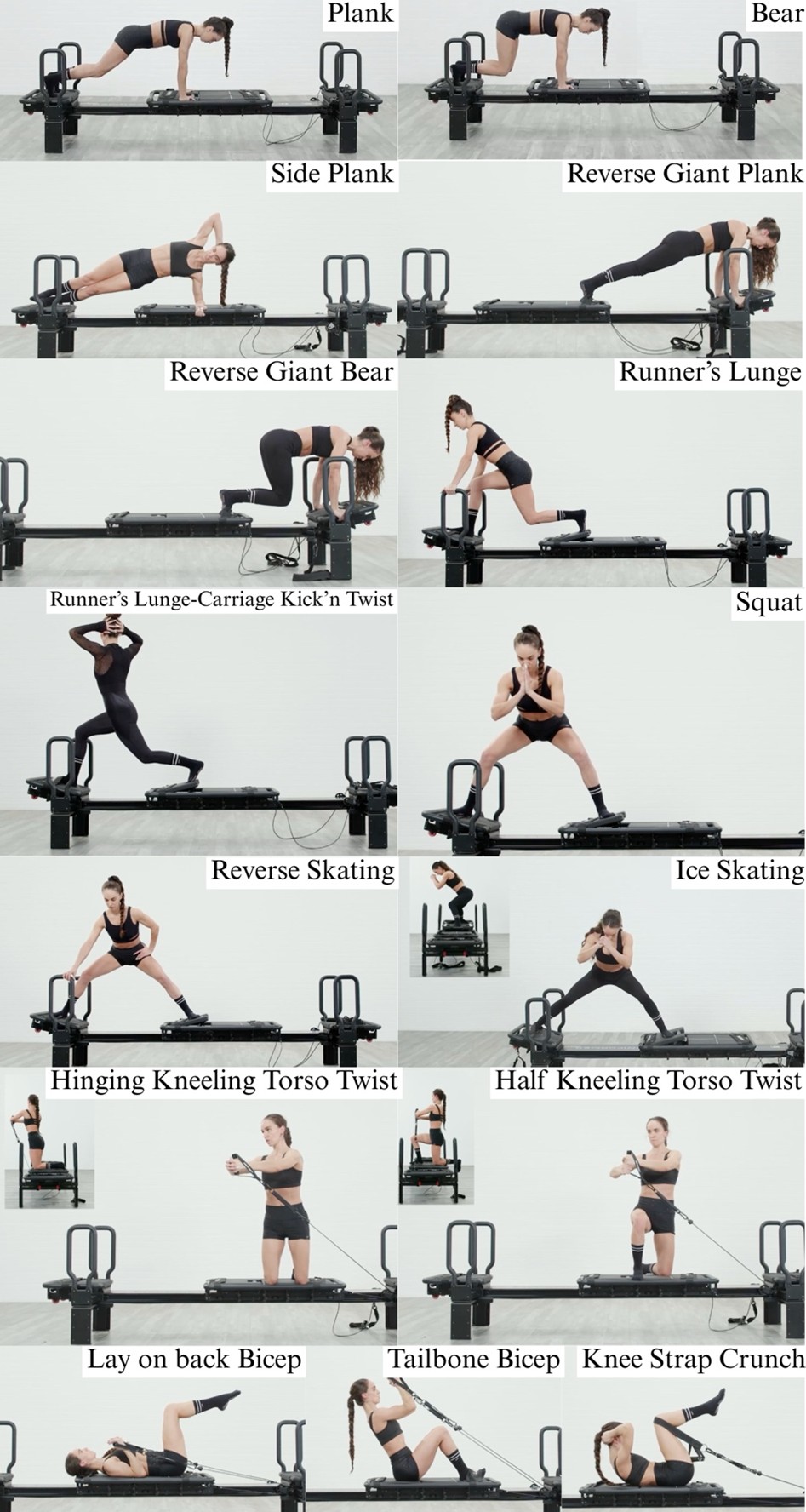
Figure 1. Lagree progressions.
Statistical analysis
This study examined the effect of the intervention (pre- vs. post-test) on measures of functional movement screen, dynamic balance, and static and dynamic core muscular endurance. For the Y-Balance test, we also examined the extent to which the intervention affected their balance on the dominant and non-dominant limbs. Prior to analysis, the data were checked for normality. For the normally distributed variables, a paired t-test was used to assess differences from pre- to post-intervention. For the data that were not normally distributed, the Wilcoxon signed-ranks test for statistical analysis. The alpha level was set to 0.05.
Results
The results of the 7 functional tasks and the composite scores for FMS are shown in Table 3. Among these variables only the total FMS scores were normally distributed. For the FMS, all variables improved from pre-to-post intervention, however, only the active straight leg raise and total FMS score improvements were statistically significant.
|
Variable |
Pre-test (mean ± SD) |
Post-test (mean ± SD) |
p-value (t or Wilcoxon z) |
% change |
|
Deep Squat |
1.63 ± 0.74 |
2.13 ± 0.35 |
0.102 |
30.67 |
|
Hurdle Step |
1.75 ± 0.46 |
2.38 ± 0.52 |
0.059 |
36.00 |
|
Inline Lunge |
1.38 ± 0.92 |
2.13 ± 0.64 |
0.059 |
54.35 |
|
Shoulder Mobility |
1.63 ± 1.41 |
2.13 ± 0.99 |
0.336 |
30.67 |
|
Active Straight Leg Raise |
1.38 ± 0.74 |
2.38 ± 0.52 |
0.011 (z=2.530) |
72.46 |
|
Trunk Stability Push Up |
1.75 ± 1.17 |
2.62 ± 0.52 |
0.084 |
49.71 |
|
Rotary Stability |
1.63 ± 0.74 |
2.13 ± 0.35 |
0.102 |
30.67 |
|
Total FMS |
11.25 ± 3.66 |
15.88 ± 2.59 |
0.002 (t=4.802) |
41.16 |
The data for dynamic balance as well as static and dynamic muscular endurance are presented in Table 4. The prone bridge test and half sit-up test scores were not normally distributed. Similar to FMS data, dynamic balance and muscular endurance improved from pre-to-post intervention, however, only the improvement in the composite Y-Balance test score for the left leg was statistically significant.
|
Variable |
Pre-test (mean ± SD) |
Post-test (mean ± SD) |
p-value (t or Wilcoxon z) |
% change |
|
Left Y-Balance Composite score (%) |
92.79 ± 8.27 |
99.27 ± 10.54
|
0.035 (t=2.137) |
6.98 |
|
Right Y-Balance Composite score (%) |
94.07 ± 8.48 |
97.93 ± 10.86
|
0.140 |
4.10 |
|
Prone Bridge Test Duration (s) |
87.50 ± 38.83 |
107.50 ± 23.76 |
0.068 |
22.86 |
|
Half Sit-ups Test (repetitions) |
11.37 ± 19.29 |
17.88 ± 15.41 |
0.248 |
57.26 |
Discussion
This is the first study to explore the efficacy of the Lagree Methodology on functional movement, balance, and muscular endurance. In this exploratory experimental case series, we hypothesized that a 6-week Lagree intervention will increase muscular endurance, functional movements, and dynamic balance. As hypothesized, all these aspects of fitness showed a trend towards improvement over the 6-week intervention, however, only improvements in functional movements (measured via total FMS score) and dynamic balance (measured via the Y-Balance test) were statistically significant. The improvements in static and dynamic endurance did not reach statistical significance. These improvements in functional movement, balance, and muscular endurance observed in the current study can be directly attributed to specificity of training as corresponding aspects of fitness were trained via multimodal exercises performed during the Lagree intervention.
The FMS is a low-cost method of evaluation that was developed for fitness and health care professionals to assess fundamental movement patterns of an individual and prescribe therapeutic exercises to prevent musculoskeletal injuries[19]. For FMS, seven functional tests were performed pre- and post- Lagree intervention and each test scored from a scale of zero to 3. A score of zero represented the presence of pain, a score of 1 is related to a patient having many movement dysfunctions, a score of 2 is related to a patient having few movement dysfunctions, and a score of 3 is a patient having a normal movement pattern [20]. In the current study, all seven functional tests showed an increase in average scores after the Lagree intervention. However, only the active straight leg raise test showed a significant improvement from pre to post Lagree intervention (Table 3). These improvements may be attributed to the specificity of training in the Lagree Methodology where participants were performing individual leg exercises while their other limb was in a stretched position similar to that done for Runner’s Lunge and Skaters (Figure 1).
In this study, participants had an average total FMS score of 11.25 out of 21 points before undergoing the Lagree intervention. Previous literature used a cut-off score of 14 to positively predict serious injury with a specificity of 0.91 and a sensitivity of 0.54 [21]. The odds ratio (OR) of sustaining a serious injury was 11.7 times higher in those with an FMS composite score of less than 14 compared with those with a score of greater than 14 [22,23]. Based on these cut-off values, our participants were at risk of sustaining serious injury at pre-testing. From pre- to post- intervention, the total FMS score of our participant group improved by 41% from 11.25/21 (pre) to 15.88 (post), thus removing these participants from the at-risk category. These results highlight the potential for the Lagree Methodology to be an effective tool for reducing injury risk in general populations. However, a recent systematic review by raised concerns about the validity of the FMS for injury prediction [24]. Therefore, future studies should consider using an instrument with stronger validity to assess the effect of the Lagree intervention on potential injury-risk reduction [24].
The Y-Balance test is a commercially available, highly reliable tool to assess dynamic balance that was developed to standardize the modified Star Excursion Balance Test [25]. The composite score for the Y-Balance test is calculated by summing the 3 reach directions and normalizing to lower extremity length. Our study found improvements for left and right limb average participant composite scores post the Lagree intervention. However, only the left leg had a significant improvement after the intervention. This improvement may be due to 7 out of the 8 participants indicating right leg dominance for kicking [26]. In other words, the participants were accustomed to maintaining stance stability on their non-dominant (i.e., left leg) while they engaged in dynamic activities such as kicking, and this may be a factor contributing to significant improvements observed for the left and not the right side. The Lagree Intervention yielded an approximate 7% and 4% improvements for the left and right leg, respectively. Greater improvements could be observed in future studies if the intervention is modified to include more dynamic lower body balance movement such as Lagree lunge movements (i.e., Escalator, Elevator, and Floor Lunge series) and was longer in duration [26].
In the current study, both static and dynamic core muscular endurance improved from pre-to-post intervention, however, these improvements were non-significant. The non-significant improvements in these variables could also be attributed to specificity of training in the Lagree Intervention. For example, static endurance, which was measured via the prone bridge test, improved 23% (~20 seconds) improvement over the 6-week Lagree intervention. These improvements can be attributed to several multimodal exercises that directly and indirectly trained the static core muscle endurance. The plank exercise performed by the participants is remarkably similar but more challenging than the prone bridge test performed to assess static core muscle endurance. Similarly, the dynamic core muscle endurance improved by 56% (~6 repetitions) over the course of the Lagree intervention as measured by the YMCA half sit-up test. In addition to the plank and knee-strap crunch exercises that directly trained the specific muscle groups associated with static and dynamic core muscle endurance, there were other multimodal exercises performed during the intervention that also target the core muscle endurance such as runners lunge and giant wheelbarrow.
We speculate that these improvements in static and dynamic core muscle endurance could help improve stabilization of spine, help improve trunk posture and may also help prevent back pain [10]. Most adults spend considerable amounts of time sitting and often not in good posture. Prolonged sitting and lack of physical activity could lead to decreases in core muscle endurance, which may affect spinal stabilization, lead to poor posture, and increase the risk for back pain [27]. In the current study, we demonstrate that the Lagree intervention positively impacts static and dynamic core muscle endurance which could potentially help alleviate risk of back pain in adults who spend prolonged periods of time sitting at their jobs.
Our exploratory intervention case series study had two main limitations: a small sample size and a short duration of intervention. For the current study, we only collected data on 8 adults over 6-weeks of intervention. A comprehensive analysis was conducted, including an assessment of data normality. However, the sample size was insufficient to achieve normality. Due to the exploratory nature of this study, a small sample size was used to examine the health and fitness benefits claimed by the Lagree Methodology. So, in this case series we explored the feasibility and effectiveness of the Lagree Methodology with a small sample size with the goal of doing a larger study if it was found to be effective. The promising results of the current study demonstrate the effectiveness of the Lagree Methodology, providing a strong foundation for future research with a larger sample size to assess its effectiveness. The second limitation of the study was the 6-week duration of intervention. From zero to 6 weeks, the performance improvements could mostly be attributed to neural adaptations and not structural changes in the soft tissues [28]. A 6-week intervention was utilized as it enabled an exploratory examination using a complete data collection (pre- and post-testing and the intervention) within one semester when students and faculty are on university campus. A longer intervention period of eight to twelve weeks would allow for a more accurate evaluation of both the health and fitness outcomes, as well as changes in soft tissues associated with the Lagree intervention. The promising findings from the present study indicate that future research should replicate this methodology with a larger and more representative sample. Studies would also benefit from incorporating a longer post-intervention follow-up and including a control group in the analysis. These additions are necessary before drawing broad or generalizable conclusions.
Conclusion
A 6-week Lagree intervention was effective in producing significant and substantial improvements in the total FMS score and active straight leg raise performance. These findings suggest that the Lagree Methodology may offer functional movement benefits in healthy adults.
Conflicts of Interests
The authors declare that they have no conflicts of interest relevant to the content of this manuscript. The corresponding author affirms responsibility for this declaration on behalf of all co-authors.
Funding Statement
The authors declare that no grant related funding was received to support this study.
Acknowledgments
The authors have no acknowledgments to declare.
References
2. CDC. Adult Physical Inactivity Outside of Work. Atlanta: Physical Activity. CDC; 2025 (cited 2025 Mar 5). Available from: https://www.cdc.gov/physical-activity/php/data/inactivity-maps.html.
3. Better Health Channel. Physical activity for seniors. Melbourne: Better Health Channel. 2025 (cited 2025 Mar 5). Available from: https://www.betterhealth.vic.gov.au/health/healthyliving/physical-activity-for-seniors.
4. Grimmer M, Riener R, Walsh CJ, Seyfarth A. Mobility related physical and functional losses due to aging and disease - a motivation for lower limb exoskeletons. J Neuroeng Rehabil. 2019 Jan 3;16(1):2.
5. Impact of Sedentary Lifestyles on Mobility & Proprioception [Internet]. 2024 [cited 2025 Mar 5]. Available from: https://www.re-silient.work/the-impact-of-sedentary-lifestyles-on-mobility-and-proprioception-in-tissues.
6. Sawyer C. The Consequences of a Sedentary Lifestyle [Internet]. The Chiropractors. 2024 [cited 2025 Mar 5]. Available from: https://the-chiropractors.co.uk/the-consequences-of-a-sedentary-lifestyle/.
7. Martinez-Calderon J, Villar-Alises O, García-Muñoz C, Pineda-Escobar S, Matias-Soto J. Multimodal exercise programs may improve posttraumatic stress disorders symptoms and quality of life in adults with PTSD: An overview of systematic reviews with meta-analysis. Clin Rehabil. 2024 May;38(5):573–88.
8. AtakInteractive. THE SCIENCE OF LAGREE FITNESS | Lagree Fitness [Internet]. Lagree Fitness High intensity Low impact. [cited 2025 Mar 5]. Available from: https://www.lagreeacademy.com/the-science-of-lagree-fitness.
9. Fitness L. The Lagree Method | What is the Lagree Method and Its Benefits [Internet]. Lagree Fitness. [cited 2025 Mar 5]. Available from: https://www.lagreefitness.com/the-lagree-method.
10. Abdelraouf OR, Abdel-Aziem AA. THE RELATIONSHIP BETWEEN CORE ENDURANCE AND BACK DYSFUNCTION IN COLLEGIATE MALE ATHLETES WITH AND WITHOUT NONSPECIFIC LOW BACK PAIN. Int J Sports Phys Ther. 2016 Jun;11(3):337–44.
11. Kraus K, Schütz E, Taylor WR, Doyscher R. Efficacy of the functional movement screen: a review. J Strength Cond Res. 2014 Dec;28(12):3571–84.
12. Functional Movement Systems [Internet]. [cited 2025 Mar 5]. Available from: https://www.functionalmovement.com/.
13. Lower Quarter Y-Balance Test Numbers | Functional Movement Systems [Internet]. [cited 2025 Mar 5]. Available from: https://www.functionalmovement.com/Articles/313/lower_quarter_y-balance_test_numbers.
14. Bohannon RW, Steffl M, Glenney SS, Green M, Cashwell L, Prajerova K, et al. The prone bridge test: Performance, validity, and reliability among older and younger adults. J Bodyw Mov Ther. 2018 Apr;22(2):385–389.
15. Measurement and Evaluation in Human Performance 6th Edition With HKPro [Internet]. Human Kinetics. [cited 2025 Mar 5]. Available from: https://us.humankinetics.com/products/measurement-and-evaluation-in-human-performance-6th-edition-with-hkpropel-access.
16. Demand LO. 6-week mini pro course [Internet]. Lagree On Demand. [cited 2025 Mar 5]. Available from: https://www.lagreeod.com/courses/6-week-mini-pro-course.
17. Fitness L. The Lagree Fitness Mini Pro | Buy the Lagree Miniformer Pro [Internet]. Lagree Fitness. [cited 2025 Mar 5]. Available from: https://www.lagreefitness.com/mini-pro.
18. Bunn PDS, Rodrigues AI, Bezerra da Silva E. The association between the functional movement screen outcome and the incidence of musculoskeletal injuries: A systematic review with meta-analysis. Phys Ther Sport. 2019 Jan;35:146–58.
19. Cook G, Burton L, Hoogenboom B. Pre-participation screening: the use of fundamental movements as an assessment of function - part 1. N Am J Sports Phys Ther. 2006 May;1(2):62–72.
20. Kiesel K, Plisky P, Butler R. Functional movement test scores improve following a standardized off-season intervention program in professional football players. Scand J Med Sci Sports. 2011 Apr;21(2):287–92.
21. Kiesel K, Plisky PJ, Voight ML. Can Serious Injury in Professional Football be Predicted by a Preseason Functional Movement Screen? N Am J Sports Phys Ther. 2007 Aug;2(3):147–58.
22. Peate WF, Bates G, Lunda K, Francis S, Bellamy K. Core strength: a new model for injury prediction and prevention. J Occup Med Toxicol. 2007 Apr 11;2:3.
23. Plisky PJ, Gorman PP, Butler RJ, Kiesel KB, Underwood FB, Elkins B. The reliability of an instrumented device for measuring components of the star excursion balance test. N Am J Sports Phys Ther. 2009 May;4(2):92–9.
24. Bonazza NA, Smuin D, Onks CA, Silvis ML, Dhawan A. Reliability, Validity, and Injury Predictive Value of the Functional Movement Screen: A Systematic Review and Meta-analysis. Am J Sports Med. 2017 Mar;45(3):725–32.
25. Ewais NF, Abdel-Aziem AA, Hassan SM. Effect of gender, leg dominancy, and body mass index on Y-balance performance among young, healthy adults. SPORT TK-Revista EuroAmericana de Ciencias Del Deporte. 2024;13(2):8.
26. LagreeFitness LMS [Internet]. [cited 2025 Mar 5]. Available from: https://www.lagreeacademy.com/lms/single_course/78.
27. O'Sullivan PB, Mitchell T, Bulich P, Waller R, Holte J. The relationship beween posture and back muscle endurance in industrial workers with flexion-related low back pain. Man Ther. 2006 Nov;11(4):264–71.
28. Moritani T, deVries HA. Neural factors versus hypertrophy in the time course of muscle strength gain. Am J Phys Med. 1979 Jun;58(3):115–30.