

Editorial
The scope of the Archives of Biomedical Research encompasses the burgeoning integration of multidisciplinary fields of medical and biological science and the translation from research into practice.
An area within the scope of neuroscience and behaviour science deserving significant attention is that of the role of the chemical and haptic senses in wellbeing and their impact on quality of life with declines occurring in ageing.
Declines occur in all of the senses with ageing, with those of vision and hearing being readily recognizable, researched and with freely available interventions. On the other hand, declines in the senses of smell and taste, along with touch occur covertly, unappreciated and with few interventions.
In the ranking of the classic Aristotelean senses, the chemical senses, smell and taste, along with ‘touch’, more broadly haptic senses, are considered to be bodily or visceral and ‘lower’ in comparison with those of vision and hearing. The value of olfaction to Homo sapiens has been downplayed as an animal sense of little value to modern man. The sense of smell, olfaction, has until recently received cursory consideration in both research and in the clinical sciences.
Olfaction is the most ancient of the senses and is believed to have evolved from the chemotaxis response, recognized in single cellular organisms, into the sense of smell in higher animals.
Olfaction provides cues in diverse functions (Figure 1). It is closely associated with cognitive function, in memories, and executive function [1] and is related to neurogenesis [2].
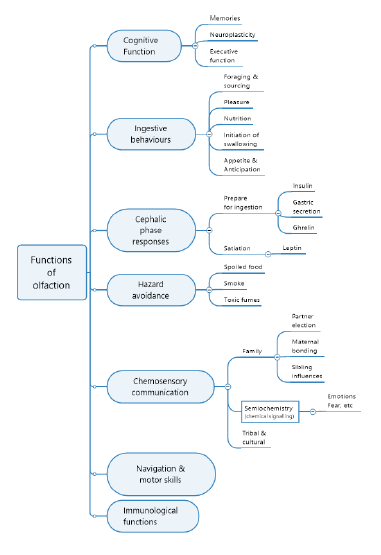
In addition, it has many functions with physiological roles which occur in ‘the background’. Amongst these are those involved in ingestive behaviours and in hazard avoidance. Olfaction confers psychosocial roles in diverse aspects of social communication, recognition and boding [3]. More recently the significance of immunological functions being identified during the recent pandemic [4]. Navigation [5], and motor skills are now believed to be influenced by olfaction.
In the ingestive process, olfaction plays a crucial role by activating neural signals in receptors in olfactory epithelium of the nose and relayed via the olfactory bulb to various brain regions including the sensory cortex and limbic system.
Odorants directly prepare the body for efficient ingestion, digestion and metabolism. In conjunction with sight, thought and sound, autonomic nervous activity is mediated largely via the vagus nerve in conjunction with other pathways in priming for ingestion by stimulating salivation, gastric secretions and release of various hormones from various organs including ghrelin in appetite generation, insulin in blood sugar homeostasis and eventually leptin leading to satiation. All of which prepare the digestive system through the cephalic phase responses to receive and managing digestion to maintain homeostasis.
Both smell and taste play important roles in the outcomes of ingestive behaviours. Smell via the external nares induces appetite and anticipation, whereas via the pharyngeal retronasal route, provides important physiological cues.
In combination with gustation, physiological taste, smell generates the brain generated perception of flavour. Much confusion exists in both laity and the scientific community concerning the word ‘taste’ which is commonly used to denote ‘flavour’. Flavour represents is a ‘neural image’ generate through the integration of olfaction on a ‘backbone’ of gustation (physiological taste) in which olfaction comprises between 75–95% of the percept [6]. This neural image generated is perceived in the mouth as flavour [7–9]. Processing of this image occurs through various neural pathways involving the specific sensors, the limbic system and cerebral cortex. Modulation of flavour occurs through numerous ways (Figure 2).
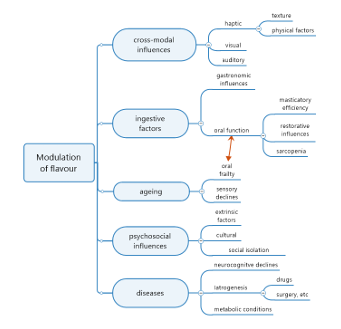
‘Pleasures of the table’ largely arise from the perceived flavours of foods and beverages, many other actions are derived from olfaction. Declines in olfactory acuity lead not only to loss of the enjoyment but are often accompanied with altered eating patterns including malnutrition and decreased social interactions. Olfaction as well as making food appealing provides cues in initiating and prompting the ensuing swallow reflex.
During the eating process food and beverages are introduced into the mouth in preparation for swallowing. During this preparatory stage, odourants and tastants are released during comminution from the food, with enhanced volatilization produced by warming and with saliva becoming incorporated into food to provide cohesion and lubrication and enables the action of salivary enzymes to commence digestion and the cleavage of ‘flavourants’. Released aromas are sensed in low volume air propulsion via the retronasal route generated during each chewing and swallowing cycle. Oral function is a key factor often not recognized in generating these aromas perceived in flavour.
Oral function can be compromised by loss of chewing ability through loss of teeth arising through dental caries and periodontal, and even with replacement can be in deficit. Oral frailty, an age-related functional decline of orofacial structures [10,11] and sarcopenia of the tongue and related oral structures is now a condition recognized as compromising swallowing function logically related to various declines in the different senses. Collection of the bolus by lips, cheeks and tongue depends on the effectives of motor senses possibly in conjunction with the chemical senses.
Uncomplicated swallowing is a complex sensory-motor process that requires foods to be provided in a suitable manner for delivery to the stomach via the oropharynx and oesophagus without aspiration into the respiratory system.
The roles of the chemical senses in conjunction with flavour release in wellbeing represent an example of a crossdisciplinarity area necessitating research with translation to clinical practice. It involves integration of the senses of touch, smell and taste, in conjunction with oral function, nutrition, swallowing, and cognitive function.,
Olfactory training, in conjunction with oral function, is being explored as an intervention in recovering olfactory decline and its potential to enable improved swallowing function. This represents an example of the translation of studies from sensory physiology into clinical applications which have the potential to provide public health benefits and improved quality of life.
Much research of value is undertaken which by necessity is ‘tunnelled visioned’ but a significant need exists for the involvement of ‘generalist’ visions and involvements to integrate often disparate disciplines in the translation from fundamental research to enjoy clinical and sociological applications. Studies of the chemical senses and touch provide examples in which cross-disciplinary approaches can be undertaken with outcomes influencing not solely clinical practice but also ageing and public health policies and budgets.
The vision of this journal, Archives of Biomedical Research, provides an ideal forum in which to publish not just focussed studies but to consider their translation from basic research into applications that directly benefit humans through multidisciplinary integration.
References
2. Kempermann G. Adult neurogenesis. In: Pfaff DW, Volkow ND, Rubenstein JL, editors. Neuroscience in the 21st century: from basic to clinical. Cham: Springer; 2022. pp. 321–39.
3. Roberts SC, Havlíček J, Schaal B. Human olfactory communication: current challenges and future prospects. Philos Trans R Soc Lond B Biol Sci. 2020 Jun 8;375(1800):20190258.
4. Wellford SA, Moseman EA. Olfactory immunology: the missing piece in airway and CNS defence. Nat Rev Immunol. 2024 Jun;24(6):381–98.
5. Hamburger K, Knauff M. Odors Can Serve as Landmarks in Human Wayfinding. Cogn Sci. 2019 Nov;43(11):e12798.
6. Spence C. Just how much of what we taste derives from the sense of smell?. FL. 2015 Nov 2;4(1):30–9.
7. Small DM, Prescott J. Odor/taste integration and the perception of flavor. Exp Brain Res. 2005 Oct;166(3-4):345–57.
8. Shepherd GM. Smell images and the flavour system in the human brain. Nature. 2006 Nov 16;444(7117):316–21.
9. Shepherd GM. Neurogastronomy: How the Brain Creates Flavor and Why It Matters. New York: Columbia University Press; 2012.
10. Morley JE. Editorial: Oral Frailty. J Nutr Health Aging. 2020;24(7):683–84.
11. Parisius KGH, Wartewig E, Schoonmade LJ, Aarab G, Gobbens R, Lobbezoo F. Oral frailty dissected and conceptualized: A scoping review. Arch Gerontol Geriatr. 2022 May-Jun;100:104653.