

Abstract
Background: Kaposi sarcoma (KS) remains a significant manifestation of advanced HIV disease, despite progress in antiretroviral therapy (ART). In the United States, the burden of KS disproportionately affects Black men and those from socioeconomically disadvantaged backgrounds. However, the neighborhood-level characteristics among patients diagnosed with KS have not been well characterized. This study explores demographic, clinical, and neighborhood-level characteristics among patients diagnosed with KS, with particular focus on the Area Deprivation Index (ADI) as an exploratory measure of structural disadvantage.
Methods: A retrospective observational study was conducted using the TriNetX database and local EMR to identify Maryland residents with confirmed KS. Records were reviewed across available years, with KS diagnoses spanning the 1990s through 2023.
Results: Forty-five patients were included, predominantly Black (71%), male (93%), gay or bisexual men (55%), and living with HIV (82%). Of people living with HIV (PLWH), 44% were diagnosed with KS within one year of their HIV diagnosis. Only 5 of 36 PLWH had CD4 count >200 cells/mm³ and HIV RNA < 200 copies/mL, consistent with well-controlled HIV at KS diagnosis. The median state ADI decile was 8 (IQR, 6–9), while the median national ADI rank was 49 (IQR, 33–70). Exploratory analyses demonstrated weak, non-significant correlations between state ADI and symptom burden (ρ=0.14, p=0.37) and national ADI and symptom burden (ρ=0.11, p=0.47). KS in this cohort occurred most commonly among people living with poorly controlled HIV and in historically disadvantaged populations.
Conclusion: Our findings emphasize the importance of timely HIV diagnosis, ongoing KS monitoring in both virally suppressed and unsuppressed individuals, and improved access to care for historically marginalized populations, particularly MSM and those in socioeconomically disadvantaged areas. Further research is needed to clarify the underlying mechanisms and explore how interventions targeting socioeconomic factors can improve outcomes.
Keywords
Kaposi Sarcoma (KS), People living with HIV (PLWH), Antiretroviral Therapy (ART), Social Determinants of Health (SDOH), Area Deprivation Index (ADI)
Introduction
In the last three decades, advancements in antiretroviral therapy (ART) have led to improved treatment adherence [1], decreased HIV mortality, and decreased incidence and mortality from many AIDS-defining illnesses, including KS [2]. The majority of KS today is AIDS-related, with decreasing incidence corresponding to these improvements in HIV care [3]. Despite decreasing rates of AIDS-related KS, long-standing racial and socioeconomic disparities persist in incidence and outcomes. Current trends in the U.S. highlight the unequal burden of KS among disadvantaged racial and ethnic groups, with disproportionately high rates in Black [4,5] and Hispanic [4] men. Furthermore, there is a higher KS incidence in areas with elevated poverty levels [6], also paralleling HIV disparities. Social determinants of health (SDOH), such as poverty and limited healthcare access, likely contribute to lower ART adherence among Black men, increasing their risk of virologic failure and, consequently, KS [7].
Kaposi sarcoma is an angioproliferative malignancy caused by infection with human herpesvirus 8 (HHV-8), also known as Kaposi sarcoma-associated herpesvirus. Although HHV-8 infection is necessary for KS development, additional factors including HIV-associated immunosuppression, host immune dysfunction, and viral persistence contribute to disease pathogenesis. HHV-8 prevalence varies substantially across geographic regions and risk groups and is particularly elevated among men who have sex with men (MSM).
The Area Deprivation Index (ADI), a measure developed by the Health Resources & Services Administration (HRSA) [8], has proven useful in quantifying SDOH and their association with poor health outcomes. The ADI ranks neighborhoods based on socioeconomic disadvantage by incorporating factors such as income, education, housing quality, and employment, enabling researchers to identify areas with higher deprivation and limited access to healthcare resources [8]. The ADI ranking system categorizes block groups based on their level of disadvantage, using a percentile scale from 1 to 100 nationally and deciles from 1 to 10 at the state level [6]. A rank of 1 indicates the lowest disadvantage, while a rank of 100 (or 10 in state deciles) signifies the highest disadvantage [6]. Despite literature highlighting the role of racial disparities and poverty on KS incidence, the impact of SDOH measured by ADI is underexplored.
Late HIV diagnosis, defined as having CD4 cell count < 350 cells/mm3 at time of HIV diagnosis or progressing to an AIDS defining condition within a year of HIV diagnosis, has been found to occur in higher rates in non-White individuals [9–11], those with less education [9–11], those living in rural or high-poverty areas [9–11], and those lacking health insurance [11]. Furthermore, late HIV diagnosis has been linked to structural inequalities such as income inequality, racial segregation, and limited access to HIV testing [9]. These findings underscore the pervasive influence of SDOH on HIV-related outcomes.
The primary objective of this study was to describe the demographic, clinical, HIV-related, and neighborhood-level characteristics of patients diagnosed with KS in Maryland. A secondary exploratory objective was to evaluate whether neighborhood disadvantage, measured by ADI, corresponded with differences in KS symptom burden.
Methods
Study design and data extraction
This study is a retrospective chart review using data compiled from a research database and from individual patients’ electronic medical records (EMR). It was deemed exempt by the institutional review boards of the University of Maryland School of Medicine. TriNetX, a global web-based health research network, was queried to identify Maryland residents within the University of Maryland Medical System from 2020 through 2023, whose EMR ‘Problem List’ included ICD-10 diagnosis codes for Kaposi Sarcoma. Because TriNetX captures patients engaged in participating healthcare systems, the cohort may overrepresent insured individuals or patients connected to care. Extracted data from TriNetX included: name, legal sex, race, ethnicity, medical record number, and address including zip code. Data collected by chart review from EMR (Epic), included: 1) Demographics (date of birth, gender identity, sexual orientation), 2) Social Determinants of Health (address for ADI determination, employment status, education level, insurance status, history of missed appointments, housing status), 3) KS-Related Data (diagnosis date, site of involvement, presenting symptoms, diagnosis method, treatment modality), 4) HIV-Related Data (HIV status at time of KS diagnosis, HIV diagnosis date, CD4 count and HIV RNA copies/mL at time of KS diagnosis (‘viral load’; VL), antiretroviral therapy (ART) regimen and adherence at the time of KS diagnosis, and ART regimen following KS diagnosis), 5) Comorbidities (diabetes mellitus, lymphoma, cardiovascular diseases (coronary artery disease, peripheral artery disease, carotid artery disease, atherosclerosis, arteriosclerosis), renal insufficiency), and 6) Vital status at 1, 3, 6 and 12 months after KS diagnosis.
Although patients were identified through a 2020–2023 TriNetX query, KS diagnosis dates were not restricted to that period, and the EMR was reviewed as far back as available records allowed. HIV and KS diagnosis were considered ‘concurrent’ if they occurred within one month of each other. Because CD4 count at the time of initial HIV diagnosis was not consistently available in historical EMR documentation, we operationalized “late HIV diagnosis” pragmatically as KS diagnosed within one year of HIV diagnosis. This approach aligns with the AIDS-defining condition component of the standard definition and allowed consistent classification across the cohort. Sexual orientation and gender identity (SOGI) were assessed first using these fields in Epic; if not available there, search terms ‘MSM’ (for men who have sex with men), ‘SGLM’ (for same-gender loving men), ‘cis’, ‘trans’, ‘hetero’, ‘homo’, ‘gay’, ‘lesbian’, ‘bisexual’, ‘queer’ and ‘pansexual’ were used to search the chart for free text describing a patient’s SOGI status. This information was adjudicated by at least one other researcher for each patient. Employment status was discerned using EMR search terms ‘employment’, ‘job’, ‘work’, ‘disability’, ‘SSI’ (supplemental security income), and ‘SSDI’ (social security disability insurance). The ADI dataset, publicly available on The Neighborhood Atlas website, was used to determine state and national ADI values (Kind et al., 2018). ADI assignment was based on the documented residential address at the time of KS diagnosis. For patients who were homeless (identified through search terms ‘homeless’, ‘housing’, and ‘shelter’), we assigned the highest state-level ADI decile a priori to reflect extreme structural disadvantage.
For presenting symptoms of KS, each chart was reviewed for report of these 7 symptom categories: rash/spots, lymphedema, B symptoms, weight loss, palpable nodes, gastrointestinal (GI) bleed, and hemoptysis. Rash/spots and lymphedema were further classified as cutaneous manifestations of KS, while B symptoms, weight loss, palpable nodes, GI bleeding, and hemoptysis were categorized as visceral manifestations. A symptom score was calculated for each patient by assigning 0 (negative symptom) or 1 (positive symptom) to each category and summing the values. The symptom score was developed as an exploratory measure of symptom burden and was not intended to serve as a validated measure of KS severity.
For any data that was missing from the local EMR, ‘CareEverywhere’, an Epic EMR extension that pulls in other Epic EMR data from local and regional healthcare systems, and Chesapeake Regional Information System for our Patients (CRISP), the State Designated Health Information Exchange, were utilized. Patients who did not reside in Maryland, or whose KS diagnoses could not be verified, were excluded.
Chart review was restricted to one year before and six months after the KS diagnosis date for the following variables: HIV status and diagnosis date, latest CD4 count and date, latest viral load and date, ART regimen and adherence, employment status, education level, household income, insurance status, missed appointments, and comorbidities.
Statistical analysis
Because ADI values are ranked measures and symptom scores represent ordinal count data, Spearman rank correlation was selected a priori to evaluate the relationship between ADI and symptom burden. Formal normality testing was not performed because ADI represents an ordinal ranking measure and symptom scores were treated as ordinal count data, making a nonparametric approach appropriate a priori. Missing values were not imputed. Analyses were performed using available data for each variable, and denominators are reported where missingness occurred. Statistical analyses were performed using GraphPad Prism software. P values of <.05 were considered statistically significant. Descriptive statistics were used to analyze and describe the final cohort.
Results
A cohort of 55 patients was generated from TriNetX. Eight patients were excluded because they did not have KS, and 2 patients were excluded based on state of residence. The final cohort consisted of 45 patients. The majority of patients’ legal sex was male (42, 93%), while 7% (3) identified as female, and mean age was 53.4 (range: 28-94). All patients with SOGI information available were cis-gender. 51% (23) identified as gay/lesbian, 35% (16) as heterosexual, and 4% (2) as bisexual. The cohort was predominantly Black (32, 71%), followed by White (10, 22%), American Indian/Alaskan Native (1, 2%), and multiracial (1, 2%). The majority was non-Hispanic (44, 98%). Most patients (39, 87%) had stable housing, were insured (41, 91%), and were employed (24, 53%) (Table 1).
|
Number of Patients (n=45) |
% of Patient Cohort |
|
|
Legal Sex |
||
|
Male |
42 |
93 |
|
Female |
3 |
7 |
|
Gender Identity |
||
|
Male |
22 |
49 |
|
Female |
1 |
2 |
|
Missing Data |
22 |
49 |
|
Sexual Orientation |
||
|
Heterosexual |
16 |
36 |
|
Bisexual |
2 |
4 |
|
Gay/Lesbian |
23 |
51 |
|
Missing Data |
4 |
9 |
|
Race |
||
|
Black |
32 |
71 |
|
White |
10 |
22 |
|
Asian |
0 |
0 |
|
American Indian/Alaskan Native |
1 |
2 |
|
Native Hawaiian/Other Pacific Islander |
0 |
0 |
|
Multiracial |
1 |
2 |
|
Missing Data |
1 |
2 |
|
Ethnicity |
||
|
Hispanic |
0 |
0 |
|
Non-Hispanic |
44 |
98 |
|
Missing Data |
1 |
2 |
|
Homeless/Unstable Housing |
||
|
No |
39 |
87 |
|
Yes |
6 |
13 |
|
Employment Status |
|
|
|
Employed |
24 |
53 |
|
Unemployed |
9 |
20 |
|
Social Security/Disability Benefits |
4 |
9 |
|
Retired |
5 |
11 |
|
Missing Data |
3 |
7 |
|
Insurance Status |
|
|
|
Insured |
41 |
91 |
|
Uninsured |
4 |
9 |
The distribution of national and state ADI scores among 44 patients is depicted in Figures 1a and 1b. One patient was excluded from analysis because their geographic area was not classified into the standard ADI scoring categories (i.e., PO box-only zip code). The median state ADI decile was 8 (IQR, 6–9), while the median national ADI rank was 49 (IQR, 33–70). In the national distribution, the majority of patients (24) were in neighborhoods with lowest levels of disadvantage (1st to 50th percentiles) (Figure 2). In the state distribution, most patients (35) resided in neighborhoods within the 6th to 10th state ADI deciles (Figure 2). In this small cohort, patients with higher ADI scores appeared to exhibit more KS symptoms, including symptoms categorized as visceral manifestations (Figure 2). Although weak positive correlations were observed, these findings should be interpreted cautiously given the small sample size and lack of statistical significance (state ADI: Spearman ρ = 0.14, p = 0.37; national ADI: Spearman ρ = 0.11, p = 0.47).
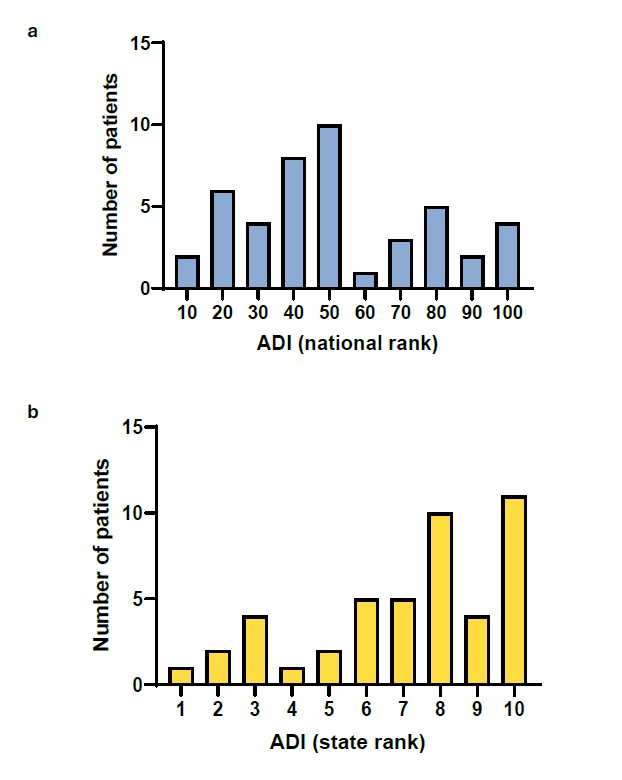
Figure 1. Distribution of national and state ADI scores across ranges from least to most disadvantaged. (a) National ADI scores over n=44 patients. (b) State ADI scores over n=44 patients. (ADI: Lower = Least Disadvantaged, Higher = Most Disadvantaged).
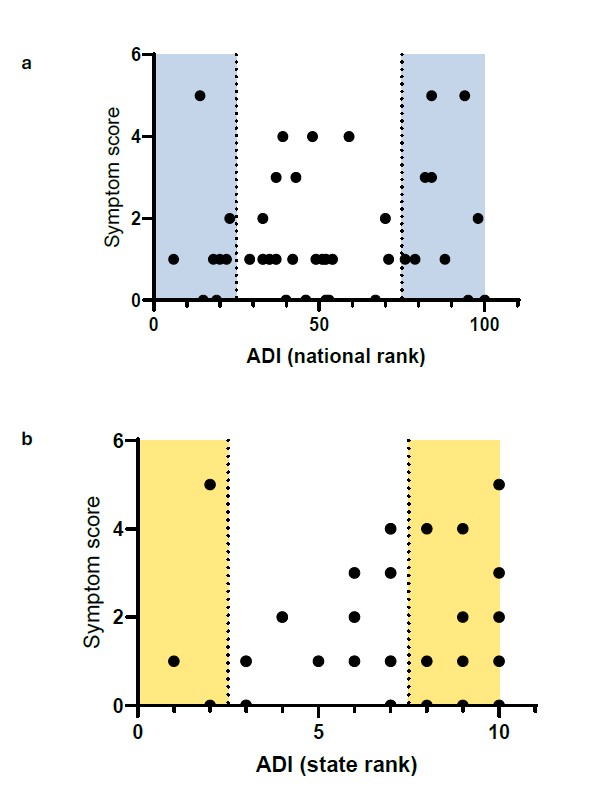
Figure 2. Distribution of symptom scores across ADI. (a) Symptom scores against national ADI scores. (b) Symptom scores against state ADI scores. (ADI: Lower = Least Disadvantaged, Higher = Most Disadvantaged). Dashed vertical lines denote the 25th and 75th percentiles of ADI.
Patients were diagnosed with KS in the 1990s (3 patients), 2000s (6), 2010s (16), and 2020–2023 (20). In this cohort, biopsy was the most frequently used method for the diagnosis of KS, followed by imaging and endoscopy. Rash and/or spots were the most common presenting symptom at KS diagnosis, and patients exhibited from 0 to 5 of the 7 queried typical KS symptoms. Initiation or continuation of ART was the most common treatment modality (15, 33%) followed by chemotherapy with paclitaxel (26%) or doxorubicin (11%). Surgery or radiation were utilized in 24% for local management of KS lesions.
Thirty-six of 45 patients with KS (82%) were also known or found to be living with HIV when diagnosed with KS. Six patients (13%) had a negative HIV test, and three (7%) did not have documented HIV testing at the time of KS diagnosis. Among the six HIV-negative patients, four were classified as having classic Kaposi sarcoma, while two had iatrogenic Kaposi sarcoma in the setting of chronic immunosuppression following kidney transplantation. Two patients were never tested; the third was not tested for HIV at the time of KS diagnosis but tested positive 7 months later (not included in count of 36 PLWH and KS). Of the 36 PLWH with CD4 and/or VL data available at time of KS diagnosis, average CD4 count was 239 cells/mm³ (range 1- 1125) and average HIV VL was 101,917 copies/mL (range <20 – 862,000). 63% had CD4 counts <200, and 31% had VLs <200, highlighting both the degree of HIV-related immunosuppression typically present when KS develops, and the significant proportion of patients that may develop KS even in the setting of a more intact immune system and HIV viral suppression (Table 2).
Twelve patients (33%) were diagnosed with HIV concurrently with KS, defined as within one month of each other (Table 2), and another 4 (11%) had been diagnosed with HIV 1-12 months prior to KS. Using the pragmatic definition (i.e., classifying KS diagnosed within one year of HIV diagnosis as late), 16 patients (44%) were classified as having a late HIV diagnosis. Of those diagnosed concurrently and with data available, the majority (7 of 11) also had CD4 ≤200 cells/mm3.
In patients whose HIV diagnoses pre-dated KS diagnosis by at least a month, 11 of the 18 with data available had CD4 count ≤200 cells/mm3. Half had controlled viremia with HIV RNA <200 copies/mL; four of these patients also had CD4 count ≤200 cells/mm3 at the time of KS diagnosis. Thus, only 5 of these 18 patients with previously diagnosed HIV had well controlled HIV with a CD4 ≥200 cells/mm3 and HIV VL <200 copies/mL when diagnosed with KS. This cohort had been living with HIV from as little as 6 months prior to KS diagnosis, to as long as 33 years prior (Table 2).
|
|
Number of Patients |
% |
|
HIV Duration prior to KS Diagnosis |
n=36 |
|
|
Concurrent |
12 |
33 |
|
Diagnosed within last year |
4 |
11 |
|
Diagnosed 1–10 years ago |
9 |
25 |
|
Diagnosed more than 10 years ago |
11 |
31 |
|
Latest CD4+ Counts Prior to KS Diagnosis |
n=36 |
|
|
≤200 |
18 |
50 |
|
201–500 |
6 |
17 |
|
>500 |
5 |
14 |
|
Missing Data |
7 |
19 |
|
Viral Loads (VL) Prior to KS Diagnosis |
n=36 |
|
|
<200 |
9 |
24 |
|
201–100,000 |
13 |
35 |
|
>100,001 |
8 |
22 |
|
Missing Data |
7 |
19 |
Of patients known to be living with HIV at the time of KS diagnosis and with antiretroviral therapy (ART) regimen known (n=14), 11 were prescribed an integrase strand transfer inhibitor (INSTI) based regimen of 3 drugs (3DR; n=9) or 2 drugs (2DR; n=2). Three patients were prescribed 3-drug regimens with boosted protease inhibitors (PI). Regimens for all patients diagnosed with KS before 2009 were not found in available medical records. All on INSTI-based 3DR remained on an INSTI-based 3DR, though 4 switched specific drugs within this category. Both patients on an INSTI-based 2DR also stayed within this category, though 1 had a drug switch. One patient on a boosted PI 3DR switched to an INSTI 2DR, and the other 2 patients on a boosted PI 3DR stayed on the same regimen.
Review of comorbidities revealed 9 patients with diabetes mellitus (2 type 1, 7 type 2), 2 with lymphoma, and 17 with any cardiovascular disease (2 congestive heart failure, 3 cerebrovascular accident, 4 coronary artery disease, and 7 peripheral vascular disease). Sixteen patients had stage 2 through 4 chronic kidney disease (CKD); no patient had stage 5 CKD. Three patients died within one year of their KS diagnosis – 1 within 1 month, 1 within 6 months, and another within 12 months.
Discussion
The study sample included a majority of adult males, consistent with findings from similar database studies [12]. In our cohort, 51% (23) of patients identified as gay/lesbian, and 4% (2) identified as bisexual. Prior epidemiologic studies have reported higher KS incidence among MSM with HIV; the composition of our cohort is consistent with these previously described patterns. This is thought to be linked to the higher prevalence of HHV-8 in MSM compared to other HIV transmission groups [13,14]. Higher HHV-8 seroprevalence among MSM likely contributes to the disproportionate burden of KS observed in this population. Sexual transmission of HHV-8 has been well documented among MSM, resulting in substantially higher rates of HHV-8 infection compared with other HIV transmission groups [13,14]. Many patients presented with KS concurrently with their HIV diagnosis, highlighting the continued presence of late HIV diagnosis within this cohort, which is already known to be associated with SDOH and increased HIV mortality. Late HIV diagnosis has been consistently associated with structural and socioeconomic determinants, including poverty, reduced access to HIV testing, and neighborhood deprivation, and is known to contribute to increased HIV-related morbidity and mortality [9–11]. These disparities have important clinical implications, as delayed HIV diagnosis and reduced engagement in care may increase the likelihood of advanced immunosuppression, delayed KS recognition, and the need for more intensive treatment. Addressing structural barriers to HIV testing, treatment access, and longitudinal care may therefore represent an important strategy for reducing KS-related morbidity [9–11].
In this cohort, the national distribution of ADI showed that the highest number of patients reside in areas with lowest levels of disadvantage. At the state level, most patients resided in areas with ADI with the highest level of disadvantage in Maryland. The discrepancy between the national ADI rankings compared to state-level rankings may suggest that participants were not necessarily living in more disadvantaged neighborhoods when compared to individuals across the country. This discrepancy may highlight the limited generalizability of state ADI findings, as economic conditions and resources within certain states may be more favorable than in others. A patient may appear less disadvantaged when ADI is evaluated nationally yet still reside in one of Maryland’s most deprived neighborhoods. This within-state relative deprivation may provide additional context regarding healthcare access and neighborhood-level disadvantage among patients diagnosed with KS. For example, a study by Hu et al. showed how the impact of ADI can differ across contexts, particularly when comparing state-level analyses to a national distribution [15]. This emphasizes the need to account for unique factors at both the state and national levels when interpreting ADI data.
In this small cohort, the correlations between ADI and symptom burden were weak and not statistically significant. However, patients with higher ADI scores often exhibited more KS symptoms, including symptoms categorized as visceral manifestations. Visceral KS is more advanced and aggressive than cutaneous KS, typically requiring more aggressive treatment including systemic chemotherapy [16]. It is important to note that the symptom score assigned equal weight to all symptom categories despite differences in clinical severity and has not been independently validated. Therefore, symptom burden findings should be interpreted as exploratory.
The analysis of CD4 counts and HIV VL revealed that the majority of PLWH had poorly controlled HIV at the time of KS diagnosis, with CD4 < 200 cells/mm3 and HIV viremia.
As an AIDS-defining cancer, most Kaposi’s sarcoma (KS) cases have traditionally occurred at low CD4 counts (<200 cells/mm3) and/ or in those with high VLs [17]. While the majority of KS cases in PLWH were diagnosed in the setting of poorly controlled HIV, this was not exclusively the case in our cohort. These findings are consistent with the emerging recognition of KS occurring among virally suppressed individuals, highlighting the unpredictable nature of the disease [18]. Why KS occurs in HIV-suppressed patients is not yet clear. Preliminary data suggest that immunodominant HHV-8 proteins are likely not appropriately presented to the immune system during KS and that T-cell exhaustion could also be at play [18]. Treating KS in virally suppressed PLWH is especially challenging [18]. Once the options of surveillance and local treatment are exhausted, those patients will inevitably require systemic chemotherapy, such as anthracyclines or taxanes [19,20]. Unlike many low- and middle-income countries (LMICs), where limited HIV testing infrastructure, delayed ART initiation, and restricted access to chemotherapy continue to drive substantial KS morbidity and mortality, most patients in the United States have access to effective ART and oncologic care [20,21]. Nevertheless, persistent disparities in HIV diagnosis, treatment engagement, and social determinants of health continue to contribute to KS burden in vulnerable populations [7,9–11].
The analysis of ART regimens before and after the diagnosis of KS indicates a notable shift in treatment strategies compared to historical literature. Older guidance emphasized starting patients on protease inhibitor (PI)-based regimens as part of the treatment of KS [22]. Particularly, indinavir and saquinavir have been shown to inhibit tumor growth by directly blocking two fundamental steps of KS initiation and progression—angiogenesis and tumor cell invasion [22]. However, most patients in this study were initiated or continued on integrase strand transfer inhibitor (INSTI)-based regimens following their KS diagnosis, in line with current clinical practices and guidelines for HIV treatment, which increasingly favor INSTI-based therapies for their efficacy and tolerability [21,22].
Study limitations include a small sample size, missing data, and the inherent constraints of a retrospective chart review, particularly for retrieving remote or incomplete data. First, our pragmatic definition of late HIV diagnosis (KS diagnosed within one year of HIV diagnosis) differs from the standard definition that incorporates CD4 count at HIV diagnosis. This approach was necessary because historical CD4 data were frequently unavailable and may have resulted in misclassification of some patients. Second, TriNetX captures patients engaged with participating healthcare systems and may therefore overrepresent insured individuals or patients connected to care. As such, this cohort may not fully represent the broader population of Maryland residents living with HIV or KS. Also, ADI values were not time-updated longitudinally. For patients diagnosed in earlier decades, neighborhood deprivation measured from available EMR addresses may not fully reflect neighborhood conditions at the time of KS diagnosis. Third, the method of database query introduced survivorship bias, as any patient in the database with KS who died prior to 2020 would have been excluded from the dataset. Additionally, the lack of long-term follow-up data for more recently diagnosed patients limited the ability to assess the sustained impact of clinical and socioeconomic factors on KS outcomes. Fourth, because denominator data for the broader HIV population were not available, this study cannot estimate KS incidence or relative risk across demographic groups. Therefore, the racial and sexual orientation distributions observed in this cohort should be interpreted descriptively rather than as measures of comparative risk. Additionally, cases spanned multiple eras of HIV care, from the pre-modern ART period through the contemporary ART era, which limits interpretation of pooled findings across decades with substantially different HIV treatment landscapes. Because ART regimens, HIV testing practices, and KS management changed substantially across these decades, pooled analyses should be interpreted cautiously.
Conclusion
This retrospective case series describes demographic, HIV-related, and neighborhood-level characteristics among patients diagnosed with KS in Maryland. Most patients were living with HIV, and many demonstrated advanced immunosuppression or late HIV diagnosis at the time of KS diagnosis. Exploratory analyses using ADI provided neighborhood-level context but did not demonstrate statistically significant associations with symptom burden. Given the descriptive nature of this study and lack of denominator data, future population-based studies are needed to better characterize disparities in KS presentation and outcomes across HIV populations. Future studies should aim to include a broader and more diverse sample to increase statistical power and enhance generalizability. Comparative analyses, such as evaluating the ADI of matched HIV-positive patients with KS versus HIV-positive patients without KS, may also provide additional insights into the role of social determinants of health in KS development and outcomes.
Acknowledgments
The authors would like to thank the University of Maryland Medical System and its dedicated research staff for providing access to the TriNetX database and supporting this project. Special thanks to the patients and healthcare professionals whose contributions made this research possible.
Declaration of Interests Statement
The authors report there are no competing interests to declare.
Funding Details
This research received no specific grant from any funding agency in the public, commercial, or not-for-profit sectors.
Data Availability Statement
The data that support the findings of this study are available from the corresponding author, TSB, upon reasonable request.
List of Abbreviations
ADI: Area Deprivation Index; ART: Antiretroviral Therapy; CD4+: Cluster of Differentiation 4 Positive Cells; EMR: Electronic Medical Records; GI: Gastrointestinal; HIV: Human Immunodeficiency Virus; ICD-10: International Classification of Diseases, 10th Revision; INSTI: Integrase Strand Transfer Inhibitor; KS: Kaposi Sarcoma; PI: Protease Inhibitor; PLWH: People Living with HIV; SDOH: Social Determinants of Health; VL: Viral Load
Author Contributions
TSB: Conceptualization, Data curation, Formal analysis, Investigation, Methodology, Project administration, Supervision, Visualization, Writing—original draft, Writing—review & editing.
KK: Data curation, Formal analysis, Software, Visualization, Writing—original draft, Writing—review & editing.
JM: Investigation, Writing—original draft, Writing—review & editing.
GP: Investigation, Writing—original draft, Writing—review & editing.
RB: Investigation, Writing—original draft, Writing—review & editing.
SAS: Conceptualization, Data curation, Formal analysis, Investigation, Methodology, Project administration, Supervision, Validation, Writing—original draft, Writing—review & editing.
References
2. Valantin MA, Royston L, Hentzien M, Jary A, Makinson A, Veyri M, et al. Therapeutic Perspectives in the Systemic Treatment of Kaposi's Sarcoma. Cancers (Basel). 2022 Jan 18;14(3):484.
3. Peprah S, Engels EA, Horner MJ, Monterosso A, Hall HI, Johnson AS, et al. Kaposi Sarcoma Incidence, Burden, and Prevalence in United States People with HIV, 2000-2015. Cancer Epidemiol Biomarkers Prev. 2021 Sep;30(9):1627–33.
4. Hsieh MC, Wu XC, Andrews PA, Chen VW. Racial and Ethnic Disparities in the Incidence and Trends of Soft Tissue Sarcoma Among Adolescents and Young Adults in the United States, 1995-2008. J Adolesc Young Adult Oncol. 2013 Sep;2(3):89–94.
5. Reiner AS, Panageas KS. Kaposi Sarcoma in the United States: Understanding Disparate Risk. JNCI Cancer Spectr. 2022 Nov 1;6(6):pkac079.
6. Boscoe FP, Johnson CJ, Sherman RL, Stinchcomb DG, Lin G, Henry KA. The relationship between area poverty rate and site-specific cancer incidence in the United States. Cancer. 2014 Jul 15;120(14):2191–8.
7. Ragi SD, Moseley I, Ouellette S, Rao B. Epidemiology and Survival of Kaposi's Sarcoma by Race in the United States: A Surveillance, Epidemiology, and End Results Database Analysis. Clin Cosmet Investig Dermatol. 2022 Aug 18;15:1681–5.
8. Kind AJH, Buckingham WR. Making Neighborhood-Disadvantage Metrics Accessible - The Neighborhood Atlas. N Engl J Med. 2018 Jun 28;378(26):2456–8.
9. Ransome Y, Kawachi I, Braunstein S, Nash D. Structural inequalities drive late HIV diagnosis: The role of black racial concentration, income inequality, socioeconomic deprivation, and HIV testing. Health Place. 2016 Nov;42:148–58.
10. Bendera A, Baryomuntebe DM, Kevin NU, Nanyingi M, Kinengyere PB, Mujeeb S, et al. Determinants of Late HIV Diagnosis and Advanced HIV Disease Among People Living with HIV in Tanzania. HIV AIDS (Auckl). 2024 Aug 26;16:313–23.
11. Mugavero MJ, Castellano C, Edelman D, Hicks C. Late diagnosis of HIV infection: the role of age and sex. Am J Med. 2007 Apr;120(4):370–3.
12. Fu L, Tian T, Wang B, Lu Z, Gao Y, Sun Y, et al. Global patterns and trends in Kaposi sarcoma incidence: a population-based study. Lancet Glob Health. 2023 Oct;11(10):e1566-75.
13. Gonçalves PH, Uldrick TS, Yarchoan R. HIV-associated Kaposi sarcoma and related diseases. AIDS. 2017 Sep 10;31(14):1903–16.
14. Dupin N, Jary A, Boussouar S, Syrykh C, Gandjbakhche A, Bergeret S, et al. Current and Future Tools for Diagnosis of Kaposi's Sarcoma. Cancers (Basel). 2021 Nov 25;13(23):5927.
15. Hu J, Kind AJH, Nerenz D. Area Deprivation Index Predicts Readmission Risk at an Urban Teaching Hospital. Am J Med Qual. 2018 Sep/Oct;33(5):493–501.
16. Saif MW. Diagnosis and Treatment of Kaposi's Sarcoma. Resid Staff Physician. 2001 Nov;47(13):19–24.
17. Farizo KM, Buehler JW, Chamberland ME, Whyte BM, Froelicher ES, Hopkins SG, et al. Spectrum of disease in persons with human immunodeficiency virus infection in the United States. JAMA. 1992 Apr 1;267(13):1798–805.
18. Palich R, Makinson A, Veyri M, Guihot A, Valantin MA, Brégigeon-Ronot S, et al. Kaposi's Sarcoma in Virally Suppressed People Living with HIV: An Emerging Condition. Cancers (Basel). 2021 Nov 15;13(22):5702.
19. Gbabe OF, Okwundu CI, Dedicoat M, Freeman EE. Treatment of severe or progressive Kaposi's sarcoma in HIV-infected adults. Cochrane Database Syst Rev. 2014;(9):CD003256.
20. Gandhi RT, Bedimo R, Hoy JF, Landovitz RJ, Smith DM, Eaton EF, et al. Antiretroviral Drugs for Treatment and Prevention of HIV Infection in Adults: 2022 Recommendations of the International Antiviral Society-USA Panel. JAMA. 2023 Jan 3;329(1):63–84.
21. Cheng H, Tong Z, Han R, Yang G, Gao M, Cui F, et al. The global burden, trends, and inequalities of HIV/AIDS: a multicountry observational analysis. BMC Infect Dis. 2025 Oct 9;25(1):1259.
22. Barillari G, Sgadari C, Toschi E, Monini P, Ensoli B. HIV protease inhibitors as new treatment options for Kaposi's sarcoma. Drug Resist Updat. 2003 Aug;6(4):173–81.
23. Girometti N, Lander F, McOwan A, Nwokolo N, Boffito M, Whitlock G; Dean Street Collaborative group†. Rapid ART start in early HIV infection: Time to viral load suppression and retention in care in a London cohort. HIV Med. 2020 Oct;21(9):613–5.