

Abstract
Thermogenic adipocytes convert chemical energy into heat and are increasingly viewed as targets for treating obesity and metabolic disease. Recent work establishes a functional relationship between exosome trafficking and the cellular capacity to execute a thermogenic response. Activation of human and mouse thermogenic adipocytes increases extracellular vesicle release, whereas genetic or pharmacological inhibition of exosome biogenesis and secretion reduces thermogenic gene expression, mitochondrial respiration, and directly measured heat production. Conversely, genetic enhancement of exosome secretion augments thermogenic output. These findings extend the conventional focus on vesicle-mediated communication by raising the possibility that secretion also alters the metabolic state of the cell producing the vesicles. The underlying mechanism remains unresolved and could involve export of one or more intracellular inhibitors, energy consumed during vesicle biogenesis and release, shared functions of trafficking machinery in cellular remodeling, or some combination of these possibilities. Testing this working hypothesis will clarify how vesicle trafficking contributes to thermogenic competence and may identify new ways to enhance adipocyte energy expenditure.
Keywords
Beige adipocytes, Brown adipocytes, Thermogenesis, Extracellular vesicles, Exosomes, Rab27a, microRNAs
Adipocyte Thermogenesis Emerges from Coordinated Cellular Processes
Brown and beige adipocytes are specialized fat cells that dissipate stored chemical energy as heat. Brown adipocytes reside in dedicated thermogenic depots and are developmentally programmed for relatively stable thermogenic activity. Beige adipocytes arise within white adipose tissue and can reversibly acquire thermogenic properties in response to cold exposure, adrenergic stimulation, and other environmental or hormonal signals [1–3]. Both cell types contain abundant mitochondria and can express uncoupling protein 1 (UCP1), which permits proton conductance across the inner mitochondrial membrane and converts the energy of substrate oxidation into heat rather than ATP. UCP1 is not the only route to heat production. Calcium cycling, creatine cycling, and lipid cycling can consume ATP without producing net chemical work, thereby dissipating energy as heat [4–6]. Recent work also indicates that thermogenic adipocytes are heterogeneous, with distinct populations differing in their reliance on UCP1 and ATP-consuming futile cycles [7,8]. Together, these observations show that thermogenic capacity cannot be defined by UCP1 expression alone. Instead, an adipocyte must possess the signaling, mitochondrial, metabolic, and intracellular machinery required to convert stimulation into heat through one or more thermogenic pathways. This broader property can be described as thermogenic competence and depends on sufficient mitochondrial capacity, signaling fidelity, substrate access, organelle quality control, and intracellular organization to support and sustain heat production [9]. Thermogenic competence is therefore ultimately a functional property. Gene and protein expression, mitochondrial respiration, and whole-body energy expenditure provide important but indirect measures of thermogenic activity, whereas direct measurement of heat captures the final functional output shared by both UCP1-dependent and UCP1-independent pathways. Isothermal microcalorimetry provides one approach for making this direct assessment [10].
Within this framework, extracellular vesicle trafficking has emerged as an unexpected determinant of thermogenic capacity. Exosomes and related small extracellular vesicles are usually discussed as vehicles of intercellular communication. They carry microRNAs, proteins, lipids, and other cellular material to neighboring or distant recipient cells. Our recent study extends this conventional view by asking whether secretion also regulates the thermogenic adipocyte that produces the vesicles [11].
Vesicle Trafficking is Coupled to Thermogenic Activation and Function
An initial indication that vesicle trafficking might be linked to thermogenic function came from examining how exosome release changed during adipocyte activation. In human beige adipocytes, thermogenic activation caused a rapid increase in exosome release and markedly altered exosomal microRNA composition [11,12]. Comparable activation-associated changes in exosome release were observed in primary mouse beige adipocytes. The relationship between exosome trafficking and thermogenic function was subsequently examined across human and mouse beige and brown adipocyte models using cAMP-dependent activation, adrenergic stimulation, and cold exposure [11].
The functional evidence did not rest on a single perturbation. Loss of Rab27a, a small GTPase required for multivesicular-body docking and exosome release, reduced exosome secretion, UCP1 expression, mitochondrial content, and heat production measured directly in cultured adipocytes by high-resolution isothermal microcalorimetry [11,13]. Adipose tissue isolated from cold-exposed Rab27a-deficient mice also produced less heat when measured ex vivo by microcalorimetry. Consistent with these tissue-level findings, Rab27a-deficient mice exhibited reduced UCP1 induction following cold exposure and lower whole-body energy expenditure during cold and β3-adrenergic stimulation [11]. Two small molecules targeting distinct components of exosome formation and release produced convergent effects. Manumycin A suppresses exosome biogenesis through a Ras/Raf/ERK1/2- and hnRNP H1-associated pathway, whereas GW4869 inhibits neutral sphingomyelinase-dependent ceramide formation and intraluminal vesicle budding [14,15]. Each inhibitor attenuated thermogenic responses, and combined treatment reduced agonist-induced UCP1 expression and heat production in human beige and brown adipocytes. Conversely, a doxycycline-inducible ExoBooster cassette containing STEAP3, SDC4, and NadB increased exosome release and enhanced UCP1 expression and heat production in cultured beige adipocytes and inguinal adipose tissue following cold exposure [11,16].
The convergence of genetic loss of Rab27a, pharmacological inhibition through two distinct pathways, and genetic enhancement of exosome secretion makes a compound-specific explanation unlikely. Moreover, many of the experiments were conducted in differentiated adipocyte cultures lacking the macrophages, endothelial cells, and other stromal populations present in intact adipose tissue. These findings support an adipocyte-intrinsic relationship between exosome trafficking and thermogenic function, while the complementary mouse studies establish its physiological relevance. However, purified adipocyte cultures do not exclude signaling between adipocytes or reuptake of secreted vesicles. Distinguishing a donor-cell effect from conventional recipient-cell signaling will require experiments that manipulate cargo loading or release in defined producer cells while independently controlling vesicle uptake by the same or neighboring adipocytes. Conditioned-medium transfer, transwell designs, and blockade of vesicle uptake could help resolve these alternatives.
Secretion as a Cell-Intrinsic Regulatory Process
Exosome secretion is generally viewed as a mechanism of intercellular communication in which vesicles deliver regulatory cargo to recipient cells. Evidence from several cellular contexts shows that secretion can also affect the producing cell. In human fibroblasts, exosomal export of harmful cytoplasmic DNA protected against aberrant innate immune activation, senescence, and apoptosis [17]. CD9- and CD82-dependent exosomal discharge of beta-catenin reduced the intracellular beta-catenin pool and attenuated Wnt signaling [18]. In neurons, exosomal secretion contributed to clearance of pathological TDP-43, whereas inhibition of exosome production increased TDP-43 aggregation and worsened disease phenotypes in a transgenic mouse model [19]. Prominin-2 promoted ferritin-containing exosome release and iron export, thereby limiting intracellular iron accumulation and ferroptotic death [20]. Extracellular-vesicle secretion was also shown to regulate intracellular CYFIP2 abundance in cortical neurons [21]. More broadly, vesicular extrusion of misfolded or aggregated proteins may provide a disposal route when lysosomal or proteasomal handling is insufficient, although it can also distribute pathogenic material to recipient cells [22]. These studies support a recurring donor-cell principle in which vesicle secretion can change intracellular cargo abundance, signaling, proteostasis, stress tolerance, or survival. Our findings extend this cell-intrinsic view to thermogenic adipocytes and raise the possibility that vesicle release influences the metabolic function of the producing cell. Export could remove inhibitory regulators, relieve endosomal or trafficking constraints, dispose of selected material, or redirect cellular energy and metabolites. The extracellular destination of the vesicle remains biologically important, but it may not be the only consequence of secretion.
This distinction is especially relevant to beige adipocytes. These cells reversibly transition between relatively quiescent and highly oxidative states and must rapidly remodel transcription, lipid handling, mitochondrial abundance, and organelle quality [2,3,9]. Vesicle release could provide a means of changing intracellular regulatory content without requiring each inhibitory molecule to be degraded individually. Viewed in this context, the functional evidence supports a working hypothesis in which exosome trafficking helps adipocytes achieve their full thermogenic response. The present data establish a functional relationship but do not show whether secretion itself, removal of a particular cargo, recipient-cell signaling, or another function of the trafficking machinery is responsible. Figure 1 summarizes these potential mechanisms and distinguishes relationships supported by the study from mechanisms that require direct testing.
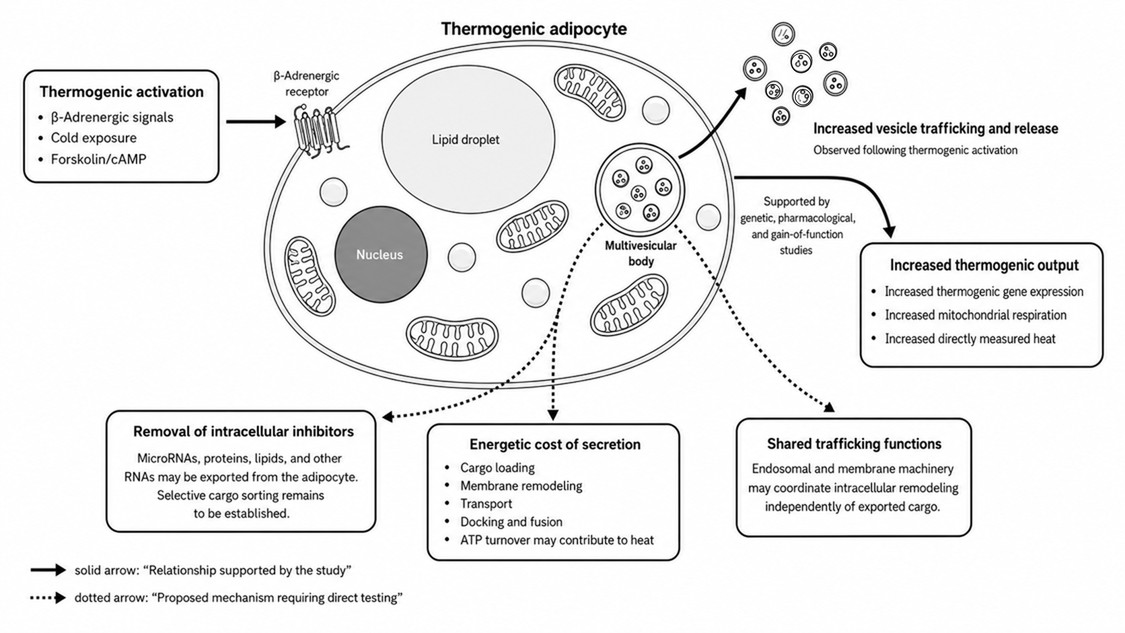
Figure 1. Working hypothesis for donor-cell effects of vesicle trafficking in thermogenic adipocytes. Thermogenic activation increases vesicle trafficking and release. Genetic loss- and gain-of-function approaches, together with pharmacological inhibition of exosome biogenesis and release, support a functional relationship between vesicle trafficking and increased thermogenic output, but do not establish the responsible mechanism. Vesicle trafficking could facilitate thermogenesis by removing one or more intracellular inhibitors, increasing ATP turnover through the energetic demands of vesicle biogenesis and secretion, or engaging trafficking machinery that also regulates intracellular remodeling. Any one of these mechanisms, or a combination, could be responsible. Solid arrows indicate relationships supported by the exosome-trafficking study, whereas dotted arrows indicate proposed mechanisms requiring direct testing.
Potential Nonexclusive Mechanisms Linking Vesicle Trafficking to Heat Production
Export of inhibitory microRNAs
One potential mechanism is the export of intracellular microRNAs that suppress adipocyte thermogenic programs. Thermogenic activation increased both the number of exosomes released and the relative abundance of several adipocyte-regulatory microRNAs within the exosomal cargo [11]. Thus, increased vesicle secretion could enhance microRNA export even without changes in cargo composition, while the observed enrichment of specific microRNAs could further amplify their removal from the cell. Whether this enrichment reflects active sorting, passive loading, differential stability, or changes in intracellular availability remains unknown. Several microRNAs enriched in the exosome fraction declined in adipocytes within one hour after thermogenic stimulation [11]. This rapid decrease is consistent with their secretion from the cell, although exosome-independent release and enhanced intracellular degradation cannot be excluded.
miR-99b-5p provides a useful example of how vesicle export might have different consequences in the producing and recipient cells. Following thermogenic activation, its relative abundance in beige-adipocyte exosomes increased by more than 1,200-fold as its intracellular abundance decreased [11]. Brown adipose tissue-derived exosomal miR-99b-5p can reach the liver and suppress hepatic Fgf21 expression, demonstrating endocrine communication between thermogenic adipose tissue and a distant metabolic organ [23]. Because beige and brown adipocytes also produce FGF21, depletion of intracellular miR-99b could instead relieve repression of Fgf21 within the source adipocyte and reinforce browning through autocrine or local paracrine signaling. Export could therefore increase FGF21 signaling locally while reducing it in a distant recipient tissue, although this model has not yet been tested directly. The miR-27 family was also strongly enriched, including an approximately 3,500-fold increase in miR-27b-3p and a smaller but significant increase in miR-27a-3p. Independent studies have established miR-27a and miR-27b as suppressors of brown and beige adipocyte differentiation and thermogenic transcription [24,25].
Additional microRNAs enriched in exosomes from thermogenically activated beige adipocytes included miR-133a-5p, miR-130b-3p, miR-454-3p, and miR-126-3p [11]. Prior studies showed that miR-133a suppresses adipocyte browning and thermogenic gene expression, miR-130b inhibits adipogenesis, miR-454-3p suppresses preadipocyte proliferation and differentiation in broilers, and miR-126-3p promotes adipose tissue insulin resistance and endoplasmic reticulum stress [26–29]. The simultaneous enrichment of regulators affecting adipogenesis, thermogenesis, lipid storage, and metabolic stress suggests that vesicle release may remodel several dimensions of adipocyte state rather than acting through one cargo molecule. Nevertheless, enrichment alone does not establish that export of any individual microRNA is necessary or sufficient for thermogenesis. Selective export of inhibitory regulatory factors is therefore best viewed as a mechanistic model supported by the data, not yet as the exclusive explanation.
The energetic cost of vesicle production
An important alternative interpretation is that increased heat could partly reflect the energy required to generate and release vesicles. Cargo sorting, endosomal remodeling, intraluminal vesicle formation, transport of multivesicular bodies, membrane docking, and fusion all require coordinated enzymatic and cytoskeletal activity. The ESCRT (Endosomal Sorting Complex Required for Transport) machinery, for example, uses the VPS4 ATPase during membrane constriction, scission, and recycling [30,31]. Rab-family GTPases, motor proteins, membrane-lipid remodeling, and restoration of ionic and membrane homeostasis add further energetic demands. If ATP consumed by these processes must be replenished through oxidative metabolism, some of that energy will ultimately appear as heat.
This possibility is particularly relevant because adipocytes isolated from transgenic mice carrying the inducible ExoBooster cassette displayed increased heat production despite only a modest increase in UCP1 protein, even in the absence of an additional thermogenic stimulus [11]. Vesicle production could therefore contribute directly to the calorimetric signal or engage UCP1-independent, ATP-consuming thermogenic pathways. Such a contribution would not invalidate the cargo-export model because increased vesicle production could both consume energy and remove intracellular inhibitors.
The available evidence suggests, however, that the energetic cost of vesicle production is unlikely to fully explain the increase in heat. Forskolin increased extracellular vesicle secretion from primary mouse gonadal white adipocytes, yet these cells exhibited a substantially weaker thermogenic response than mouse beige adipocytes, and inhibiting vesicle release did not significantly suppress their modest Ucp1 induction [11]. Consistent with this depot-specific difference, Rab27a deficiency had little effect on UCP1 expression or heat production in mouse gonadal white adipose tissue [11]. In human thermogenic adipocytes, inhibitor treatment did not significantly reduce basal heat production but selectively impaired agonist-induced thermogenesis. If vesicle generation alone were sufficient to account for the heat signal, a stronger relationship would be expected in nonthermogenic adipocytes and in unstimulated cells. The data instead suggest that the energetic burden of secretion may amplify heat production most effectively when it is embedded within an already competent thermogenic program.
Proteins, lipids, RNAs, and selective cargo sorting
MicroRNAs are only one component of extracellular vesicles. Proteins, lipids, messenger RNAs, metabolites, and membrane constituents could alter the donor cell through their removal or influence recipient cells after release. Thermogenic activation may direct specific cargo into vesicles through sequence motifs, RNA-binding proteins, lipid microdomains, or endosomal sorting machinery. Alternatively, apparent enrichment could arise passively from changes in intracellular abundance, cargo stability, or increased bulk membrane turnover. Distinguishing selective sorting from passive loading will require intracellular and vesicular abundance to be examined together with the secretion kinetics of individual cargo species. Defining the full range of material exported during thermogenic activation will therefore be important for understanding how vesicle trafficking reshapes both the producing adipocyte and its interactions with other cells.
Shared machinery between secretion and intracellular remodeling
A final possibility is that molecular components controlling exosome formation and release also regulate processes required for thermogenesis independently of the exported vesicles. Here, trafficking machinery refers to components that govern endosome maturation, multivesicular-body formation, vesicle transport, docking, and membrane fusion, including Rab GTPases, ESCRT complexes, ceramide-dependent budding pathways, cytoskeletal motors, and SNARE proteins. These components intersect with lysosomal function, autophagy, lipid-droplet turnover, plasma-membrane recycling, and organelle contact sites. Disrupting Rab27a or ceramide-dependent budding could therefore alter mitochondrial abundance or thermogenic signaling even if the exported cargo were biologically inert. The reduced mitochondrial DNA content and broad suppression of thermogenic genes in Rab27a-deficient adipocytes are consistent with an effect extending beyond UCP1 alone [11].
Together, the available evidence supports the possibility that vesicle trafficking facilitates thermogenic activation. The effect could arise from removal of a single intracellular inhibitor or several cargo species, the energetic demands of vesicle production, shared functions of trafficking machinery in cellular remodeling, or some combination of these possibilities. The current evidence does not establish which explanation is responsible, and the relevant mechanism may differ among brown, beige, and white adipocytes.
A framework for resolving the mechanisms
The mechanistic alternatives can be separated experimentally without treating them as mutually exclusive. Simultaneous time-resolved measurement of intracellular cargo, vesicular cargo, particle release, ATP turnover, oxygen consumption, and heat production could establish whether energetic expenditure precedes, accompanies, or follows cargo export. Selective disruption of cargo loading while preserving overall vesicle release would help distinguish the consequences of removing particular cargo from the energetic demands of vesicle production. Producer-cell-specific manipulation combined with conditioned-medium transfer, transwell coculture, or blockade of vesicle uptake could distinguish changes within the secreting adipocyte from conventional signaling to recipient cells. Parallel measurements of UCP1-dependent respiration and ATP-consuming calcium, creatine, or lipid cycling could determine whether vesicle trafficking preferentially influences a particular thermogenic pathway. Finally, profiling vesicular proteins, lipids, RNAs, and metabolites across brown, beige, and white adipocytes could identify cargo associated with thermogenic activation and determine whether it is shared across adipocyte subtypes.
The use of direct heat measurement is important in this context. Gene expression and oxygen consumption are informative but do not necessarily capture all routes of energy dissipation. Isothermal microcalorimetry integrates heat arising from mitochondrial uncoupling, ATP turnover, biosynthesis, membrane trafficking, and other metabolic processes [10]. This strength also creates an interpretive challenge because a change in heat cannot by itself identify the responsible pathway. Combining calorimetry with pathway-specific metabolic and trafficking measurements will allow the field to determine how much of the signal derives from canonical thermogenesis and how much reflects the cellular work required to establish and maintain the activated state.
Implications beyond adipocytes
The broader importance of this model is that regulated secretion could alter the function of many cell types by changing what remains inside the secreting cell. This possibility may be relevant to neurons, immune cells, endocrine cells, cancer cells, and highly secretory epithelial cells. In these settings, the conventional question of what a vesicle does to the recipient may need to be paired with the question of what releasing the vesicle does to the source cell. The answer may involve changes in signaling thresholds, organelle quality, metabolic demand, or stress tolerance. Testing this principle in other cell types will require functional readouts appropriate to each cellular context. These questions may also be relevant to human metabolic disease and cancer. In obesity, changes in adipocyte vesicle output and cargo could affect both adipocyte function and communication with the liver, immune system, and tumors. Adipocyte-derived exosomes have been implicated in the microenvironment of hepatocellular carcinoma [32]. Separately, experimental hyperthermia alters autophagy, stress signaling, and apoptotic sensitivity in osteosarcoma cells [33]. That form of therapeutic heating is mechanistically distinct from adipocyte thermogenesis, but it illustrates that heat and cellular stress responses can have disease-specific consequences. Neither observation establishes that source-cell vesicle effects drive cancer, and direct testing will be required.
Conclusion
Vesicle trafficking is functionally linked to thermogenic adipocyte activation rather than being only a passive byproduct. The convergence of Rab27a deficiency, two pharmacological inhibitors acting through distinct exosome pathways, and genetic enhancement of secretion supports this relationship, but it does not yet identify the responsible mechanism. The effect could reflect export of one or more inhibitory cargo species, energy consumed during vesicle biogenesis and secretion, shared functions of trafficking machinery in intracellular remodeling, recipient-cell signaling, or some combination of these possibilities. Defining the contribution of each possibility will determine whether vesicle trafficking can be used to enhance the thermogenic capacity of brown and beige adipocytes and increase energy expenditure without relying exclusively on chronic adrenergic stimulation.
Conflicts of Interest
The authors declare no conflicts of interest.
Funding
This work was supported by the National Institute of Diabetes and Digestive and Kidney Diseases of the National Institutes of Health under Award Number R01DK124261 (A.C.B.).
References
2. Rosenwald M, Perdikari A, Rülicke T, Wolfrum C. Bi-directional interconversion of brite and white adipocytes. Nat Cell Biol. 2013 Jun;15(6):659–67.
3. Lee YH, Petkova AP, Mottillo EP, Granneman JG. In vivo identification of bipotential adipocyte progenitors recruited by β3-adrenoceptor activation and high-fat feeding. Cell Metab. 2012 Apr 4;15(4):480–91.
4. Ikeda K, Kang Q, Yoneshiro T, Camporez JP, Maki H, Homma M, et al. UCP1-independent signaling involving SERCA2b-mediated calcium cycling regulates beige fat thermogenesis and systemic glucose homeostasis. Nat Med. 2017 Dec;23(12):1454–65.
5. Kazak L, Chouchani ET, Jedrychowski MP, Erickson BK, Shinoda K, Cohen P, et al. A creatine-driven substrate cycle enhances energy expenditure and thermogenesis in beige fat. Cell. 2015 Oct 22;163(3):643–55.
6. Sharma AK, Khandelwal R, Zurkovic J, Long F, Wang T, Dewal RS, et al. DGAT-driven futile lipid cycling has a pronounced, yet concealed, thermogenic function. Cell Metab. 2026 Jun 2;38(6):1154–71.e7.
7. Wang T, Sharma AK, Wu C, Maushart CI, Ghosh A, Yang W, et al. Single-nucleus transcriptomics identifies separate classes of UCP1 and futile cycle adipocytes. Cell Metab. 2024 Sep 3;36(9):2130–45.e7.
8. Vargas-Castillo A, Sun Y, Smythers AL, Grauvogel L, Dumesic PA, Emont MP, et al. Development of a functional beige fat cell line uncovers independent subclasses of cells expressing UCP1 and the futile creatine cycle. Cell Metab. 2024 Sep 3;36(9):2146–55.e5.
9. Brown AC. Thermogenesis is limited by cellular competence. Front Cell Dev Biol. 2026 Feb 20;14:1784579.
10. Schots PC, Kesharwani D, Doucette CC, Brown AC. Direct Measurement of Adipose Thermogenesis by Isothermal Microcalorimetry. Cells. 2026 Mar 25;15(7):579.
11. Kesharwani D, Karolak M, Doucette C, Mendola R, Pray S, Bhardwaj R, et al. Exosome trafficking is a key regulator of adipocyte thermogenesis. Proc Natl Acad Sci U S A. 2026 Sep 15;123(37):e2621342123.
12. Su S, Guntur AR, Nguyen DC, Fakory SS, Doucette CC, Leech C, et al. A Renewable Source of Human Beige Adipocytes for Development of Therapies to Treat Metabolic Syndrome. Cell Rep. 2018 Dec 11;25(11):3215-3228.e9.
13. Ostrowski M, Carmo NB, Krumeich S, Fanget I, Raposo G, Savina A, et al. Rab27a and Rab27b control different steps of the exosome secretion pathway. Nat Cell Biol. 2010 Jan;12(1):19–30.
14. Datta A, Kim H, Lal M, McGee L, Johnson A, Moustafa AA, et al. Manumycin A suppresses exosome biogenesis and secretion via targeted inhibition of Ras/Raf/ERK1/2 signaling and hnRNP H1 in castration-resistant prostate cancer cells. Cancer Lett. 2017 Nov 1;408:73–81.
15. Trajkovic K, Hsu C, Chiantia S, Rajendran L, Wenzel D, Wieland F, et al. Ceramide triggers budding of exosome vesicles into multivesicular endosomes. Science. 2008 Feb 29;319(5867):1244–7.
16. Kojima R, Bojar D, Rizzi G, Hamri GC, El-Baba MD, Saxena P, et al. Designer exosomes produced by implanted cells intracerebrally deliver therapeutic cargo for Parkinson's disease treatment. Nat Commun. 2018 Apr 3;9(1):1305.
17. Takahashi A, Okada R, Nagao K, Kawamata Y, Hanyu A, Yoshimoto S, et al. Exosomes maintain cellular homeostasis by excreting harmful DNA from cells. Nat Commun. 2017 May 16;8:15287.
18. Chairoungdua A, Smith DL, Pochard P, Hull M, Caplan MJ. Exosome release of β-catenin: a novel mechanism that antagonizes Wnt signaling. J Cell Biol. 2010 Sep 20;190(6):1079–91.
19. Iguchi Y, Eid L, Parent M, Soucy G, Bareil C, Riku Y, et al. Exosome secretion is a key pathway for clearance of pathological TDP-43. Brain. 2016 Dec;139(Pt 12):3187–201.
20. Brown CW, Amante JJ, Chhoy P, Elaimy AL, Liu H, Zhu LJ, et al. Prominin2 Drives Ferroptosis Resistance by Stimulating Iron Export. Dev Cell. 2019 Dec 2;51(5):575–86.e4.
21. Culp MJ, Rosolia BJ, Keyser C, Yan J. Extracellular Vesicles-Dependent Secretion Regulates Intracellular CYFIP2 Protein Homeostasis in Cortical Neurons. Biomedicines. 2025 Oct 15;13(10):2518.
22. Eitan E, Suire C, Zhang S, Mattson MP. Impact of lysosome status on extracellular vesicle content and release. Ageing Res Rev. 2016 Dec;32:65–74.
23. Thomou T, Mori MA, Dreyfuss JM, Konishi M, Sakaguchi M, Wolfrum C, et al. Adipose-derived circulating miRNAs regulate gene expression in other tissues. Nature. 2017 Feb 23;542(7642):450–5.
24. Sun L, Trajkovski M. MiR-27 orchestrates the transcriptional regulation of brown adipogenesis. Metabolism. 2014 Feb;63(2):272–82.
25. Yu J, Lv Y, Wang F, Kong X, Di W, Liu J, et al. MiR-27b-3p Inhibition Enhances Browning of Epididymal Fat in High-Fat Diet Induced Obese Mice. Front Endocrinol (Lausanne). 2019 Feb 4;10:38.
26. Liu W, Bi P, Shan T, Yang X, Yin H, Wang YX, et al. miR-133a regulates adipocyte browning in vivo. PLoS Genet. 2013;9(7):e1003626.
27. Lee EK, Lee MJ, Abdelmohsen K, Kim W, Kim MM, Srikantan S, et al. miR-130 suppresses adipogenesis by inhibiting peroxisome proliferator-activated receptor gamma expression. Mol Cell Biol. 2011 Feb;31(4):626–38.
28. Liu C, Tian Z, Wang Z. [miR-454-3p suppresses the proliferation of abdominal preadipocytes in broilers]. Sheng Wu Gong Cheng Xue Bao. 2026 Aug 25;42(8):3564–79.
29. de Almeida-Faria J, Duque-Guimarães DE, Ong TP, Pantaleão LC, Carpenter AA, Loche E, et al. Maternal obesity during pregnancy leads to adipose tissue ER stress in mice via miR-126-mediated reduction in Lunapark. Diabetologia. 2021 Apr;64(4):890–902.
30. Adell MA, Vogel GF, Pakdel M, Müller M, Lindner H, Hess MW, et al. Coordinated binding of Vps4 to ESCRT-III drives membrane neck constriction during MVB vesicle formation. J Cell Biol. 2014 Apr 14;205(1):33–49.
31. Schöneberg J, Lee IH, Iwasa JH, Hurley JH. Reverse-topology membrane scission by the ESCRT proteins. Nat Rev Mol Cell Biol. 2017 Jan;18(1):5–17.
32. Rios-Colon L, Arthur E, Niture S, Qi Q, Moore JT, Kumar D. The Role of Exosomes in the Crosstalk between Adipocytes and Liver Cancer Cells. Cells. 2020 Aug 29;9(9):1988.
33. Obu S, Niture S, Hoang H, Gadi S, Vandana, He Y, et al. Clemastine and hyperthermia enhance sensitization of osteosarcoma cells for apoptosis. Mol Cell Oncol. 2024 May 14;11(1):2351622.